

 搜索
搜索
第45页
- 第1页
- 第2页
- 第3页
- 第4页
- 第5页
- 第6页
- 第7页
- 第8页
- 第9页
- 第10页
- 第11页
- 第12页
- 第13页
- 第14页
- 第15页
- 第16页
- 第17页
- 第18页
- 第19页
- 第20页
- 第21页
- 第22页
- 第23页
- 第24页
- 第25页
- 第26页
- 第27页
- 第28页
- 第29页
- 第30页
- 第31页
- 第32页
- 第33页
- 第34页
- 第35页
- 第36页
- 第37页
- 第38页
- 第39页
- 第40页
- 第41页
- 第42页
- 第43页
- 第44页
- 第45页
- 第46页
- 第47页
- 第48页
- 第49页
- 第50页
- 第51页
- 第52页
- 第53页
- 第54页
- 第55页
- 第56页
- 第57页
- 第58页
- 第59页
- 第60页
- 第61页
- 第62页
- 第63页
- 第64页
- 第65页
- 第66页
- 第67页
- 第68页
- 第69页
- 第70页
- 第71页
- 第72页
- 第73页
- 第74页
- 第75页
- 第76页
- 第77页
- 第78页
- 第79页
- 第80页
一、完形填空。
I went to a Chinese handicraft market with my parents. When we arrived at the market, we saw 1
We walked around and stopped at a stall (摊位). It sold inksticks. The inksticks were 4
Then, we saw a craftsperson 5
My mother bought a pair of 8
Before we left, we bought some postcards with beautiful Chinese paintings on them to 10
1. A. a set of
B. a pair of
C. a kind of
D. a lot of
2. A. knives
B. figures
C. books
D. laptops
3. A. price
B. size
C. colour
D. quality
4. A. largely
B. quickly
C. carefully
D. easily
5. A. making
B. feeling
C. buying
D. watching
6. A. express
B. add
C. taste
D. carve
7. A. turn
B. value
C. respect
D. create
8. A. knives
B. scissors
C. pens
D. brushes
9. A. bad
B. simple
C. good
D. cultural
10. A. make
B. forget
C. remember
D. spend
I went to a Chinese handicraft market with my parents. When we arrived at the market, we saw 1
D
beautiful handicrafts here and there. There were 2B
made of clay, woodcarvings and paper - cuts. I was amazed by the high 3D
of the crafts. The workers really made them with great effort!We walked around and stopped at a stall (摊位). It sold inksticks. The inksticks were 4
C
made by the shop owner and each had a special design. My father was very interested in them.Then, we saw a craftsperson 5
A
a wooden figure. It was a lovely dog. He used a knife to 6D
the wood slowly. We watched for minutes. It was amazing to see how he could 7A
a piece of wood into a work of art.My mother bought a pair of 8
B
. She said she wanted to try paper - cutting at home. We also saw some Chinese knots. They were in different shapes and meant 9C
luck. I bought one for my friend as a gift.Before we left, we bought some postcards with beautiful Chinese paintings on them to 10
C
this wonderful day.1. A. a set of
B. a pair of
C. a kind of
D. a lot of
2. A. knives
B. figures
C. books
D. laptops
3. A. price
B. size
C. colour
D. quality
4. A. largely
B. quickly
C. carefully
D. easily
5. A. making
B. feeling
C. buying
D. watching
6. A. express
B. add
C. taste
D. carve
7. A. turn
B. value
C. respect
D. create
8. A. knives
B. scissors
C. pens
D. brushes
9. A. bad
B. simple
C. good
D. cultural
10. A. make
B. forget
C. remember
D. spend
答案:
1. D 根据 beautiful handicrafts here and there 可知,市场上到处都是手工艺品,推测有很多手工艺品。
2. B 根据 made of clay 可知,此处指泥人。figures made of clay 意为“泥人”。
3. D 根据“The workers really made them with great effort!”可知,这些工艺品的质量很高。
4. C 根据 made by the shop owner and each had a special design 可知,这些墨条都是精心制作的。
5. A 根据 a wooden figure 可知,作者看见一个工匠正在做木制雕像。
6. D 根据 He used a knife 并结合常识可知,做木制雕像需要用小刀慢慢雕刻木头。
7. A 根据语境可知,工匠把一块木头变成了一件工艺品。“turn...into...”意为“把……变成……”。
8. B 根据“She said she wanted to try paper - cutting at home.”可知,作者妈妈想自己尝试剪纸,所以推测她买了一把剪刀。
9. C 根据常识可知,中国结寓意着好运。
10. C 结合上文可知,此处表示在离开前,作者一家买了一些明信片作为纪念,来记住这美妙的一天。
2. B 根据 made of clay 可知,此处指泥人。figures made of clay 意为“泥人”。
3. D 根据“The workers really made them with great effort!”可知,这些工艺品的质量很高。
4. C 根据 made by the shop owner and each had a special design 可知,这些墨条都是精心制作的。
5. A 根据 a wooden figure 可知,作者看见一个工匠正在做木制雕像。
6. D 根据 He used a knife 并结合常识可知,做木制雕像需要用小刀慢慢雕刻木头。
7. A 根据语境可知,工匠把一块木头变成了一件工艺品。“turn...into...”意为“把……变成……”。
8. B 根据“She said she wanted to try paper - cutting at home.”可知,作者妈妈想自己尝试剪纸,所以推测她买了一把剪刀。
9. C 根据常识可知,中国结寓意着好运。
10. C 结合上文可知,此处表示在离开前,作者一家买了一些明信片作为纪念,来记住这美妙的一天。
二、热考内容 科学精神 阅读理解。
① Scientists have found that plants can make sounds.
② A scientist Lilach Hadany and her team recorded (录制) tomato plants at different times. It showed that the plants made ultrasonic(超声的) sounds. People could only hear them with the help of a computer. They were noises like clicking sounds.
③ As the scientists studied the sounds, they began to find some interesting facts. Plants made different sounds at different times. They seldom clicked (发出咔嗒声) when they had enough water, but when they needed water, they clicked more and more. Scientists also found that plants made sounds when they got hurt. When scientists cut a leaf off the plants, the plants also clicked more. But the clicking sound was different when the plants needed water.
④ Some scientists designed an AI system to tell the different kinds of clicking sounds apart. It was able to find the difference between the plants that needed water and the plants with cuts about 70% of the time. This means that one day we may be able to use a plant's sounds to find out when it is in difficult times, and what problem it has. That could be very helpful to farmers.
⑤ The team's findings have changed our ideas about plants. As Dr Hadany says, “Even in a quiet field, there are sounds made by plants, and those sounds carry information and may help us a lot. ”
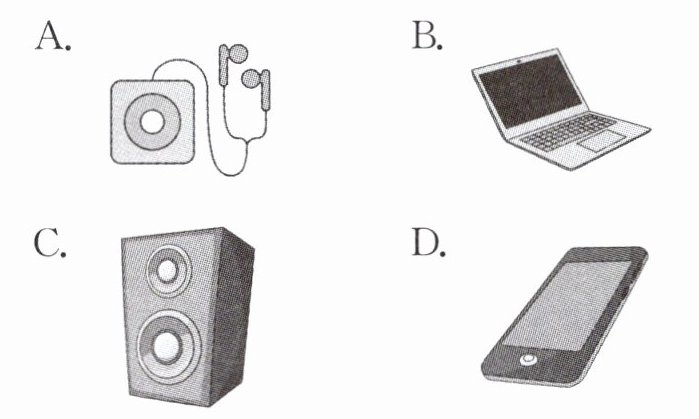
1. 新考法 图片理解 Which of the following may you need if you want to hear the sounds of plants?(
2. 新考法 行文方式 How does the writer show the interesting facts in Paragraph 3?
A. By giving examples.
B. By telling stories.
C. By asking questions.
D. By using numbers.(
3. 新考法 篇章结构 What is the structure of the passage?
A. ①/②③④/⑤
B. ①②③④/⑤
C. ①/②/③/④⑤
D. ①/②③④⑤(
① Scientists have found that plants can make sounds.
② A scientist Lilach Hadany and her team recorded (录制) tomato plants at different times. It showed that the plants made ultrasonic(超声的) sounds. People could only hear them with the help of a computer. They were noises like clicking sounds.
③ As the scientists studied the sounds, they began to find some interesting facts. Plants made different sounds at different times. They seldom clicked (发出咔嗒声) when they had enough water, but when they needed water, they clicked more and more. Scientists also found that plants made sounds when they got hurt. When scientists cut a leaf off the plants, the plants also clicked more. But the clicking sound was different when the plants needed water.
④ Some scientists designed an AI system to tell the different kinds of clicking sounds apart. It was able to find the difference between the plants that needed water and the plants with cuts about 70% of the time. This means that one day we may be able to use a plant's sounds to find out when it is in difficult times, and what problem it has. That could be very helpful to farmers.
⑤ The team's findings have changed our ideas about plants. As Dr Hadany says, “Even in a quiet field, there are sounds made by plants, and those sounds carry information and may help us a lot. ”
1. 新考法 图片理解 Which of the following may you need if you want to hear the sounds of plants?(
B
)2. 新考法 行文方式 How does the writer show the interesting facts in Paragraph 3?
A. By giving examples.
B. By telling stories.
C. By asking questions.
D. By using numbers.(
A
)3. 新考法 篇章结构 What is the structure of the passage?
A. ①/②③④/⑤
B. ①②③④/⑤
C. ①/②/③/④⑤
D. ①/②③④⑤(
A
)
答案:
1. B 推理判断题。根据“People could only hear them with the help of a computer.”可知,人们需要借助电脑来听到植物的声音。
2. A 推理判断题。根据“They seldom clicked when they had enough water...When scientists cut a leaf off the plants, the plants also clicked more.”可知,作者通过举例来说明一些有意思的事实。
3. A 篇章结构题。根据“Scientists have found that plants can make sounds.”可知,第一段总体指出植物能发出声音;根据“A scientist Lilach Hadany and her team recorded tomato plants at different times.”“As the scientists studied the sounds, they began to find some interesting facts.”及“Some scientists designed an AI system to tell the different kinds of clicking sounds apart.”可知,第二、三、四段说的是科学家们对此观点进行了不同的论证;第五段总结全文,指出这一发现的意义。
2. A 推理判断题。根据“They seldom clicked when they had enough water...When scientists cut a leaf off the plants, the plants also clicked more.”可知,作者通过举例来说明一些有意思的事实。
3. A 篇章结构题。根据“Scientists have found that plants can make sounds.”可知,第一段总体指出植物能发出声音;根据“A scientist Lilach Hadany and her team recorded tomato plants at different times.”“As the scientists studied the sounds, they began to find some interesting facts.”及“Some scientists designed an AI system to tell the different kinds of clicking sounds apart.”可知,第二、三、四段说的是科学家们对此观点进行了不同的论证;第五段总结全文,指出这一发现的意义。
查看更多完整答案,请扫码查看

