

 搜索
搜索
第18页
- 第1页
- 第2页
- 第3页
- 第4页
- 第5页
- 第6页
- 第7页
- 第8页
- 第9页
- 第10页
- 第11页
- 第12页
- 第13页
- 第14页
- 第15页
- 第16页
- 第17页
- 第18页
- 第19页
- 第20页
- 第21页
- 第22页
- 第23页
- 第24页
- 第25页
- 第26页
- 第27页
- 第28页
- 第29页
- 第30页
- 第31页
- 第32页
- 第33页
- 第34页
- 第35页
- 第36页
- 第37页
- 第38页
- 第39页
- 第40页
- 第41页
- 第42页
- 第43页
- 第44页
- 第45页
- 第46页
- 第47页
- 第48页
- 第49页
- 第50页
- 第51页
- 第52页
- 第53页
- 第54页
- 第55页
- 第56页
- 第57页
- 第58页
- 第59页
- 第60页
- 第61页
- 第62页
- 第63页
- 第64页
- 第65页
- 第66页
- 第67页
- 第68页
- 第69页
- 第70页
- 第71页
- 第72页
- 第73页
- 第74页
- 第75页
- 第76页
- 第77页
- 第78页
- 第79页
- 第80页
三、阅读理解。(每小题 2 分,共 20 分)
A
The area of the Yellow River Wetland(湿地) Park in Yinchuan was once(曾经) a place that people didn't like: wastewater caused terrible smells and almost no grass could grow on the land. Now, it is not only a popular place for people to take a walk, but also a good place for migratory birds to live.
Li Zhijun is a member of a bird protection organization. He has seen the great changes in the park. According to him, the Yinchuan Wetland Park has become a famous place for bird photographers(摄影师). Most birds would like to stay here in winter.
Besides Ningxia, many cities in China have made great efforts to protect wetlands. Wuhan, the capital city of Hubei Province, is known as a “city of one hundred lakes”. The city has large wetland nature reserves where tens of thousands of birds come to stay in winter.
Panjin in Liaoning Province is another surprising wetland city. In the past, the city had a lot of environmental problems because of oil production. But now in the wetlands by the sea, the seagrass turns red every autumn, creating beautiful “red beaches”.
Chen Zhihai, a local fishery(渔场) worker, said, “In the past, there were almost no wild fish. Thanks to the efforts of Panjin people, now the wetland is back again!”
1. What was the Yellow River Wetland Park like in the past?
A. No grass could grow on the land.
B. People liked to go there for a walk.
C. Birds stayed there in winter.
D. It was a good place for bird photographers.
2. What does the underlined word “it” in Paragraph 1 refer to?
A. Wastewater.
B. The Yellow River Wetland Park.
C. Grass.
D. Land.
3. Which city is called the “city of one hundred lakes”?
A. Yinchuan.
B. Shenzhen.
C. Panjin.
D. Wuhan.
4. Why did Panjin have many environmental problems in the past?
A. People put wastewater into the rivers.
B. Migratory birds didn't go there in winter.
C. People caused pollution during oil production.
D. The government didn't build any wetland nature reserves.
5. Where is this passage probably from?
A. A nature magazine.
B. A storybook.
C. A history book.
D. A scientific report.
A
The area of the Yellow River Wetland(湿地) Park in Yinchuan was once(曾经) a place that people didn't like: wastewater caused terrible smells and almost no grass could grow on the land. Now, it is not only a popular place for people to take a walk, but also a good place for migratory birds to live.
Li Zhijun is a member of a bird protection organization. He has seen the great changes in the park. According to him, the Yinchuan Wetland Park has become a famous place for bird photographers(摄影师). Most birds would like to stay here in winter.
Besides Ningxia, many cities in China have made great efforts to protect wetlands. Wuhan, the capital city of Hubei Province, is known as a “city of one hundred lakes”. The city has large wetland nature reserves where tens of thousands of birds come to stay in winter.
Panjin in Liaoning Province is another surprising wetland city. In the past, the city had a lot of environmental problems because of oil production. But now in the wetlands by the sea, the seagrass turns red every autumn, creating beautiful “red beaches”.
Chen Zhihai, a local fishery(渔场) worker, said, “In the past, there were almost no wild fish. Thanks to the efforts of Panjin people, now the wetland is back again!”
1. What was the Yellow River Wetland Park like in the past?
A. No grass could grow on the land.
B. People liked to go there for a walk.
C. Birds stayed there in winter.
D. It was a good place for bird photographers.
2. What does the underlined word “it” in Paragraph 1 refer to?
A. Wastewater.
B. The Yellow River Wetland Park.
C. Grass.
D. Land.
3. Which city is called the “city of one hundred lakes”?
A. Yinchuan.
B. Shenzhen.
C. Panjin.
D. Wuhan.
4. Why did Panjin have many environmental problems in the past?
A. People put wastewater into the rivers.
B. Migratory birds didn't go there in winter.
C. People caused pollution during oil production.
D. The government didn't build any wetland nature reserves.
5. Where is this passage probably from?
A. A nature magazine.
B. A storybook.
C. A history book.
D. A scientific report.
答案:
1. A 细节理解题。根据第一段中的“The area of the Yellow River Wetland Park in Yinchuan was once a place that people didn't like: wastewater caused terrible smells and almost no grass could grow on the land.”可知答案。
2. B 代词指代题。联系上下文可知,黄河湿地公园现在不仅成了受人欢迎的散步之处,也是候鸟栖息的好地方,因此 it 指代的是黄河湿地公园。
3. D 细节理解题。根据第三段中的“Wuhan, the capital city of Hubei Province, is known as a 'city of one hundred lakes'.”可知,武汉被称为“百湖之市”。
4. C 细节理解题。根据第四段中的“In the past, the city had a lot of environmental problems because of oil production.”可知,盘锦过去的许多环境问题是石油生产造成的。
5. A 推理判断题。本文主要介绍了中国的几个城市在湿地保护方面做出的努力和成就,因此很可能来自自然杂志。
2. B 代词指代题。联系上下文可知,黄河湿地公园现在不仅成了受人欢迎的散步之处,也是候鸟栖息的好地方,因此 it 指代的是黄河湿地公园。
3. D 细节理解题。根据第三段中的“Wuhan, the capital city of Hubei Province, is known as a 'city of one hundred lakes'.”可知,武汉被称为“百湖之市”。
4. C 细节理解题。根据第四段中的“In the past, the city had a lot of environmental problems because of oil production.”可知,盘锦过去的许多环境问题是石油生产造成的。
5. A 推理判断题。本文主要介绍了中国的几个城市在湿地保护方面做出的努力和成就,因此很可能来自自然杂志。
B 热考内容 传统文化
Xi'an was the capital of the Tang Dynasty. It was called Chang'an then. It's said that over one million people lived in the city, and about 50,000 of them were foreigners. Plenty of them came along the Silk Road. They brought their food, goods(货物), art and fashion. People lived a colourful life in Chang'an.
Foreign clothes were popular in Chang'an. They had close-fitting sleeves(窄袖) and turn-down collars(翻领). Central Asian people wore these kinds of clothes. People in Chang'an liked to wear them too.
In Chang'an, there were many kinds of delicious foods brought by people on the Silk Road. Hubing, a kind of popular street food in the city, was one of them. It was a pancake with sesame seeds(芝麻粒) on it. Travellers on the Silk Road liked to eat it and brought it to Chang'an.
Dancers from Central Asia were big stars in Chang'an. They could whirl(旋转) very fast on a small carpet. From emperors to common people, everyone in the city enjoyed the dance. Many musicians from Central Asia liked playing the pipa.
Chang'an embodied(体现) the prosperity(繁荣) of the Tang Dynasty. Through the famous Silk Road starting from Chang'an, the splendid Chinese civilization(文明) was taken to the world.
(
A. 100,000.
B. About 200,000.
C. More than 1,000,000.
D. About 10,000,000.
(
A. Only Central Asian people.
B. Only Persian people.
C. Only Central Asian people and Persian people.
D. Central Asian people and people in Chang'an.
(
A. interesting
B. wonderful
C. happy
D. easy
(
A. Giving examples.
B. Raising questions.
C. Listing numbers.
D. Comparing facts(事实).
(
Xi'an was the capital of the Tang Dynasty. It was called Chang'an then. It's said that over one million people lived in the city, and about 50,000 of them were foreigners. Plenty of them came along the Silk Road. They brought their food, goods(货物), art and fashion. People lived a colourful life in Chang'an.
Foreign clothes were popular in Chang'an. They had close-fitting sleeves(窄袖) and turn-down collars(翻领). Central Asian people wore these kinds of clothes. People in Chang'an liked to wear them too.
In Chang'an, there were many kinds of delicious foods brought by people on the Silk Road. Hubing, a kind of popular street food in the city, was one of them. It was a pancake with sesame seeds(芝麻粒) on it. Travellers on the Silk Road liked to eat it and brought it to Chang'an.
Dancers from Central Asia were big stars in Chang'an. They could whirl(旋转) very fast on a small carpet. From emperors to common people, everyone in the city enjoyed the dance. Many musicians from Central Asia liked playing the pipa.
Chang'an embodied(体现) the prosperity(繁荣) of the Tang Dynasty. Through the famous Silk Road starting from Chang'an, the splendid Chinese civilization(文明) was taken to the world.
(
C
)6. How many people lived in Chang'an in the Tang Dynasty?A. 100,000.
B. About 200,000.
C. More than 1,000,000.
D. About 10,000,000.
(
D
)7. Who wore the clothes with close-fitting sleeves and turn-down collars?A. Only Central Asian people.
B. Only Persian people.
C. Only Central Asian people and Persian people.
D. Central Asian people and people in Chang'an.
(
B
)8. The underlined word “splendid” in the last paragraph probably means “______”.A. interesting
B. wonderful
C. happy
D. easy
(
A
)9. 新考法 行文方式 Which writing skill is used in Paragraphs 2, 3 and 4?A. Giving examples.
B. Raising questions.
C. Listing numbers.
D. Comparing facts(事实).
(
D
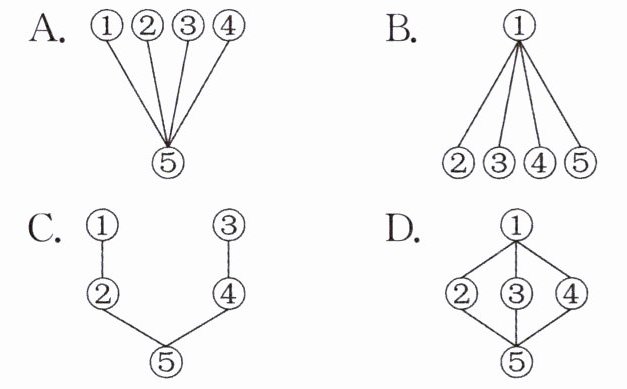
)10. 新考法 篇章结构 Which of the following shows the structure(结构) of the passage?
答案:
6. C 细节理解题。根据第一段中的“Xi'an was the capital of the Tang Dynasty. It was called Chang'an then. It's said that over one million people lived in the city, and about 50,000 of them were foreigners.”可知,唐代长安有 100 多万人。
7. D 细节理解题。根据第二段“Foreign clothes were popular in Chang'an. They had close-fitting sleeves and turn-down collars. Central Asian people wore these kinds of clothes. People in Chang'an liked to wear them too.”可知,中亚人和长安人穿带有窄袖和翻领的衣服。
8. B 词义猜测题。根据最后一段“Chang'an embodied the prosperity of the Tang Dynasty. Through the famous Silk Road starting from Chang'an, the splendid Chinese civilization was taken to the world.”可知,长安体现了唐朝的繁荣。通过以长安为起点的著名丝绸之路,灿烂的中华文明被带到了世界。所以 splendid 与 wonderful 意思相近。
9. A 推理判断题。根据第二段中的“Foreign clothes were popular in Chang'an.”、第三段中的“In Chang'an, there were many kinds of delicious foods brought by people on the Silk Road.”和第四段中的“Dancers from Central Asia were big stars in Chang'an.”可知,第二、三、四段使用了举例子的写作技巧。
10. D 篇章结构题。第一段总述长安丰富多彩的生活;第二、三、四段举例说明丰富多彩的生活是什么样的;第五段是作者的总结。
7. D 细节理解题。根据第二段“Foreign clothes were popular in Chang'an. They had close-fitting sleeves and turn-down collars. Central Asian people wore these kinds of clothes. People in Chang'an liked to wear them too.”可知,中亚人和长安人穿带有窄袖和翻领的衣服。
8. B 词义猜测题。根据最后一段“Chang'an embodied the prosperity of the Tang Dynasty. Through the famous Silk Road starting from Chang'an, the splendid Chinese civilization was taken to the world.”可知,长安体现了唐朝的繁荣。通过以长安为起点的著名丝绸之路,灿烂的中华文明被带到了世界。所以 splendid 与 wonderful 意思相近。
9. A 推理判断题。根据第二段中的“Foreign clothes were popular in Chang'an.”、第三段中的“In Chang'an, there were many kinds of delicious foods brought by people on the Silk Road.”和第四段中的“Dancers from Central Asia were big stars in Chang'an.”可知,第二、三、四段使用了举例子的写作技巧。
10. D 篇章结构题。第一段总述长安丰富多彩的生活;第二、三、四段举例说明丰富多彩的生活是什么样的;第五段是作者的总结。
查看更多完整答案,请扫码查看

