

 搜索
搜索
第27页
- 第1页
- 第2页
- 第3页
- 第4页
- 第5页
- 第6页
- 第7页
- 第8页
- 第9页
- 第10页
- 第11页
- 第12页
- 第13页
- 第14页
- 第15页
- 第16页
- 第17页
- 第18页
- 第19页
- 第20页
- 第21页
- 第22页
- 第23页
- 第24页
- 第25页
- 第26页
- 第27页
- 第28页
- 第29页
- 第30页
- 第31页
- 第32页
- 第33页
- 第34页
- 第35页
- 第36页
- 第37页
- 第38页
- 第39页
- 第40页
- 第41页
- 第42页
- 第43页
- 第44页
- 第45页
- 第46页
- 第47页
- 第48页
- 第49页
- 第50页
- 第51页
- 第52页
- 第53页
- 第54页
- 第55页
- 第56页
- 第57页
- 第58页
- 第59页
- 第60页
- 第61页
- 第62页
- 第63页
- 第64页
- 第65页
- 第66页
- 第67页
- 第68页
- 第69页
- 第70页
- 第71页
- 第72页
- 第73页
- 第74页
- 第75页
- 第76页
- 第77页
- 第78页
- 第79页
- 第80页
一、完形填空。
Every school day, we use schoolbags to carry all of our things to school. They are a big part of our lives. But have you ever thought about the 1
In the Han Dynasty, students used bamboo boxes to carry books to school. People thought that the bamboo box was the 2
Hundreds of years later, people 5
A new kind of schoolbag has 7
Schoolbags are still 10
1. A. year B. history C. shape D. colour
2. A. cheapest B. heaviest C. finest D. earliest
3. A. football B. food C. clothes D. paper
4. A. At first B. For example C. At least D. In the end
5. A. suffered B. shook C. invented D. caught
6. A. experiences B. pictures C. ideas D. dreams
7. A. produced B. came C. appeared D. lost
8. A. people B. wheels C. words D. patterns
9. A. covered B. filled C. carried D. poured
10. A. preparing B. changing C. disappearing D. using
Every school day, we use schoolbags to carry all of our things to school. They are a big part of our lives. But have you ever thought about the 1
B
of the schoolbag?In the Han Dynasty, students used bamboo boxes to carry books to school. People thought that the bamboo box was the 2
D
schoolbag. There were usually two or three layers (层) in the box. Kids put different things, like books, brushes, ink stones (砚) and 3D
, in the boxes. You can see the bamboo box in many TV shows. 4B
, in The Legend of White Snake, Xu Shilin carries a bamboo box to the capital to take an exam.Hundreds of years later, people 5
C
a kind of schoolbag called budai. The budai was lighter than the bamboo box. With the founding (建立) of the PRC, military canvas bags (军用帆布包) became popular. Ask your grandparents or parents about these bags. Maybe they can tell you about their 6A
of carrying them when they were at school.A new kind of schoolbag has 7
C
in recent years. Many of them have colourful and fashionable 8D
on them, such as pictures of cartoon characters or pop stars. And they are more comfortable to use. Some students pull wheeled bags 9B
with heavy books.Schoolbags are still 10
B
. Can you imagine what future schoolbags will be like?1. A. year B. history C. shape D. colour
2. A. cheapest B. heaviest C. finest D. earliest
3. A. football B. food C. clothes D. paper
4. A. At first B. For example C. At least D. In the end
5. A. suffered B. shook C. invented D. caught
6. A. experiences B. pictures C. ideas D. dreams
7. A. produced B. came C. appeared D. lost
8. A. people B. wheels C. words D. patterns
9. A. covered B. filled C. carried D. poured
10. A. preparing B. changing C. disappearing D. using
答案:
1. B 通读全文可知,本文主要介绍书包的发展史。
2. D 根据“In the Han Dynasty, students used bamboo boxes to carry books to school.”可知,此处介绍的是最早的书包。
3. D 根据“Kids put... books, brushes, ink stones... boxes.”可知,此处指的是学习物品,故用 paper。
4. B 根据前句“You can see the bamboo box in many TV shows.”可知,后句是前句的具体例子,所以此处应用 For example。
5. C 根据宾语 a kind of schoolbag called budai 及语境可知,数百年后,人们发明了一种叫作布袋的新书包。
6. A 根据上下文可知,此处指祖父母或父母上学时背军用帆布包的经历。
7. C 根据主语 A new kind of schoolbag 及所给选项可知,此处指近年来出现了一种新型书包。
8. D 根据后文 such as pictures of cartoon characters or pop stars 可知,许多书包上都有五颜六色的时尚图案。
9. B 根据 pull wheeled bags 和 heavy books 可知,此处用过去分词作后置定语,表示装满重书的轮式书包。(be) filled with 意为“充满,装满”。
10. B 根据“Can you imagine what future schoolbags will be like?”可知,此处表示书包仍然在不断变化,人们不确定未来的书包是什么样的。
2. D 根据“In the Han Dynasty, students used bamboo boxes to carry books to school.”可知,此处介绍的是最早的书包。
3. D 根据“Kids put... books, brushes, ink stones... boxes.”可知,此处指的是学习物品,故用 paper。
4. B 根据前句“You can see the bamboo box in many TV shows.”可知,后句是前句的具体例子,所以此处应用 For example。
5. C 根据宾语 a kind of schoolbag called budai 及语境可知,数百年后,人们发明了一种叫作布袋的新书包。
6. A 根据上下文可知,此处指祖父母或父母上学时背军用帆布包的经历。
7. C 根据主语 A new kind of schoolbag 及所给选项可知,此处指近年来出现了一种新型书包。
8. D 根据后文 such as pictures of cartoon characters or pop stars 可知,许多书包上都有五颜六色的时尚图案。
9. B 根据 pull wheeled bags 和 heavy books 可知,此处用过去分词作后置定语,表示装满重书的轮式书包。(be) filled with 意为“充满,装满”。
10. B 根据“Can you imagine what future schoolbags will be like?”可知,此处表示书包仍然在不断变化,人们不确定未来的书包是什么样的。
二、(2024·巴中改编)阅读理解。
① Do you still remember me, Liangliang, an 11-year-old boy from a small village? My friends and I used to go on a ropeway to cross a big river to school.
② Thanks to our government and the nice people, the villagers' dream has come true. There is a big and wide bridge over the river. Besides, the villagers have lived in the new buildings and worked in companies in our village.
③ As for me, with the love and encouragement from kind people, I had no fear on the way to my dream. Last year I graduated from a university. To follow the call of rural revitalization (乡村振兴), I chose to build my hometown as an engineer with some of my friends. In fact, with the Chinese Dream, great changes have taken place everywhere in China in the last few years. China has also got many achievements such as 5G, the high-speed railway and Beidou Navigation Satellite System.
④ Now our government is carrying out a lot of projects such as urban-rural integration (城乡融合) and ecological tourism (生态旅游) to increase people's income and improve the quality of their life. More and more people would like to return to their hometowns to do some meaningful things.
⑤ “Where there are dreams, actions and union, there is a way.” I believe Chinese will continue getting together and working hard to get more achievements in the near future.
1. Who helped the villagers build the bridge?
(
A. Liangliang.
B. The teachers.
C. Liangliang's friends.
D. The government and the nice people.
2. 新考法 行文方式 How does Liangliang show China's achievements?
(
A. By listing numbers.
B. By giving examples.
C. By comparing facts.
D. By showing pictures.
3. 新考法 篇章结构 What is the best structure of the passage?
(
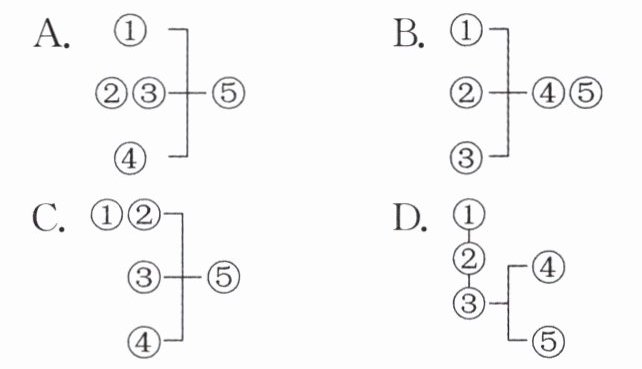
① Do you still remember me, Liangliang, an 11-year-old boy from a small village? My friends and I used to go on a ropeway to cross a big river to school.
② Thanks to our government and the nice people, the villagers' dream has come true. There is a big and wide bridge over the river. Besides, the villagers have lived in the new buildings and worked in companies in our village.
③ As for me, with the love and encouragement from kind people, I had no fear on the way to my dream. Last year I graduated from a university. To follow the call of rural revitalization (乡村振兴), I chose to build my hometown as an engineer with some of my friends. In fact, with the Chinese Dream, great changes have taken place everywhere in China in the last few years. China has also got many achievements such as 5G, the high-speed railway and Beidou Navigation Satellite System.
④ Now our government is carrying out a lot of projects such as urban-rural integration (城乡融合) and ecological tourism (生态旅游) to increase people's income and improve the quality of their life. More and more people would like to return to their hometowns to do some meaningful things.
⑤ “Where there are dreams, actions and union, there is a way.” I believe Chinese will continue getting together and working hard to get more achievements in the near future.
1. Who helped the villagers build the bridge?
(
D
)A. Liangliang.
B. The teachers.
C. Liangliang's friends.
D. The government and the nice people.
2. 新考法 行文方式 How does Liangliang show China's achievements?
(
B
)A. By listing numbers.
B. By giving examples.
C. By comparing facts.
D. By showing pictures.
3. 新考法 篇章结构 What is the best structure of the passage?
(
A
)
答案:
1. D 细节理解题。根据“Thanks to our government and the nice people, the villagers' dream has come true. There is a big and wide bridge over the river.”可知,政府和善良的人帮助他们建了一座桥。
2. B 推理判断题。根据第三段最后两句可知是通过举例 子展现中国的成就。
3. A 篇章结构题。第一段引出话题;第二段和第三段主要介绍了亮亮(音译)以及他的村庄的变化;第四段介绍了中国各地的发展;第五段进行了总结。结合选项可知,选项 A 符合文章结构。
2. B 推理判断题。根据第三段最后两句可知是通过举例 子展现中国的成就。
3. A 篇章结构题。第一段引出话题;第二段和第三段主要介绍了亮亮(音译)以及他的村庄的变化;第四段介绍了中国各地的发展;第五段进行了总结。结合选项可知,选项 A 符合文章结构。
查看更多完整答案,请扫码查看

