

 搜索
搜索
第19页
- 第1页
- 第2页
- 第3页
- 第4页
- 第5页
- 第6页
- 第7页
- 第8页
- 第9页
- 第10页
- 第11页
- 第12页
- 第13页
- 第14页
- 第15页
- 第16页
- 第17页
- 第18页
- 第19页
- 第20页
- 第21页
- 第22页
- 第23页
- 第24页
- 第25页
- 第26页
- 第27页
- 第28页
- 第29页
- 第30页
- 第31页
- 第32页
- 第33页
- 第34页
- 第35页
- 第36页
- 第37页
- 第38页
- 第39页
- 第40页
- 第41页
- 第42页
- 第43页
- 第44页
- 第45页
- 第46页
- 第47页
- 第48页
- 第49页
- 第50页
- 第51页
- 第52页
- 第53页
- 第54页
- 第55页
- 第56页
- 第57页
- 第58页
- 第59页
- 第60页
- 第61页
- 第62页
- 第63页
- 第64页
- 第65页
- 第66页
Ⅰ. 完形填空
$Although my daughter is only two years old, I let her do a few “chores”. The “chores” aren’t cleaning the house, folding the clothes or __1__ the floor.$
$When she could just walk and started to play with toys, she sometimes __2__ them away because of being bored. I started to teach her to __3__ these toys. Now she understands it is one of her chores. Another thing I asked her to do was to take her dishes to the __4__. Now every time she finishes her meal, she __5__ and runs to the kitchen with her bowl or plate! It’s __6__!$
$Actually, I don’t make a “chore list” for her. However, little by little I add chores to her everyday life. Doing chores __7__ a child to be responsible for what he or she does. It also helps to develop a child’s __8__. In my opinion, the earlier a kid learns to be independent, the __9__ it is for his or her future.$
$I think it’s __10__ to teach children how to do some small chores, but big chores should wait until they’re older. Do you think so?$
1. A. sweeping
B. changing
C. using
D. moving
2. A. put
B. threw
C. gave
D. kept
3. A. put on
B. put out
C. put off
D. put away
4. A. bedroom
B. kitchen
C. library
D. cinema
5. A. stands up
B. looks up
C. cuts up
D. turns up
6. A. wide
B. useful
C. lovely
D. careful
7. A. sweeps
B. teaches
C. fixes
D. imagines
8. A. advice
B. importance
C. notice
D. independence
9. A. worse
B. older
C. better
D. harder
10. A. comfortable
B. terrible
C. difficult
D. necessary
$Although my daughter is only two years old, I let her do a few “chores”. The “chores” aren’t cleaning the house, folding the clothes or __1__ the floor.$
$When she could just walk and started to play with toys, she sometimes __2__ them away because of being bored. I started to teach her to __3__ these toys. Now she understands it is one of her chores. Another thing I asked her to do was to take her dishes to the __4__. Now every time she finishes her meal, she __5__ and runs to the kitchen with her bowl or plate! It’s __6__!$
$Actually, I don’t make a “chore list” for her. However, little by little I add chores to her everyday life. Doing chores __7__ a child to be responsible for what he or she does. It also helps to develop a child’s __8__. In my opinion, the earlier a kid learns to be independent, the __9__ it is for his or her future.$
$I think it’s __10__ to teach children how to do some small chores, but big chores should wait until they’re older. Do you think so?$
1. A. sweeping
B. changing
C. using
D. moving
2. A. put
B. threw
C. gave
D. kept
3. A. put on
B. put out
C. put off
D. put away
4. A. bedroom
B. kitchen
C. library
D. cinema
5. A. stands up
B. looks up
C. cuts up
D. turns up
6. A. wide
B. useful
C. lovely
D. careful
7. A. sweeps
B. teaches
C. fixes
D. imagines
8. A. advice
B. importance
C. notice
D. independence
9. A. worse
B. older
C. better
D. harder
10. A. comfortable
B. terrible
C. difficult
D. necessary
答案:
1.A[提示:句意:"家务"不是打扫房子、叠衣服或扫地。sweeping 打扫;changing 改变;using 使用;moving 移动。此处表示"扫地",故选 A。] 2.B[提示:句意:当她刚刚会走路并开始玩玩具时,她有时会因为觉得无聊而扔掉它们。put 放置;threw 扔;gave 给;kept 保持。throw away 意为"扔掉",故选 B。] 3.D[提示:句意:我开始教她收拾这些玩具。put on 增加(体重);put out 扑灭;put off 推迟;put away 收拾,放好。此处表示放好这些玩具,故选 D。] 4.B[提示:句意:我让她做的另一件事是把她的盘子拿到厨房去。bedroom 卧室;kitchen 厨房;library 图书馆;cinema 电影院。此处表示把她的盘子拿到厨房去,故选 B。] 5.A[提示:句意:现在她每次吃完饭都会站起来,拿着她的碗或者盘子跑到厨房去! stands up 站起来;looks up 查阅;cuts up 切碎;turns up 调高(音量)。此处表示她站起来,拿着她的碗或者盘子跑到厨房去,故选 A。] 6.C[提示:句意:这很可爱! wide 宽阔的;useful 有用的;lovely 可爱的;careful 仔细的。指作者认为女儿把她自己的碗或盘子拿去厨房这一行为很可爱,故选 C。] 7.B[提示:句意:做家务教会孩子对自己的行为负责。sweeps 打扫;teaches 教;fixes 修理;imagines 想象。此处表示做家务教会孩子对自己的行为负责,故选 B。] 8.D[提示:句意:这也有助于培养孩子的独立性。advice 建议;importance 重要性;notice 通知;independence 独立性。此处表示培养孩子的独立性,故选 D。] 9.C[提示:句意:在我看来,孩子越早学会独立,对他或她的未来越好。worse 更差的;older 更老的;better 更好的;harder 更难的。结合选项和句意可知,此处表示作者认为孩子越早学会独立,对他或她的未来越好,故选 C。] 10.D[提示:句意:我认为教孩子们如何做一些小的家务是必要的,但是大的家务应该等到他们大一点的时候再做。comfortable 舒适的;terrible 糟糕的;difficult 困难的;necessary 必要的。根据上文可知,作者要求女儿做家务,所以此处应表示作者认为教孩子们如何做一些小的家务是必要的,故选 D。]
Ⅱ. 阅读理解
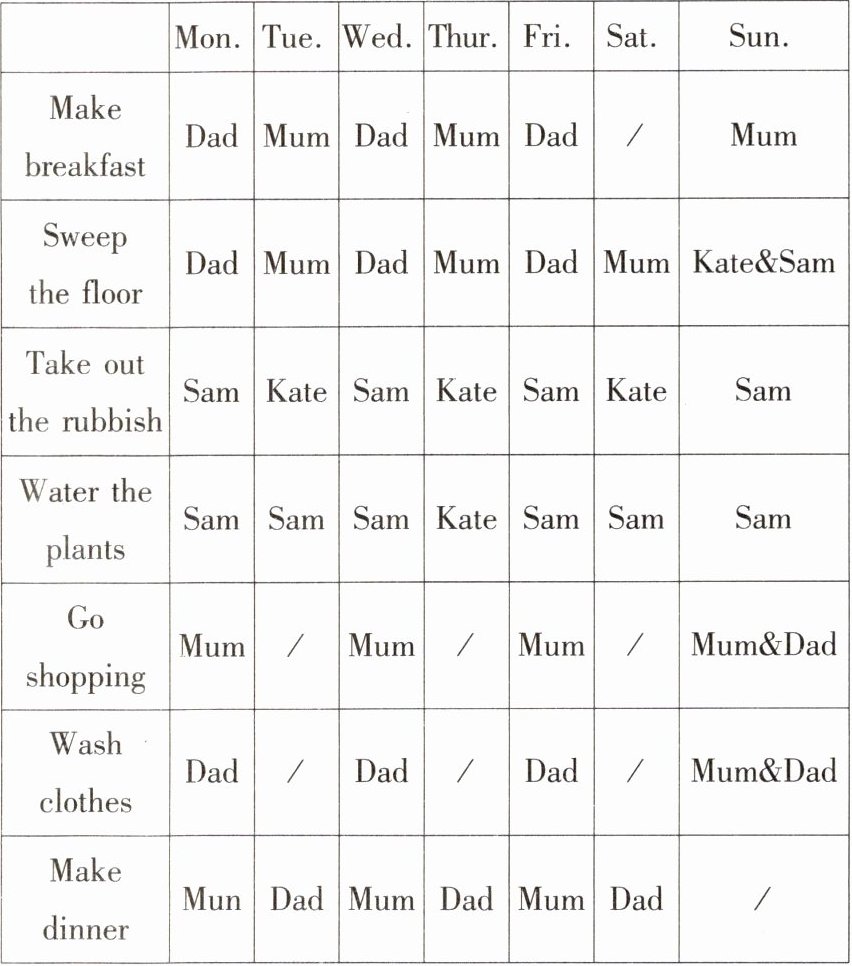
11. Who makes breakfast on Tuesday?
A. Dad.
B. Mum.
C. Sam.
D. Nobody.
12. When does Kate water the plants?
A. On Tuesday.
B. On Wednesday.
C. On Thursday.
D. On Friday.
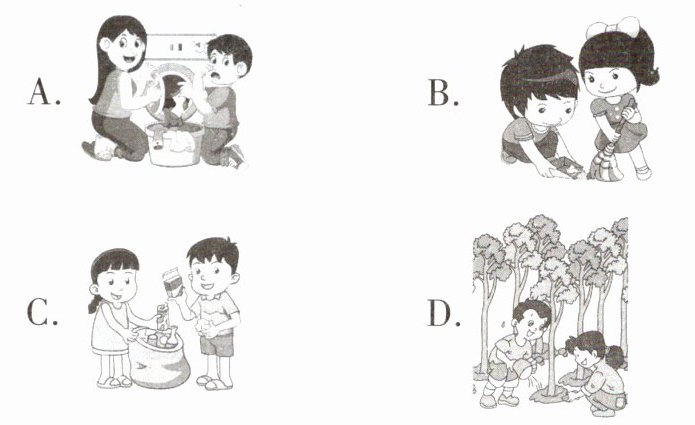
13. What do Kate and Sam do together?
14. How often does Dad cook?
A. Every day.
B. Every two days.
C. Six times a week.
D. Never.
15. Where may we find the material?
A. On a menu.
B. On a calendar.
C. In an invitation.
D. In a diary.
11. Who makes breakfast on Tuesday?
A. Dad.
B. Mum.
C. Sam.
D. Nobody.
12. When does Kate water the plants?
A. On Tuesday.
B. On Wednesday.
C. On Thursday.
D. On Friday.
13. What do Kate and Sam do together?
14. How often does Dad cook?
A. Every day.
B. Every two days.
C. Six times a week.
D. Never.
15. Where may we find the material?
A. On a menu.
B. On a calendar.
C. In an invitation.
D. In a diary.
答案:
11.B[提示:细节理解题。根据"Make breakfast";"Tue."以及"Mum"可知,妈妈周二做早餐,故选 B。] 12.C[提示:细节理解题。根据"Water the plants";"Kate"以及"Thur."可知,Kate 周四给花浇水,故选 C。] 13.B[提示:细节理解题。根据"Kate&Sam"以及"Sweep the floor"可知,Kate 和 Sam 一起做的家务是扫地,故选 B。] 14.C[提示:细节理解题。根据"Make breakfast"以及"Make dinner"中的数据可知,爸爸一周要做三次早餐和三次晚餐,因此是做六次饭,故选 C。] 15.B[提示:推理判断题。本文主要是做家务的安排表,因此可以在日历上看到,故选 B。]
查看更多完整答案,请扫码查看

