

 搜索
搜索
第74页
- 第1页
- 第2页
- 第3页
- 第4页
- 第5页
- 第6页
- 第7页
- 第8页
- 第9页
- 第10页
- 第11页
- 第12页
- 第13页
- 第14页
- 第15页
- 第16页
- 第17页
- 第18页
- 第19页
- 第20页
- 第21页
- 第22页
- 第23页
- 第24页
- 第25页
- 第26页
- 第27页
- 第28页
- 第29页
- 第30页
- 第31页
- 第32页
- 第33页
- 第34页
- 第35页
- 第36页
- 第37页
- 第38页
- 第39页
- 第40页
- 第41页
- 第42页
- 第43页
- 第44页
- 第45页
- 第46页
- 第47页
- 第48页
- 第49页
- 第50页
- 第51页
- 第52页
- 第53页
- 第54页
- 第55页
- 第56页
- 第57页
- 第58页
- 第59页
- 第60页
- 第61页
- 第62页
- 第63页
- 第64页
- 第65页
- 第66页
- 第67页
- 第68页
- 第69页
- 第70页
- 第71页
- 第72页
- 第73页
- 第74页
- 第75页
- 第76页
- 第77页
- 第78页
- 第79页
- 第80页
- 第81页
- 第82页
- 第83页
- 第84页
- 第85页
- 第86页
- 第87页
- 第88页
- 第89页
- 第90页
- 第91页
- 第92页
- 第93页
- 第94页
- 第95页
- 第96页
- 第97页
- 第98页
- 第99页
- 第100页
- 第101页
- 第102页
- 第103页
- 第104页
- 第105页
- 第106页
- 第107页
- 第108页
- 第109页
- 第110页
- 第111页
- 第112页
- 第113页
- 第114页
- 第115页
- 第116页
- 第117页
- 第118页
- 第119页
- 第120页
- 第121页
- 第122页
- 第123页
- 第124页
- 第125页
- 第126页
- 第127页
- 第128页
- 第129页
- 第130页
- 第131页
- 第132页
- 第133页
- 第134页
- 第135页
- 第136页
- 第137页
- 第138页
- 第139页
- 第140页
- 第141页
- 第142页
- 第143页
- 第144页
- 第145页
- 第146页
- 第147页
- 第148页
- 第149页
- 第150页
- 第151页
- 第152页
- 第153页
- 第154页
- 第155页
- 第156页
四、完形填空。
阅读下面一篇短文,从短文后各题所给的 A、B、C 三个选项中,选出可以填入各题空白处的最佳选项。
(2024·深圳改编) William grew up in a poor family in Africa. His family lived in a village with no 16. At night, they used oil lamps for light. However, oil was too expensive for his parents to afford.
William wanted to 17 life there but he had no idea how to realize it. One day, he read a book on how to turn wind into electricity with a windmill (风车).
“That is 18!” Though he didn't know what a windmill was, he decided to give it a try.
First he had to 19 all the materials. He dug through the rubbish with his cousin in the villages nearby and 20 working hard toward his goal until he got what he wanted.
Then he started to make the windmill. The moment his farm work finished in the fields, he threw himself into studying the materials, staying 21 till midnight. Finally, he made it after 22 many times. He fixed the windmill on the top of a wood tower to catch wind. The villagers came to look. A long wire was used to connect a bulb to the windmill. The wind blew and the windmill 23. To their amazement, the bulb lit up. The villagers cheered. William threw his hands in the air and jumped 24. To produce more energy, he built another windmill for his village.
Born into poverty, William didn't give up in the face of difficulties. He kept reading, taught himself and lit up the whole 25.
( )16. A. food B. water C. electricity
( )17. A. protect B. improve C. create
( )18. A. amazing B. surprised C. worried
( )19. A. buy B. invent C. collect
( )20. A. kept on B. went over C. looked up
( )21. A. asleep B. awake C. relaxed
( )22. A. increasing B. requesting C. failing
( )23. A. fell B. flew C. turned
( )24. A. excitedly B. politely C. carefully
( )25. A. team B. club C. village
阅读下面一篇短文,从短文后各题所给的 A、B、C 三个选项中,选出可以填入各题空白处的最佳选项。
(2024·深圳改编) William grew up in a poor family in Africa. His family lived in a village with no 16. At night, they used oil lamps for light. However, oil was too expensive for his parents to afford.
William wanted to 17 life there but he had no idea how to realize it. One day, he read a book on how to turn wind into electricity with a windmill (风车).
“That is 18!” Though he didn't know what a windmill was, he decided to give it a try.
First he had to 19 all the materials. He dug through the rubbish with his cousin in the villages nearby and 20 working hard toward his goal until he got what he wanted.
Then he started to make the windmill. The moment his farm work finished in the fields, he threw himself into studying the materials, staying 21 till midnight. Finally, he made it after 22 many times. He fixed the windmill on the top of a wood tower to catch wind. The villagers came to look. A long wire was used to connect a bulb to the windmill. The wind blew and the windmill 23. To their amazement, the bulb lit up. The villagers cheered. William threw his hands in the air and jumped 24. To produce more energy, he built another windmill for his village.
Born into poverty, William didn't give up in the face of difficulties. He kept reading, taught himself and lit up the whole 25.
( )16. A. food B. water C. electricity
( )17. A. protect B. improve C. create
( )18. A. amazing B. surprised C. worried
( )19. A. buy B. invent C. collect
( )20. A. kept on B. went over C. looked up
( )21. A. asleep B. awake C. relaxed
( )22. A. increasing B. requesting C. failing
( )23. A. fell B. flew C. turned
( )24. A. excitedly B. politely C. carefully
( )25. A. team B. club C. village
答案:
16—20 CBACA 21—25 BCCAC
五、阅读理解。
阅读下面短文,根据其内容填空和回答问题。(26 至 29 每题答案不超过 3 个词,30 题需用完整句子回答。)
When you see a globe (地球仪), close your eyes and spin (旋转) it quickly. Then stop it with your finger. Your finger will probably land on a body of water (水域). That's because water covers about 71% of the earth's surface. But if it doesn't land on water, you might discover a place you've never heard of.
These days, computers and smartphones can tell us where we are. But globes have remained popular. Peter Bellerby, a globe maker in London, says this is because a globe “connects us to our planet”. With a globe, you can easily see what's on the other side of the world from where you are. Joshua Nall is a museum director in England. He agrees that technology can give students more detailed information about the world. But the physical globe has become a symbol of knowledge.
Peter's company makes about 600 globes a year. To make a globe, workers produce a sphere (球状物) first. Then they place map pieces called “gores” onto it. The gores fit together to cover the sphere completely. Artists then paint the globe with different colors.
The world's oldest surviving globe dates from the 1490s. It is called the “Earth Apple”. Martin Behaim, a German, made it. The globe showed the world in the late 15th century. You couldn't find North or South America on it because Europeans hadn't discovered them yet. Two of the world's most famous globes were created about 450 years later after the 1490s. They were made for British Prime Minister Winston Churchill and the US President Franklin D. Roosevelt during the World War Ⅱ.
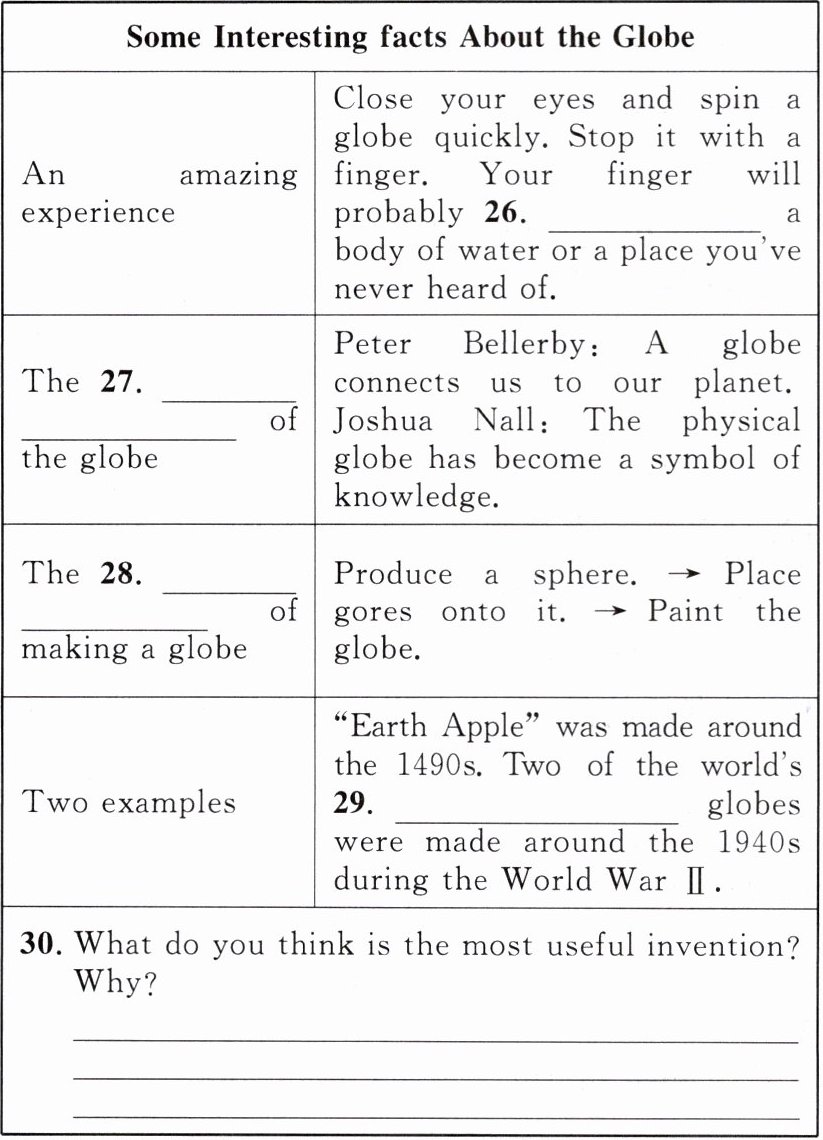
阅读下面短文,根据其内容填空和回答问题。(26 至 29 每题答案不超过 3 个词,30 题需用完整句子回答。)
When you see a globe (地球仪), close your eyes and spin (旋转) it quickly. Then stop it with your finger. Your finger will probably land on a body of water (水域). That's because water covers about 71% of the earth's surface. But if it doesn't land on water, you might discover a place you've never heard of.
These days, computers and smartphones can tell us where we are. But globes have remained popular. Peter Bellerby, a globe maker in London, says this is because a globe “connects us to our planet”. With a globe, you can easily see what's on the other side of the world from where you are. Joshua Nall is a museum director in England. He agrees that technology can give students more detailed information about the world. But the physical globe has become a symbol of knowledge.
Peter's company makes about 600 globes a year. To make a globe, workers produce a sphere (球状物) first. Then they place map pieces called “gores” onto it. The gores fit together to cover the sphere completely. Artists then paint the globe with different colors.
The world's oldest surviving globe dates from the 1490s. It is called the “Earth Apple”. Martin Behaim, a German, made it. The globe showed the world in the late 15th century. You couldn't find North or South America on it because Europeans hadn't discovered them yet. Two of the world's most famous globes were created about 450 years later after the 1490s. They were made for British Prime Minister Winston Churchill and the US President Franklin D. Roosevelt during the World War Ⅱ.
答案:
26. land on 27. value/importance 28. steps/process 29. most famous 30. I think the most useful invention is the light bulb because we can have more time to learn, work and have fun. / ...
查看更多完整答案,请扫码查看

