

 搜索
搜索
第111页
- 第1页
- 第2页
- 第3页
- 第4页
- 第5页
- 第6页
- 第7页
- 第8页
- 第9页
- 第10页
- 第11页
- 第12页
- 第13页
- 第14页
- 第15页
- 第16页
- 第17页
- 第18页
- 第19页
- 第20页
- 第21页
- 第22页
- 第23页
- 第24页
- 第25页
- 第26页
- 第27页
- 第28页
- 第29页
- 第30页
- 第31页
- 第32页
- 第33页
- 第34页
- 第35页
- 第36页
- 第37页
- 第38页
- 第39页
- 第40页
- 第41页
- 第42页
- 第43页
- 第44页
- 第45页
- 第46页
- 第47页
- 第48页
- 第49页
- 第50页
- 第51页
- 第52页
- 第53页
- 第54页
- 第55页
- 第56页
- 第57页
- 第58页
- 第59页
- 第60页
- 第61页
- 第62页
- 第63页
- 第64页
- 第65页
- 第66页
- 第67页
- 第68页
- 第69页
- 第70页
- 第71页
- 第72页
- 第73页
- 第74页
- 第75页
- 第76页
- 第77页
- 第78页
- 第79页
- 第80页
- 第81页
- 第82页
- 第83页
- 第84页
- 第85页
- 第86页
- 第87页
- 第88页
- 第89页
- 第90页
- 第91页
- 第92页
- 第93页
- 第94页
- 第95页
- 第96页
- 第97页
- 第98页
- 第99页
- 第100页
- 第101页
- 第102页
- 第103页
- 第104页
- 第105页
- 第106页
- 第107页
- 第108页
- 第109页
- 第110页
- 第111页
- 第112页
- 第113页
- 第114页
- 第115页
- 第116页
- 第117页
- 第118页
- 第119页
- 第120页
- 第121页
- 第122页
- 第123页
- 第124页
- 第125页
- 第126页
- 第127页
- 第128页
- 第129页
- 第130页
- 第131页
- 第132页
- 第133页
- 第134页
- 第135页
- 第136页
- 第137页
- 第138页
- 第139页
- 第140页
- 第141页
- 第142页
- 第143页
- 第144页
- 第145页
- 第146页
- 第147页
- 第148页
- 第149页
- 第150页
- 第151页
- 第152页
- 第153页
- 第154页
- 第155页
- 第156页
一、完形填空。
阅读下面一篇短文,从短文前的选项中选出能填入空白处的最佳选项。选项中有一个为多余选项。
“What is that?” I asked the other two.
“It might be a wolf. The noise sounds 4. _______ that animal,” answered Peter.
“No, it can’t be a wolf. There are no wolves in our city. These animals are only in the zoo,” Mike said to us.
“Let’s call the policemen now,” I suggested.
“No, they can’t arrive here quickly. They may be very busy now,” Peter said.
As we were talking 5. _______ that, a dog came up to us.
“Haha, it is a dog,” we all laughed.
“But whose dog is it?” Mike asked Peter.
“I have no idea.”
“It is Lisa’s. She has gone to Canada with her parents. She asked me to look 6. _______ her pet dog,” I said to them.
“It’s really a false alarm(虚惊一场),” we all said.
阅读下面一篇短文,从短文前的选项中选出能填入空白处的最佳选项。选项中有一个为多余选项。
A. about B. the C. after D. Until
E. like F. of G. When
I think that life is really full of mysteries. And many kinds 1. _______ strange things are always happening. Sometimes they’re very funny, but sometimes they’re very scary. Last Friday evening, I went to the cinema with my two good friends. 2. _______ we went out of the cinema and wanted to go back home, it was ten o’clock in the evening. It was very dark when we were walking on 3. _______ way home. It was very silent around us. When we looked back, we all found something far away following us. Suddenly, we all heard a strange noise.“What is that?” I asked the other two.
“It might be a wolf. The noise sounds 4. _______ that animal,” answered Peter.
“No, it can’t be a wolf. There are no wolves in our city. These animals are only in the zoo,” Mike said to us.
“Let’s call the policemen now,” I suggested.
“No, they can’t arrive here quickly. They may be very busy now,” Peter said.
As we were talking 5. _______ that, a dog came up to us.
“Haha, it is a dog,” we all laughed.
“But whose dog is it?” Mike asked Peter.
“I have no idea.”
“It is Lisa’s. She has gone to Canada with her parents. She asked me to look 6. _______ her pet dog,” I said to them.
“It’s really a false alarm(虚惊一场),” we all said.
答案:
1—6 FGBEAC
第一节 阅读短文内容,从短文后的选项中选出能填入空白处的最佳选项。选项中有一项为多余选项。
Is there intelligent life on other planets? For years, scientists said “no” or “we don’t know”. 7. _______ Seth Shostak and Alexandra Barnett are astronomers. They believe intelligent life exists(存在)somewhere in space. They also think we will soon contact(联系)these beings.
Why do astronomers think intelligent life exists on other planets? 8. _______ Scientists believe the space is about 12 billion years old. “This is long enough for other planets to have intelligent life,” Shostak and Barnett say. Another reason is size. 9. _______ “Tools like the Hubble Space Telescope have shown that there are at least 100 billion galaxies(星系),” says Shostak. “And our galaxy, the Milky Way, has at least 400 billion stars. Some planets going around these stars might be similar to the earth.”
10. _______ But now, powerful telescopes allow scientists to discover smaller planets in other solar systems. These planets might have intelligent life.
11. _______ “Probably not,” says Shostak. “It’s a long way away. However, intelligent beings may contact us in other ways, such as radio signals(信号). In fact, they may be trying to communicate with us now, but we don’t have the right tools to receive their messages. By 2050, however, we might be able to communicate with other life forms in space and we might help each other.”
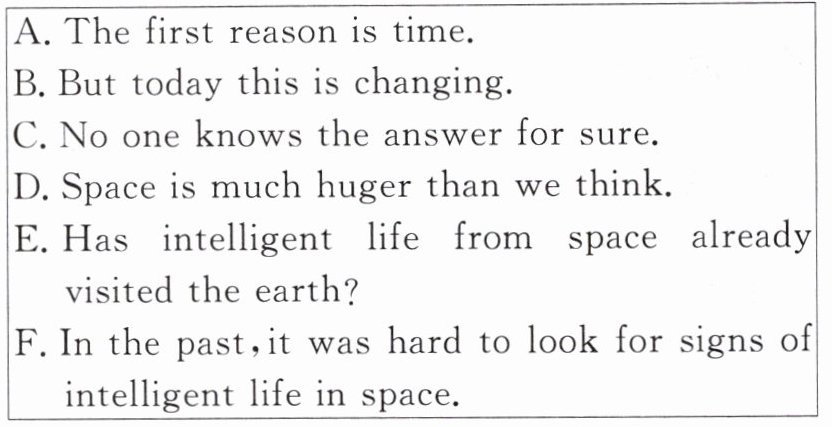
Is there intelligent life on other planets? For years, scientists said “no” or “we don’t know”. 7. _______ Seth Shostak and Alexandra Barnett are astronomers. They believe intelligent life exists(存在)somewhere in space. They also think we will soon contact(联系)these beings.
Why do astronomers think intelligent life exists on other planets? 8. _______ Scientists believe the space is about 12 billion years old. “This is long enough for other planets to have intelligent life,” Shostak and Barnett say. Another reason is size. 9. _______ “Tools like the Hubble Space Telescope have shown that there are at least 100 billion galaxies(星系),” says Shostak. “And our galaxy, the Milky Way, has at least 400 billion stars. Some planets going around these stars might be similar to the earth.”
10. _______ But now, powerful telescopes allow scientists to discover smaller planets in other solar systems. These planets might have intelligent life.
11. _______ “Probably not,” says Shostak. “It’s a long way away. However, intelligent beings may contact us in other ways, such as radio signals(信号). In fact, they may be trying to communicate with us now, but we don’t have the right tools to receive their messages. By 2050, however, we might be able to communicate with other life forms in space and we might help each other.”
答案:
7—11 BADFE
查看更多完整答案,请扫码查看

