

 搜索
搜索
第54页
- 第1页
- 第2页
- 第3页
- 第4页
- 第5页
- 第6页
- 第7页
- 第8页
- 第9页
- 第10页
- 第11页
- 第12页
- 第13页
- 第14页
- 第15页
- 第16页
- 第17页
- 第18页
- 第19页
- 第20页
- 第21页
- 第22页
- 第23页
- 第24页
- 第25页
- 第26页
- 第27页
- 第28页
- 第29页
- 第30页
- 第31页
- 第32页
- 第33页
- 第34页
- 第35页
- 第36页
- 第37页
- 第38页
- 第39页
- 第40页
- 第41页
- 第42页
- 第43页
- 第44页
- 第45页
- 第46页
- 第47页
- 第48页
- 第49页
- 第50页
- 第51页
- 第52页
- 第53页
- 第54页
- 第55页
- 第56页
- 第57页
- 第58页
- 第59页
- 第60页
- 第61页
- 第62页
- 第63页
- 第64页
- 第65页
- 第66页
- 第67页
- 第68页
- 第69页
- 第70页
- 第71页
- 第72页
- 第73页
- 第74页
- 第75页
- 第76页
- 第77页
- 第78页
- 第79页
- 第80页
- 第81页
- 第82页
- 第83页
- 第84页
- 第85页
- 第86页
- 第87页
- 第88页
- 第89页
- 第90页
- 第91页
- 第92页
- 第93页
- 第94页
- 第95页
- 第96页
- 第97页
- 第98页
- 第99页
- 第100页
- 第101页
- 第102页
- 第103页
- 第104页
- 第105页
- 第106页
- 第107页
- 第108页
一、新词巩固。
本课时学习的新单词和短语你都掌握了吗?请在课本第46和47页找出下面这些单词或短语,然后用其正确形式填空。每个单词或短语限用一次。
| not only ... but also ... | professional | divide ... into ... | hero | look up to |
1. The teacher
2. Zhang Heng is
3. To be a
4. The young should
5. Firefighters are often seen as
本课时学习的新单词和短语你都掌握了吗?请在课本第46和47页找出下面这些单词或短语,然后用其正确形式填空。每个单词或短语限用一次。
| not only ... but also ... | professional | divide ... into ... | hero | look up to |
1. The teacher
divided
the students into
four groups to play the game just now.2. Zhang Heng is
not only
a scientist but also
a great inventor.3. To be a
professional
basketball player, you need to train hard every day.4. The young should
look up to
those who have made great achievements in society.5. Firefighters are often seen as
heroes
because they risk their lives to save others.
答案:
【解析】:
这是一道英语词汇和短语应用题,主要考查学生对新学的单词和短语的理解和运用能力。题目给出了几个新学的单词和短语,包括"not only ... but also ...","professional","divide ... into ...","hero","look up to",并要求用这些单词或短语的正确形式填空。
1. 第一空需要填入一个动词短语,表示老师刚刚将学生分成了四组,所以选择"divide ... into ..."短语,并根据时态使用过去式"divided ... into ..."。
2. 第二空需要表达“不仅是科学家,还是伟大的发明家”的意思,所以选择"not only ... but also ..."短语。
3. 第三空需要填入一个形容词来修饰篮球运动员,根据给出的词汇,应选择"professional"表示专业的。
4. 第四空需要表达年轻人应该尊敬在社会上有杰出成就的人,所以选择"look up to"短语。
5. 第五空需要填入一个名词,表示消防员通常被视为英雄,所以选择"hero"。
【答案】:
1. divided; into
2. not only; but also
3. professional
4. look up to
5. heroes
这是一道英语词汇和短语应用题,主要考查学生对新学的单词和短语的理解和运用能力。题目给出了几个新学的单词和短语,包括"not only ... but also ...","professional","divide ... into ...","hero","look up to",并要求用这些单词或短语的正确形式填空。
1. 第一空需要填入一个动词短语,表示老师刚刚将学生分成了四组,所以选择"divide ... into ..."短语,并根据时态使用过去式"divided ... into ..."。
2. 第二空需要表达“不仅是科学家,还是伟大的发明家”的意思,所以选择"not only ... but also ..."短语。
3. 第三空需要填入一个形容词来修饰篮球运动员,根据给出的词汇,应选择"professional"表示专业的。
4. 第四空需要表达年轻人应该尊敬在社会上有杰出成就的人,所以选择"look up to"短语。
5. 第五空需要填入一个名词,表示消防员通常被视为英雄,所以选择"hero"。
【答案】:
1. divided; into
2. not only; but also
3. professional
4. look up to
5. heroes
二、任务型阅读。
作为改变世界的中国四大发明之一,印刷术(printing)的发展历程你了解吗?请阅读短文,完成相应的任务。
If you are reading this now, it is because these words are printed on this page. Could this happen 2,000 years ago? Well, you could have read some words but the words wouldn't be printed by a machine on paper.
Modern printing began in China somewhere between 200 BCE and 200 CE. A block(段)of wood was carved(雕刻)so that the words or pictures stood out. Ink(墨)was put on the wood and then cloth was put on top of the wood. Later, during the Han Dynasty in 105 CE, paper-making was invented in China and printing was done mostly on paper after that.
Much later, a new way called "movable type" was invented. It used small blocks with characters or letters. The blocks could be moved around easily to make a whole page and it was much faster than carving wood. It was invented in China between 1041 and 1048.
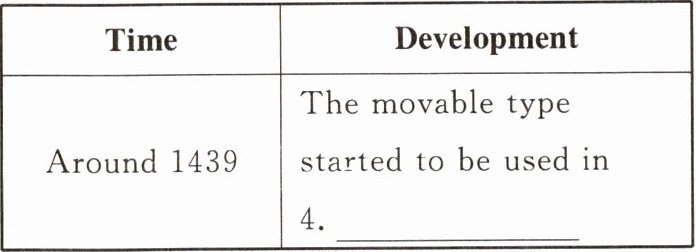
Later it started to be used in Europe around 1439. Printing became much easier and faster and printing presses became popular everywhere.
Nowadays, we send emails, texts and photos to each other. We can get books and read on our phones and computers. Ideas and knowledge are spreading faster than at any other time in history and the screen is taking the place of the page for many people.
任务一:根据短文内容完成表格。
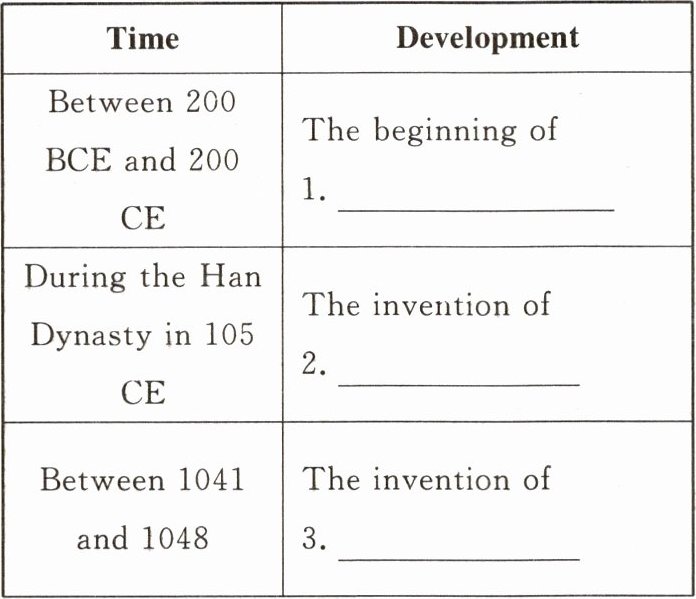
1.
2.
3.
4.
任务二:根据短文内容从每小题所给的A、B、C、D四个选项中选出最佳选项。
5. What would be the best structure of the passage? (
A. ①②/③④/⑤
B. ①/②③④⑤
C. ①/②③/④⑤
D. ①/②/③④⑤
6. How does the writer start the passage? (
A. By telling a story.
B. By asking a question.
C. By giving an example.
D. By listing some numbers.
作为改变世界的中国四大发明之一,印刷术(printing)的发展历程你了解吗?请阅读短文,完成相应的任务。
If you are reading this now, it is because these words are printed on this page. Could this happen 2,000 years ago? Well, you could have read some words but the words wouldn't be printed by a machine on paper.
Modern printing began in China somewhere between 200 BCE and 200 CE. A block(段)of wood was carved(雕刻)so that the words or pictures stood out. Ink(墨)was put on the wood and then cloth was put on top of the wood. Later, during the Han Dynasty in 105 CE, paper-making was invented in China and printing was done mostly on paper after that.
Much later, a new way called "movable type" was invented. It used small blocks with characters or letters. The blocks could be moved around easily to make a whole page and it was much faster than carving wood. It was invented in China between 1041 and 1048.
Later it started to be used in Europe around 1439. Printing became much easier and faster and printing presses became popular everywhere.
Nowadays, we send emails, texts and photos to each other. We can get books and read on our phones and computers. Ideas and knowledge are spreading faster than at any other time in history and the screen is taking the place of the page for many people.
任务一:根据短文内容完成表格。
1.
modern printing
2.
paper-making
3.
movable type
4.
Europe
任务二:根据短文内容从每小题所给的A、B、C、D四个选项中选出最佳选项。
5. What would be the best structure of the passage? (
B
)A. ①②/③④/⑤
B. ①/②③④⑤
C. ①/②③/④⑤
D. ①/②/③④⑤
6. How does the writer start the passage? (
B
)A. By telling a story.
B. By asking a question.
C. By giving an example.
D. By listing some numbers.
答案:
1. modern printing
2. paper-making
3. movable type
4. Europe
5.B
6.B
查看更多完整答案,请扫码查看

