

 搜索
搜索
第23页
- 第1页
- 第2页
- 第3页
- 第4页
- 第5页
- 第6页
- 第7页
- 第8页
- 第9页
- 第10页
- 第11页
- 第12页
- 第13页
- 第14页
- 第15页
- 第16页
- 第17页
- 第18页
- 第19页
- 第20页
- 第21页
- 第22页
- 第23页
- 第24页
- 第25页
- 第26页
- 第27页
- 第28页
- 第29页
- 第30页
- 第31页
- 第32页
- 第33页
- 第34页
- 第35页
- 第36页
- 第37页
- 第38页
- 第39页
- 第40页
- 第41页
- 第42页
- 第43页
- 第44页
- 第45页
- 第46页
- 第47页
- 第48页
- 第49页
- 第50页
- 第51页
- 第52页
- 第53页
- 第54页
- 第55页
- 第56页
- 第57页
- 第58页
- 第59页
- 第60页
- 第61页
- 第62页
- 第63页
- 第64页
- 第65页
- 第66页
- 第67页
- 第68页
- 第69页
- 第70页
- 第71页
- 第72页
- 第73页
- 第74页
- 第75页
- 第76页
- 第77页
- 第78页
- 第79页
- 第80页
- 第81页
- 第82页
- 第83页
- 第84页
- 第85页
- 第86页
- 第87页
- 第88页
- 第89页
- 第90页
- 第91页
- 第92页
- 第93页
- 第94页
- 第95页
- 第96页
- 第97页
- 第98页
- 第99页
- 第100页
- 第101页
- 第102页
- 第103页
- 第104页
- 第105页
- 第106页
- 第107页
- 第108页
- 第109页
- 第110页
- 第111页
- 第112页
B(2024·南京淮期中)
Rainbows are created by light shining through water or clear objects. In nature, rainbows usually appear where rain and sunlight meet. Rainbows are beautiful tricks of light. Science, though, has unlocked their mysteries.
Where and when rainbows appear
Notice the weather the next time you see a rainbow. There will be rain or mist(薄雾) in front of you, and the sun will be shining from behind you. The rainbow will appear in the rain or mist. Water in the air and direct light are the two things needed to see a rainbow in nature. A rainbow won't appear if the sky is too cloudy.
The best time to see a rainbow is usually in the morning or late afternoon. That's when the sun is in the best place to create one. If you're lucky, you might see a double or even a triple rainbow.
You can sometimes see rainbows in the mist of a waterfall too. A fountain(喷泉) can create a small rainbow, and a sprinkler(洒水器) on a sunny day may put on a colourful show. Rainbows can even form under a bright moon. These special rainbows are called moonbows.
To a viewer, a rainbow looks like a half circle. However, a rainbow actually forms a full circle. From the ground, most times we can only see a rainbow's top half. Sometimes though, lucky airline pilots may see a rainbow's complete circle from the sky.
How rainbows form
René Descartes was a French scientist. He was born over four hundred years ago. He was attracted by rainbows and wanted to learn more about them. He used sunlight and a big ball filled with water to do experiments. Descartes discovered that to see a rainbow, the viewer must be looking at the light from the right angle(角度). To understand rainbows, it helps to understand how light travels. Light moves at different speeds through different mediums(介质). Think of running on land. Then imagine running in knee-deep water. You move slower through water. In the same way, light moves faster through air than through water. This happens because water is thicker than air. When light enters water, it slows and changes its original path. This process makes objects, such as a pencil sitting in a glass of water, seem to bend(弯曲).
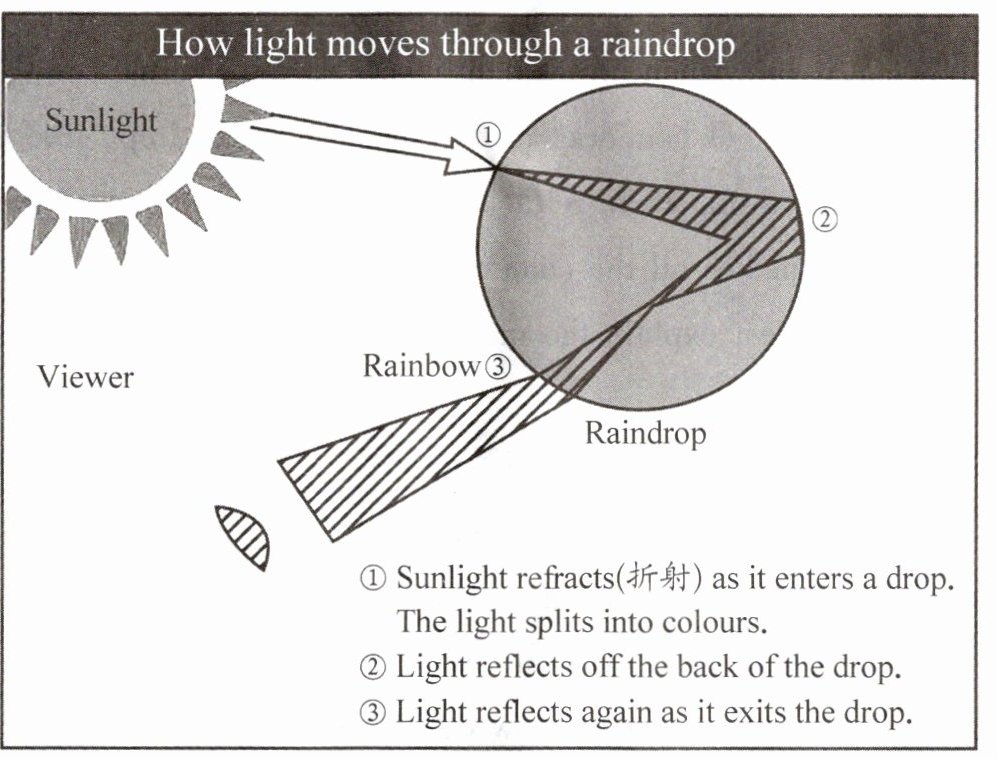
We can see rainbows in nature when direct light meets drops of rain. Sunlight refracts as it enters each drop. The light then reflects, or bounces, off the inside of each drop, like light off a mirror. The light reflects again as it exits the drop. Light refracts and reflects in millions of water droplets in the sky at the same time. This process makes all the colours of a rainbow.
1. Which sentence below can best explain the underlined sentence "Rainbows are beautiful tricks of light" in Paragraph 1?
A. Rainbows are tricks made by many scientists.
B. Someone lied to us about the truth of rainbows.
C. Rainbows are made by some unknown magic tricks.
D. The light plays tricks on people's eyes and makes rainbows.
2. In which of the following situations, a rainbow CAN'T form?
A. Over a sprinkler on a very cloudy day.
B. On a misty morning.
C. Over a fountain under a bright moon.
D. In the mist of a waterfall.
3. Which could be the best picture for the underlined sentence in Paragraph 6?

4. Which statement below is TRUE according to the article?
A. A rainbow can be a complete circle as well as a half circle.
B. You need to stand at the right angle to see a rainbow.
C. Light can actually make a pencil bend in water.
D. Light moves faster in thicker mediums like water.
Rainbows are created by light shining through water or clear objects. In nature, rainbows usually appear where rain and sunlight meet. Rainbows are beautiful tricks of light. Science, though, has unlocked their mysteries.
Where and when rainbows appear
Notice the weather the next time you see a rainbow. There will be rain or mist(薄雾) in front of you, and the sun will be shining from behind you. The rainbow will appear in the rain or mist. Water in the air and direct light are the two things needed to see a rainbow in nature. A rainbow won't appear if the sky is too cloudy.
The best time to see a rainbow is usually in the morning or late afternoon. That's when the sun is in the best place to create one. If you're lucky, you might see a double or even a triple rainbow.
You can sometimes see rainbows in the mist of a waterfall too. A fountain(喷泉) can create a small rainbow, and a sprinkler(洒水器) on a sunny day may put on a colourful show. Rainbows can even form under a bright moon. These special rainbows are called moonbows.
To a viewer, a rainbow looks like a half circle. However, a rainbow actually forms a full circle. From the ground, most times we can only see a rainbow's top half. Sometimes though, lucky airline pilots may see a rainbow's complete circle from the sky.
How rainbows form
René Descartes was a French scientist. He was born over four hundred years ago. He was attracted by rainbows and wanted to learn more about them. He used sunlight and a big ball filled with water to do experiments. Descartes discovered that to see a rainbow, the viewer must be looking at the light from the right angle(角度). To understand rainbows, it helps to understand how light travels. Light moves at different speeds through different mediums(介质). Think of running on land. Then imagine running in knee-deep water. You move slower through water. In the same way, light moves faster through air than through water. This happens because water is thicker than air. When light enters water, it slows and changes its original path. This process makes objects, such as a pencil sitting in a glass of water, seem to bend(弯曲).
We can see rainbows in nature when direct light meets drops of rain. Sunlight refracts as it enters each drop. The light then reflects, or bounces, off the inside of each drop, like light off a mirror. The light reflects again as it exits the drop. Light refracts and reflects in millions of water droplets in the sky at the same time. This process makes all the colours of a rainbow.
1. Which sentence below can best explain the underlined sentence "Rainbows are beautiful tricks of light" in Paragraph 1?
A. Rainbows are tricks made by many scientists.
B. Someone lied to us about the truth of rainbows.
C. Rainbows are made by some unknown magic tricks.
D. The light plays tricks on people's eyes and makes rainbows.
2. In which of the following situations, a rainbow CAN'T form?
A. Over a sprinkler on a very cloudy day.
B. On a misty morning.
C. Over a fountain under a bright moon.
D. In the mist of a waterfall.
3. Which could be the best picture for the underlined sentence in Paragraph 6?
4. Which statement below is TRUE according to the article?
A. A rainbow can be a complete circle as well as a half circle.
B. You need to stand at the right angle to see a rainbow.
C. Light can actually make a pencil bend in water.
D. Light moves faster in thicker mediums like water.
答案:
1. D 提示:推理判断题。"Rainbows are beautiful tricks of light."意为"彩虹是光的美丽把戏"。这句话的意思是光通过折射、反射等作用让我们看到彩虹,就好像在跟我们的眼睛玩把戏一样。因此D选项"光对人的眼睛玩把戏,从而形成彩虹"是最能解释这句话的。
2. A 提示:细节理解题。根据第四段中"A fountain can create a small rainbow, and a sprinkler on a sunny day may put on a colourful show."及第二段最后一句"A rainbow won't appear if the sky is too cloudy."可知,洒水器在晴朗的天气可以形成彩虹,而在多云的天气时不能形成彩虹。
3. C 提示:细节理解题。根据"When light enters water, it slows and changes its original path. This process makes objects, such as a pencil sitting in a glass of water, seem to bend."可知,当光进入水中时,它的速度会减慢,并且会改变其原本的传播路径。这一过程使得物体,例如放在水杯里的铅笔等看起来好像发生了弯曲;再结合物理知识可知,C项正确。
4. B 提示:细节理解题。根据第六段中"Descartes discovered that to see a rainbow, the viewer must be looking at the light from the right angle."可知,观看者要在正确的角度才能看到彩虹。
2. A 提示:细节理解题。根据第四段中"A fountain can create a small rainbow, and a sprinkler on a sunny day may put on a colourful show."及第二段最后一句"A rainbow won't appear if the sky is too cloudy."可知,洒水器在晴朗的天气可以形成彩虹,而在多云的天气时不能形成彩虹。
3. C 提示:细节理解题。根据"When light enters water, it slows and changes its original path. This process makes objects, such as a pencil sitting in a glass of water, seem to bend."可知,当光进入水中时,它的速度会减慢,并且会改变其原本的传播路径。这一过程使得物体,例如放在水杯里的铅笔等看起来好像发生了弯曲;再结合物理知识可知,C项正确。
4. B 提示:细节理解题。根据第六段中"Descartes discovered that to see a rainbow, the viewer must be looking at the light from the right angle."可知,观看者要在正确的角度才能看到彩虹。
查看更多完整答案,请扫码查看

