

 搜索
搜索
2025年全优课堂九年级英语下册
注:目前有些书本章节名称可能整理的还不是很完善,但都是按照顺序排列的,请同学们按照顺序仔细查找。练习册 2025年全优课堂九年级英语下册 答案主要是用来给同学们做完题方便对答案用的,请勿直接抄袭。
第80页
- 第1页
- 第2页
- 第3页
- 第4页
- 第5页
- 第6页
- 第7页
- 第8页
- 第9页
- 第10页
- 第11页
- 第12页
- 第13页
- 第14页
- 第15页
- 第16页
- 第17页
- 第18页
- 第19页
- 第20页
- 第21页
- 第22页
- 第23页
- 第24页
- 第25页
- 第26页
- 第27页
- 第28页
- 第29页
- 第30页
- 第31页
- 第32页
- 第33页
- 第34页
- 第35页
- 第36页
- 第37页
- 第38页
- 第39页
- 第40页
- 第41页
- 第42页
- 第43页
- 第44页
- 第45页
- 第46页
- 第47页
- 第48页
- 第49页
- 第50页
- 第51页
- 第52页
- 第53页
- 第54页
- 第55页
- 第56页
- 第57页
- 第58页
- 第59页
- 第60页
- 第61页
- 第62页
- 第63页
- 第64页
- 第65页
- 第66页
- 第67页
- 第68页
- 第69页
- 第70页
- 第71页
- 第72页
- 第73页
- 第74页
- 第75页
- 第76页
- 第77页
- 第78页
- 第79页
- 第80页
Passage 4
Like many high school graduates, Maggie Doyne didn't go straight to college. She decided to travel and arrived in western Nepal in 2006. A war had just ended there and left many children living on the streets. They were often forced to work at hard physical jobs for little money.
One day, while walking down a country road, Doyne saw a little girl breaking up rocks. She soon learned that 7 - year - old Hima sold the rocks to support her family. With deep sadness, she decided to pay Hima's tuition (学费) for school. Encouraged by the changes in the child, Doyne thought, "If we can help one child, why not 10?"
Doyne felt that the street children's greatest need was a home. She found a piece of land for sale and bought it with $5,000 she saved from years of babysitting (当临时保姆). In 2008 the Kopila Valley Children's Home was set up. With the help from the community, another goal was reached in 2010 - the Kopila Valley School. Over 350 children now attend the school and over 50 live in the home.
Today, Doyne lives in the home and is "mom" to the kids.
1. When did Maggie Doyne travel to western Nepal?
A. In 2006.
B. In 2007.
C. In 2008.
D. In 2010.
2. Why did Hima break up the rocks?
A. To do physical exercise.
B. To build a new school.
C. To get money for her family.
D. To repair the country road.
3. What can we learn from Paragraph 3?
A. The street children once worked as babysitters.
B. Doyne got some support from the community.
C. Doyne borrowed much money from the government.
D. Over 5,000 children attend the Kopila Valley School.
4. Which of the following might be the best title for the text?
A. Maggie Doyne - A Lonely Traveller
B. War in Western Nepal
C. Maggie Doyne - Mom to More Than 50
D. A Girl Lived on Her Own
Like many high school graduates, Maggie Doyne didn't go straight to college. She decided to travel and arrived in western Nepal in 2006. A war had just ended there and left many children living on the streets. They were often forced to work at hard physical jobs for little money.
One day, while walking down a country road, Doyne saw a little girl breaking up rocks. She soon learned that 7 - year - old Hima sold the rocks to support her family. With deep sadness, she decided to pay Hima's tuition (学费) for school. Encouraged by the changes in the child, Doyne thought, "If we can help one child, why not 10?"
Doyne felt that the street children's greatest need was a home. She found a piece of land for sale and bought it with $5,000 she saved from years of babysitting (当临时保姆). In 2008 the Kopila Valley Children's Home was set up. With the help from the community, another goal was reached in 2010 - the Kopila Valley School. Over 350 children now attend the school and over 50 live in the home.
Today, Doyne lives in the home and is "mom" to the kids.
1. When did Maggie Doyne travel to western Nepal?
A. In 2006.
B. In 2007.
C. In 2008.
D. In 2010.
2. Why did Hima break up the rocks?
A. To do physical exercise.
B. To build a new school.
C. To get money for her family.
D. To repair the country road.
3. What can we learn from Paragraph 3?
A. The street children once worked as babysitters.
B. Doyne got some support from the community.
C. Doyne borrowed much money from the government.
D. Over 5,000 children attend the Kopila Valley School.
4. Which of the following might be the best title for the text?
A. Maggie Doyne - A Lonely Traveller
B. War in Western Nepal
C. Maggie Doyne - Mom to More Than 50
D. A Girl Lived on Her Own
答案:
1. A 提示:根据第一段第二句“She decided to travel and arrived in western Nepal in 2006.”可知,Maggie Doyne在2006年去了尼泊尔西部旅行。故选A。
2. C 提示:根据第二段前两句“One day, while walking down a country road, Doyne saw a little girl breaking up rocks. She soon learned that 7 - year - old Hima sold the rocks to support her family.”可知,Hima砸石头卖掉,用得来的钱养活家人。故选C。
3. B 提示:根据第三段第二句“She found a piece of land for sale and bought it with $5,000 she saved from years of babysitting.”可知A项表述错误;根据第三段最后一句“Over 350 children now attend the school...”可知D项表述错误;C选项在短文中没有提到;根据短文第三段倒数第二句“With the help from the community, another goal was reached in 2010 — the Kopila Valley School.”可知,在社区的帮助下,Doyne建立学校的目标实现了。故选B。
4. C 提示:这篇短文介绍了高中毕业生Maggie Doyne在去尼泊尔旅行的时候,那里孩子们的贫困生活给她留下了深刻的印象,她决定帮助他们。她在那里给孩子们建立了一个家,还建立了学校供孩子们上学,而Doyne就是那些孩子们的“妈妈”。故C选项“Maggie Doyne—50多个孩子的妈妈”这个标题最符合文章主旨。故选C。
2. C 提示:根据第二段前两句“One day, while walking down a country road, Doyne saw a little girl breaking up rocks. She soon learned that 7 - year - old Hima sold the rocks to support her family.”可知,Hima砸石头卖掉,用得来的钱养活家人。故选C。
3. B 提示:根据第三段第二句“She found a piece of land for sale and bought it with $5,000 she saved from years of babysitting.”可知A项表述错误;根据第三段最后一句“Over 350 children now attend the school...”可知D项表述错误;C选项在短文中没有提到;根据短文第三段倒数第二句“With the help from the community, another goal was reached in 2010 — the Kopila Valley School.”可知,在社区的帮助下,Doyne建立学校的目标实现了。故选B。
4. C 提示:这篇短文介绍了高中毕业生Maggie Doyne在去尼泊尔旅行的时候,那里孩子们的贫困生活给她留下了深刻的印象,她决定帮助他们。她在那里给孩子们建立了一个家,还建立了学校供孩子们上学,而Doyne就是那些孩子们的“妈妈”。故C选项“Maggie Doyne—50多个孩子的妈妈”这个标题最符合文章主旨。故选C。
Passage 5
(续表)
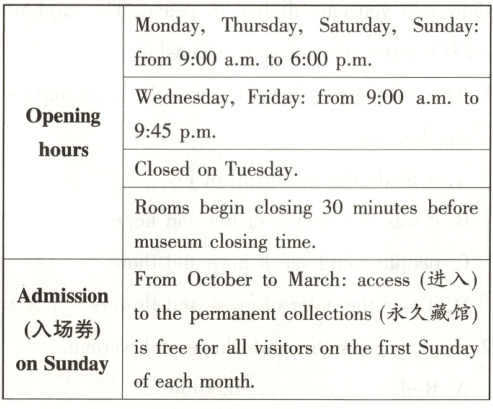
Opening hours: Monday, Thursday, Saturday, Sunday: from 9:00 a.m. to 6:00 p.m.; Wednesday, Friday: from 9:00 a.m. to 9:45 p.m.; Closed on Tuesday. Rooms begin closing 30 minutes before museum closing time.
Admission (入场券) on Sunday: From October to March: access (进入) to the permanent collections (永久藏馆) is free for all visitors on the first Sunday of each month.
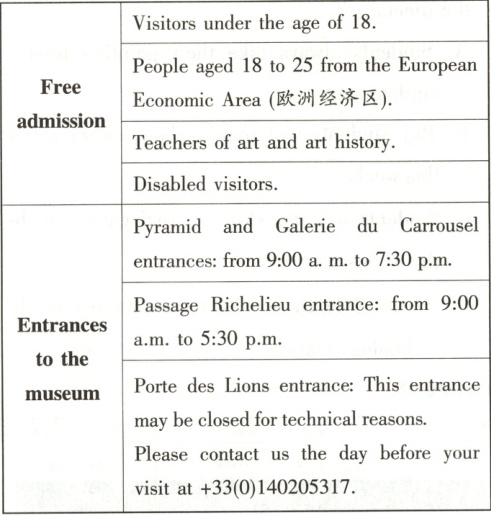
Free admission: Visitors under the age of 18.; People aged 18 to 25 from the European Economic Area (欧洲经济区).; Teachers of art and art history.; Disabled visitors.
Entrances to the museum: Pyramid and Galerie du Carrousel entrances: from 9:00 a.m. to 7:30 p.m.; Passage Richelieu entrance: from 9:00 a.m. to 5:30 p.m.; Porte des Lions entrance: This entrance may be closed for technical reasons. Please contact us the day before your visit at +33(0)140205317.
1. When do the rooms begin closing on Friday?
A. At 9:45 p.m.
B. At 9:15 p.m.
C. At 6:00 p.m.
D. At 5:30 p.m.
2. According to the table, ______.
A. you can visit the museum on Tuesday
B. the museum is closed on weekends
C. the museum is open till 9:45 p.m. on Wednesday
D. you can go to the museum at 6:00 p.m. on Monday
3. Who can visit the museum for free?
A. Only visitors under 16 years old.
B. People from the European Economic Area.
C. Students of art and art history.
D. Disabled people.
4. You should contact the museum before you use the ______.
A. Pyramid entrance
B. Galerie du Carrousel entrance
C. Porte des Lions entrance
D. Passage Richelieu entrance
(续表)
Opening hours: Monday, Thursday, Saturday, Sunday: from 9:00 a.m. to 6:00 p.m.; Wednesday, Friday: from 9:00 a.m. to 9:45 p.m.; Closed on Tuesday. Rooms begin closing 30 minutes before museum closing time.
Admission (入场券) on Sunday: From October to March: access (进入) to the permanent collections (永久藏馆) is free for all visitors on the first Sunday of each month.
Free admission: Visitors under the age of 18.; People aged 18 to 25 from the European Economic Area (欧洲经济区).; Teachers of art and art history.; Disabled visitors.
Entrances to the museum: Pyramid and Galerie du Carrousel entrances: from 9:00 a.m. to 7:30 p.m.; Passage Richelieu entrance: from 9:00 a.m. to 5:30 p.m.; Porte des Lions entrance: This entrance may be closed for technical reasons. Please contact us the day before your visit at +33(0)140205317.
1. When do the rooms begin closing on Friday?
A. At 9:45 p.m.
B. At 9:15 p.m.
C. At 6:00 p.m.
D. At 5:30 p.m.
2. According to the table, ______.
A. you can visit the museum on Tuesday
B. the museum is closed on weekends
C. the museum is open till 9:45 p.m. on Wednesday
D. you can go to the museum at 6:00 p.m. on Monday
3. Who can visit the museum for free?
A. Only visitors under 16 years old.
B. People from the European Economic Area.
C. Students of art and art history.
D. Disabled people.
4. You should contact the museum before you use the ______.
A. Pyramid entrance
B. Galerie du Carrousel entrance
C. Porte des Lions entrance
D. Passage Richelieu entrance
答案:
1. B 提示:由Opening hours部分中“Wednesday, Friday, from 9:00 a. m. to 9:45 p.m.”和“Rooms begin closing 30 minutes before museum closing time.”可知,博物馆在星期三和星期五上午9:00到晚上9:45开放,提前30分钟开始关门,故在星期五的晚上9:15开始关门。
2. C 提示:由Opening hours部分“Wednesday, Friday: from 9:00 a.m. to 9:45 p.m.”可知,星期三和星期五上午9:00到晚上9:45开放,故星期三博物馆开放到晚上9:45。
3. D 提示:由Free admission部分可知,18岁以下参观者、欧洲经济区18岁到25岁的人们、艺术和历史老师和残疾人可享受免费。故选D。
4. C 提示:由Entrances to the museum部分中“Porte des Lions entrance: This entrance may be closed for technical reasons. Please contact us the day before your visit at +33
(0)140205317”可知,在你用Porte des Lions entrance入口之前,需联系博物馆。
2. C 提示:由Opening hours部分“Wednesday, Friday: from 9:00 a.m. to 9:45 p.m.”可知,星期三和星期五上午9:00到晚上9:45开放,故星期三博物馆开放到晚上9:45。
3. D 提示:由Free admission部分可知,18岁以下参观者、欧洲经济区18岁到25岁的人们、艺术和历史老师和残疾人可享受免费。故选D。
4. C 提示:由Entrances to the museum部分中“Porte des Lions entrance: This entrance may be closed for technical reasons. Please contact us the day before your visit at +33
(0)140205317”可知,在你用Porte des Lions entrance入口之前,需联系博物馆。
查看更多完整答案,请扫码查看

