

 搜索
搜索
第61页
- 第1页
- 第2页
- 第3页
- 第4页
- 第5页
- 第6页
- 第7页
- 第8页
- 第9页
- 第10页
- 第11页
- 第12页
- 第13页
- 第14页
- 第15页
- 第16页
- 第17页
- 第18页
- 第19页
- 第20页
- 第21页
- 第22页
- 第23页
- 第24页
- 第25页
- 第26页
- 第27页
- 第28页
- 第29页
- 第30页
- 第31页
- 第32页
- 第33页
- 第34页
- 第35页
- 第36页
- 第37页
- 第38页
- 第39页
- 第40页
- 第41页
- 第42页
- 第43页
- 第44页
- 第45页
- 第46页
- 第47页
- 第48页
- 第49页
- 第50页
- 第51页
- 第52页
- 第53页
- 第54页
- 第55页
- 第56页
- 第57页
- 第58页
- 第59页
- 第60页
- 第61页
- 第62页
- 第63页
- 第64页
- 第65页
- 第66页
- 第67页
- 第68页
- 第69页
- 第70页
- 第71页
- 第72页
- 第73页
- 第74页
- 第75页
- 第76页
- 第77页
- 第78页
- 第79页
- 第80页
- 第81页
- 第82页
- 第83页
- 第84页
- 第85页
- 第86页
- 第87页
- 第88页
- 第89页
- 第90页
- 第91页
- 第92页
- 第93页
- 第94页
- 第95页
- 第96页
- 第97页
- 第98页
- 第99页
- 第100页
- 第101页
- 第102页
- 第103页
- 第104页
- 第105页
- 第106页
- 第107页
- 第108页
- 第109页
- 第110页
- 第111页
- 第112页
- 第113页
- 第114页
- 第115页
- 第116页
- 第117页
- 第118页
- 第119页
- 第120页
- 第121页
- 第122页
- 第123页
- 第124页
- 第125页
- 第126页
- 第127页
- 第128页
- 第129页
- 第130页
- 第131页
- 第132页
- 第133页
- 第134页
- 第135页
- 第136页
- 第137页
- 第138页
- 第139页
- 第140页
- 第141页
- 第142页
- 第143页
- 第144页
- 第145页
- 第146页
- 第147页
- 第148页
- 第149页
- 第150页
- 第151页
- 第152页
- 第153页
- 第154页
- 第155页
- 第156页
- 第157页
- 第158页
- 第159页
- 第160页
- 第161页
- 第162页
- 第163页
- 第164页
- 第165页
- 第166页
- 第167页
- 第168页
- 第169页
- 第170页
B(2024·山东枣庄·八下期末改编)
“Turn left! Turn right! Go forward!” In the information technology(IT)class, Leo, a student from Beijing 101 Middle School, is controlling a robot to move around. In fact, it is a daily scene(场景)of the artificial intelligence(AI)class in his school.
The school provides AI classes for both junior and senior high school students. “This year in our IT class, we have learned coding(编程)through a programming language called Python,” said Leo. Using Python to code is a basic skill for training AI models. Python has been tested in high school exams in places like Beijing and Jiangsu.
In recent years, AI education in schools has become a growing trend(趋势). ▲ In 2020, Zhejiang added AI education into textbooks from Grade 5 in primary school all the way to senior high. In the city of Wenzhou, the government is planning to build 1,000 AI experimental schools by 2025.
“With the development of technology, our textbooks have been changing all the time,” said Shang Yin, an IT teacher from Beijing 101 Middle School. “From typing to using Word and then today's coding and AI, the courses are keeping up with the times and teaching students some necessary skills. In the future, there will be more jobs where AI knowledge is needed. Even in daily life, people may need to understand things like ChatGPT. AI education will become more and more important,” Shang added.
24. The writer described the daily scene of IT class in Paragraph 1 to ______.
A. lead in the topic(主题)about AI education
B. introduce Beijing 101 Middle School
C. teach readers how to learn AI courses
D. show Leo's skill of controlling the robot
25. Which one can probably be put into the ▲?
A. Zhejiang Province is a typical example.
B. Beijing did the best in AI education.
C. Parents in Zhejiang are against AI courses.
D. Students in Jiangsu must have Python tests.
26. According to the passage, Shang Yin may agree that ______.
A. AI textbooks will never change in the future
B. AI knowledge will be less important in the future
C. people with AI knowledge will have no jobs to do
D. ChatGPT will come into daily life in the future
27. The passage is mainly about ______.
A. how students in Zhejiang are educated
B. the contents and purpose(内容和目的)of IT classes
C. the future of students without AI education
D. the situation of IT in Chinese schools
“Turn left! Turn right! Go forward!” In the information technology(IT)class, Leo, a student from Beijing 101 Middle School, is controlling a robot to move around. In fact, it is a daily scene(场景)of the artificial intelligence(AI)class in his school.
The school provides AI classes for both junior and senior high school students. “This year in our IT class, we have learned coding(编程)through a programming language called Python,” said Leo. Using Python to code is a basic skill for training AI models. Python has been tested in high school exams in places like Beijing and Jiangsu.
In recent years, AI education in schools has become a growing trend(趋势). ▲ In 2020, Zhejiang added AI education into textbooks from Grade 5 in primary school all the way to senior high. In the city of Wenzhou, the government is planning to build 1,000 AI experimental schools by 2025.
“With the development of technology, our textbooks have been changing all the time,” said Shang Yin, an IT teacher from Beijing 101 Middle School. “From typing to using Word and then today's coding and AI, the courses are keeping up with the times and teaching students some necessary skills. In the future, there will be more jobs where AI knowledge is needed. Even in daily life, people may need to understand things like ChatGPT. AI education will become more and more important,” Shang added.
24. The writer described the daily scene of IT class in Paragraph 1 to ______.
A. lead in the topic(主题)about AI education
B. introduce Beijing 101 Middle School
C. teach readers how to learn AI courses
D. show Leo's skill of controlling the robot
25. Which one can probably be put into the ▲?
A. Zhejiang Province is a typical example.
B. Beijing did the best in AI education.
C. Parents in Zhejiang are against AI courses.
D. Students in Jiangsu must have Python tests.
26. According to the passage, Shang Yin may agree that ______.
A. AI textbooks will never change in the future
B. AI knowledge will be less important in the future
C. people with AI knowledge will have no jobs to do
D. ChatGPT will come into daily life in the future
27. The passage is mainly about ______.
A. how students in Zhejiang are educated
B. the contents and purpose(内容和目的)of IT classes
C. the future of students without AI education
D. the situation of IT in Chinese schools
答案:
A
@@A
@@D
@@B
@@A
@@D
@@B
C(2024·重庆·八下期末)
①“Helicopter parents” are those parents who pay too much attention to their children. They are always making a big effort to provide children with every chance to succeed, from baby steps at age 1, homework at age 8 and work at age 25 to family problems at age 30, 40 or even older.
②Helicopter parenting can develop for a number of reasons. Worries about children's future success can push parents to take more control of their children's life. Adults who felt unloved as children may want to give as much love as they can to their own children. And when parents see others doing so, they will also follow.
③Although it develops with the idea of doing good things, the result isn't always satisfying. Mary is taken to five after - school classes each week, but she doesn't do well in any of them. “I feel like I am just checking off things on the checklist(清单),” she says.
④Worse still, overparenting can do the exact opposite. A child raised in this way may feel helpless once he has to do things on his own. “ ▲,” an expert said. “And if parents don't let their children experience failure(失败)themselves, the children won't get them.”
⑤Since helicopter parenting does such great harm(危害), does it mean parents should just back off and let it go? Of course not. “The point is to prepare the kid for the road but not the road for the kid,” another expert said. “Give them the morals(品行), give them the right start and develop their good habits, but you have to let them live their own lives.”
28. What can we learn from the passage?
A. Helicopter parenting does great harm to children.
B. Helicopter parenting only happens to very young children.
C. Helicopter parents can protect their children against all problems.
D. Children who have helicopter parents live a hard life without any happiness.
29. Which of the following can be put in the ▲?
A. Don't be a helicopter parent
B. It's a parent's job to encourage(鼓励)the children
C. Making decisions, solving problems and taking risks are key life skills
D. Parents try their best to make sure their children never meet with a bad ending
30. Which of the following is the closest in meaning to the underlined sentence in Paragraph ⑤?
A. Rome wasn't built in a day.
B. A journey of a thousand miles begins with a single step.
C. All things are difficult before they are easy.
D. Teach a man to fish and you feed him for a lifetime.
31. Which best shows the structure(结构)of the passage?
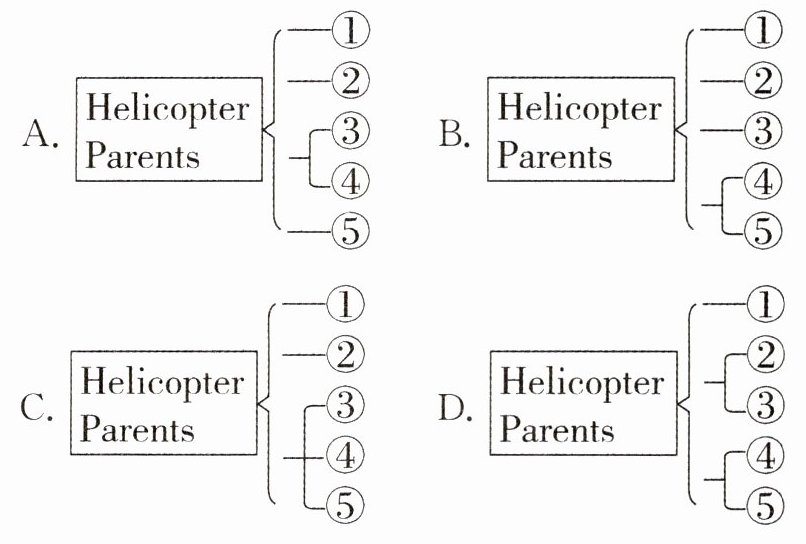
①“Helicopter parents” are those parents who pay too much attention to their children. They are always making a big effort to provide children with every chance to succeed, from baby steps at age 1, homework at age 8 and work at age 25 to family problems at age 30, 40 or even older.
②Helicopter parenting can develop for a number of reasons. Worries about children's future success can push parents to take more control of their children's life. Adults who felt unloved as children may want to give as much love as they can to their own children. And when parents see others doing so, they will also follow.
③Although it develops with the idea of doing good things, the result isn't always satisfying. Mary is taken to five after - school classes each week, but she doesn't do well in any of them. “I feel like I am just checking off things on the checklist(清单),” she says.
④Worse still, overparenting can do the exact opposite. A child raised in this way may feel helpless once he has to do things on his own. “ ▲,” an expert said. “And if parents don't let their children experience failure(失败)themselves, the children won't get them.”
⑤Since helicopter parenting does such great harm(危害), does it mean parents should just back off and let it go? Of course not. “The point is to prepare the kid for the road but not the road for the kid,” another expert said. “Give them the morals(品行), give them the right start and develop their good habits, but you have to let them live their own lives.”
28. What can we learn from the passage?
A. Helicopter parenting does great harm to children.
B. Helicopter parenting only happens to very young children.
C. Helicopter parents can protect their children against all problems.
D. Children who have helicopter parents live a hard life without any happiness.
29. Which of the following can be put in the ▲?
A. Don't be a helicopter parent
B. It's a parent's job to encourage(鼓励)the children
C. Making decisions, solving problems and taking risks are key life skills
D. Parents try their best to make sure their children never meet with a bad ending
30. Which of the following is the closest in meaning to the underlined sentence in Paragraph ⑤?
A. Rome wasn't built in a day.
B. A journey of a thousand miles begins with a single step.
C. All things are difficult before they are easy.
D. Teach a man to fish and you feed him for a lifetime.
31. Which best shows the structure(结构)of the passage?
答案:
28-31 ACDB
查看更多完整答案,请扫码查看

