

 搜索
搜索
第18页
- 第1页
- 第2页
- 第3页
- 第4页
- 第5页
- 第6页
- 第7页
- 第8页
- 第9页
- 第10页
- 第11页
- 第12页
- 第13页
- 第14页
- 第15页
- 第16页
- 第17页
- 第18页
- 第19页
- 第20页
- 第21页
- 第22页
- 第23页
- 第24页
- 第25页
- 第26页
- 第27页
- 第28页
- 第29页
- 第30页
- 第31页
- 第32页
- 第33页
- 第34页
- 第35页
- 第36页
- 第37页
- 第38页
- 第39页
- 第40页
- 第41页
- 第42页
- 第43页
- 第44页
- 第45页
- 第46页
- 第47页
- 第48页
- 第49页
- 第50页
- 第51页
- 第52页
- 第53页
- 第54页
- 第55页
- 第56页
- 第57页
- 第58页
- 第59页
- 第60页
- 第61页
- 第62页
- 第63页
- 第64页
- 第65页
- 第66页
- 第67页
- 第68页
- 第69页
- 第70页
- 第71页
- 第72页
- 第73页
- 第74页
- 第75页
- 第76页
- 第77页
- 第78页
- 第79页
- 第80页
- 第81页
- 第82页
- 第83页
- 第84页
- 第85页
- 第86页
- 第87页
- 第88页
- 第89页
- 第90页
- 第91页
- 第92页
- 第93页
- 第94页
- 第95页
- 第96页
- 第97页
- 第98页
- 第99页
- 第100页
- 第101页
- 第102页
- 第103页
- 第104页
- 第105页
- 第106页
- 第107页
- 第108页
- 第109页
- 第110页
- 第111页
- 第112页
- 第113页
- 第114页
- 第115页
- 第116页
- 第117页
- 第118页
- 第119页
- 第120页
- 第121页
- 第122页
- 第123页
- 第124页
- 第125页
- 第126页
- 第127页
- 第128页
- 第129页
- 第130页
- 第131页
- 第132页
- 第133页
- 第134页
- 第135页
- 第136页
- 第137页
- 第138页
- 第139页
- 第140页
- 第141页
- 第142页
- 第143页
- 第144页
- 第145页
- 第146页
- 第147页
- 第148页
- 第149页
- 第150页
- 第151页
- 第152页
- 第153页
- 第154页
- 第155页
- 第156页
- 第157页
- 第158页
- 第159页
- 第160页
- 第161页
- 第162页
- 第163页
- 第164页
- 第165页
- 第166页
- 第167页
- 第168页
- 第169页
- 第170页
B(2024·广东东莞·八下期末改编)
First Aid Course(急救课程) for Students
Students may have accidents at school. About 400,000 students get hurt in the UK every year. According to the Red Cross, only 25% of students know first aid skills. Most students feel nervous when they face accidents. It's very important for more students to take a first aid course. In this way, they will be prepared when accidents happen. If parents can only teach children one thing about first aid, they should teach them how to stay cool first. Things will get worse if they are too scared.
Although students can learn the 20 - hour first aid course online, it is much better to take the face - to - face course. William, a doctor from the Red Cross in the UK, said students must take a face - to - face course for at least 6 hours.
Here are three tips from the first aid course.
* How to deal with burns
Children should be careful when using fire. If they get burnt, they should cool the burn with running water or ice first. Then put some medicine on it. After that, bandage the burn.
* How to deal with small cuts
Clean the cut and put a bandage on it. If the blood doesn't stop, press the cut until it stops. When bleeding stops, put a new clean bandage on it.
* How to deal with fracture(骨折)
Don't move the person. Go and look for adults or call 120 for help. Before helpers come, keep talking to the person to cheer him or her up.
24. Which chart shows the number of the students who know first aid skills?
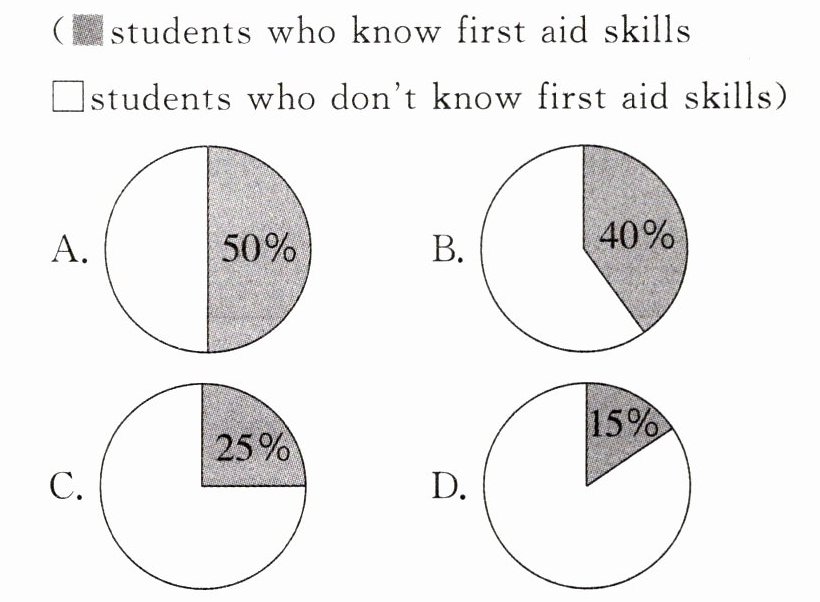
25. Which first aid course may William tell a student to take?
A. An online course for 18 hours.
B. An online course for 10 hours.
C. A face - to - face course for 8 hours.
D. A face - to - face course for 4 hours.
26. What is the first step if children get cut?
A. Cleaning the cut.
B. Cooling the cut.
C. Bandaging the cut.
D. Putting medicine on the cut.
27. What is the purpose of the passage?
A. To tell the number of first aid course.
B. To introduce the Red Cross.
C. To tell the difficulty of first aid course.
D. To tell the importance of first aid course.
First Aid Course(急救课程) for Students
Students may have accidents at school. About 400,000 students get hurt in the UK every year. According to the Red Cross, only 25% of students know first aid skills. Most students feel nervous when they face accidents. It's very important for more students to take a first aid course. In this way, they will be prepared when accidents happen. If parents can only teach children one thing about first aid, they should teach them how to stay cool first. Things will get worse if they are too scared.
Although students can learn the 20 - hour first aid course online, it is much better to take the face - to - face course. William, a doctor from the Red Cross in the UK, said students must take a face - to - face course for at least 6 hours.
Here are three tips from the first aid course.
* How to deal with burns
Children should be careful when using fire. If they get burnt, they should cool the burn with running water or ice first. Then put some medicine on it. After that, bandage the burn.
* How to deal with small cuts
Clean the cut and put a bandage on it. If the blood doesn't stop, press the cut until it stops. When bleeding stops, put a new clean bandage on it.
* How to deal with fracture(骨折)
Don't move the person. Go and look for adults or call 120 for help. Before helpers come, keep talking to the person to cheer him or her up.
24. Which chart shows the number of the students who know first aid skills?
25. Which first aid course may William tell a student to take?
A. An online course for 18 hours.
B. An online course for 10 hours.
C. A face - to - face course for 8 hours.
D. A face - to - face course for 4 hours.
26. What is the first step if children get cut?
A. Cleaning the cut.
B. Cooling the cut.
C. Bandaging the cut.
D. Putting medicine on the cut.
27. What is the purpose of the passage?
A. To tell the number of first aid course.
B. To introduce the Red Cross.
C. To tell the difficulty of first aid course.
D. To tell the importance of first aid course.
答案:
C
@@C
@@A
@@D
@@C
@@A
@@D
C(2024·广东河源·八下期末改编)
One of your classmates is suddenly having a nosebleed. What can you do at this moment? If you know some first aid skills, you can ask him or her to sit down and press the sides of his or her nose after putting his or her head down. If the bleeding doesn't stop after five or six minutes, find your teacher for help. Learning first aid skills is beneficial, because it can help you save someone's life in dangerous situations.
However, in China, fewer than one percent of adults have first aid skills. So the Ministry of Education(MOE) has asked all schools in China to teach students first aid skills, including CPR training. Then how does CPR help? CPR is a lifesaving skill used in many dangerous situations when someone's breathing or heartbeat has stopped. If you do CPR correctly within the first four to six minutes, the person who is in danger may remain alive. Even when you're unsure how to do CPR, it's always better to try than to do nothing. The difference between doing something and doing nothing could save someone's life. _______.
A survey from the Development Research Center of the State Council shows that 64.6% of schools already have these classes. However, the results are not good. We hope the results in the future will be better if students take it seriously.
28. What does the underlined word “beneficial” in Paragraph 1 mean?
A. Terrible.
B. Useful.
C. Interesting.
D. Meaningless.
29. Which is the best sentence to fill in the blank “_______” in Paragraph 2?
A. Students should make a good decision
B. It's necessary for students to learn CPR
C. It's better to do CPR quickly than to ask for help
D. Students must remember life is the most important
30. The first aid training classes _______.
A. have changed the world
B. have brought great help to students
C. will have to stop in the future
D. haven't achieved a complete success
31. What is the passage mainly about?
A. The importance of first aid skills.
B. The bright future for first aid workers.
C. The best time of doing first aid.
D. The way to solve dangerous problems.
One of your classmates is suddenly having a nosebleed. What can you do at this moment? If you know some first aid skills, you can ask him or her to sit down and press the sides of his or her nose after putting his or her head down. If the bleeding doesn't stop after five or six minutes, find your teacher for help. Learning first aid skills is beneficial, because it can help you save someone's life in dangerous situations.
However, in China, fewer than one percent of adults have first aid skills. So the Ministry of Education(MOE) has asked all schools in China to teach students first aid skills, including CPR training. Then how does CPR help? CPR is a lifesaving skill used in many dangerous situations when someone's breathing or heartbeat has stopped. If you do CPR correctly within the first four to six minutes, the person who is in danger may remain alive. Even when you're unsure how to do CPR, it's always better to try than to do nothing. The difference between doing something and doing nothing could save someone's life. _______.
A survey from the Development Research Center of the State Council shows that 64.6% of schools already have these classes. However, the results are not good. We hope the results in the future will be better if students take it seriously.
28. What does the underlined word “beneficial” in Paragraph 1 mean?
A. Terrible.
B. Useful.
C. Interesting.
D. Meaningless.
29. Which is the best sentence to fill in the blank “_______” in Paragraph 2?
A. Students should make a good decision
B. It's necessary for students to learn CPR
C. It's better to do CPR quickly than to ask for help
D. Students must remember life is the most important
30. The first aid training classes _______.
A. have changed the world
B. have brought great help to students
C. will have to stop in the future
D. haven't achieved a complete success
31. What is the passage mainly about?
A. The importance of first aid skills.
B. The bright future for first aid workers.
C. The best time of doing first aid.
D. The way to solve dangerous problems.
答案:
B
@@B
@@D
@@A
@@B
@@D
@@A
查看更多完整答案,请扫码查看

