

 搜索
搜索
2025年全品学练考高中英语必修第一册外研版
注:目前有些书本章节名称可能整理的还不是很完善,但都是按照顺序排列的,请同学们按照顺序仔细查找。练习册 2025年全品学练考高中英语必修第一册外研版 答案主要是用来给同学们做完题方便对答案用的,请勿直接抄袭。
第19页
- 第2页
- 第3页
- 第4页
- 第5页
- 第6页
- 第7页
- 第8页
- 第9页
- 第10页
- 第11页
- 第12页
- 第13页
- 第14页
- 第15页
- 第16页
- 第17页
- 第18页
- 第19页
- 第20页
- 第21页
- 第22页
- 第23页
- 第24页
- 第25页
- 第26页
- 第27页
- 第28页
- 第29页
- 第30页
- 第31页
- 第32页
- 第33页
- 第34页
- 第35页
- 第36页
- 第37页
- 第38页
- 第39页
- 第40页
- 第41页
- 第42页
- 第43页
- 第44页
- 第45页
- 第46页
- 第47页
- 第48页
- 第49页
- 第50页
- 第51页
- 第52页
- 第53页
- 第54页
- 第55页
- 第56页
- 第57页
- 第58页
- 第59页
- 第60页
- 第61页
- 第62页
- 第63页
- 第64页
- 第65页
- 第66页
- 第67页
- 第68页
- 第69页
- 第70页
- 第71页
- 第72页
练新鲜时文 拓主题语境
词数 360 难度 ★★★ 建议用时 7 分钟 正确率 _/4
My mother learned to read and write at 63—she was still the smartest woman I know.
I was typing papers for the new school students and trying to get them published in New York City in the late 1980s when Mama called. We chatted about nonsense for a while before she choked it out. “Well, Donner, there's this class set up at the high school this summer,” she said. “They say they can teach me to read and write. I'm trying to decide whether...”
“Of course, you should do it! That would be so wonderful. I'd be so proud of you,” I answered. She was 63 and was an expert at buying and selling garage sales to keep food on her own table and buy Christmas presents for me and my brother's kids. She used food stamps to buy groceries. Mama laughed, seemingly with relief. “Well, you know, I'd gotten used to being the dumbest old lady in town,” she said.
It turned out that her neighbour had found the class for her. The young woman had been doing Mama's “business” for a while in my absence, helping to reduce my guilt about leaving Mississippi. The friend was crazy, but Mama liked her. She was real and I hated pretence as much as Mama did. When I was little she would tell me: “Remember, Donner Kay, nobody's better than anybody else.”
Three months into the class, Mama left a message on my answering machine: “Donner, I taught a class tonight!” She was almost singing the words. “The teacher let me teach the class!” She soon wrote me a letter in careful, boxy print I had never seen, instead of the awkward way she had long written family names she had memorized.
The next time I flew home to visit, we both laughed like 12 - year - olds as she read words from billboards on the way from the airport. Her grammar was getting better. She gushed (滔滔不绝) about her classes, and the other students.
(
A. To introduce a course to Donner.
B. To inform Donner of her decision.
C. To ask for information about a school.
D. To tell Donner her intention.
(
A. Disappointed.
B. Doubtful.
C. Supportive.
D. Surprised.
(
A. Astonished.
B. Delighted.
C. Puzzled.
D. Worried.
(
A. What progress her mother made.
B. The difficulty her mother had in learning.
C. How her mother learned to read and write.
D. The effects learning had on her mother.
语篇分析

词海拾珠
1. chat about nonsense 闲扯一番
2. choke out (因感情激动而)哽咽着说
3. with relief 宽慰地,如释重负地
4. in one's absence 在某人不在的时候
5. pretence n. 假象,伪装→
6. awkward adj. 笨拙的;不舒适的→
举一反三
词缀 - ize
[原句再现] She soon wrote me a letter in careful, boxy print I had never seen, instead of the awkward way she had long written family names she had memorized.
不久,她给我写了一封信,信上是我从未见过的认真方正的字迹,而不是她长久以来写她记得的家人姓名时那样歪歪扭扭的写法。
后缀 - ize 加在名词或形容词后构成动词,表示“使成……状态,使……化”等。
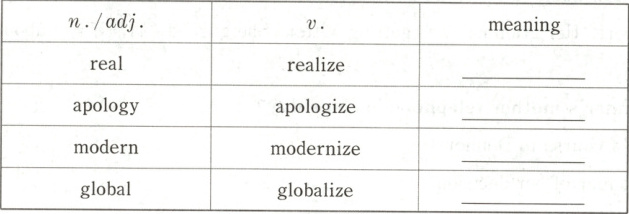
猜测词义
(1) We decided to popularize the farming method to more farmers. (
(2) The shy people are usually unwilling to socialize. (
句型透视
[原句] I was typing papers for the new school students and trying to get them published in New York City in the late 1980s when Mama called.
[分析] 这是一个复合句。该句使用了“Sb was/were doing sth when...”句型,意思是“某人正在做某事,突然……”,其中 when 是连词,连接两个分句。
[翻译] 在 20 世纪 80 年代末,我正在纽约为新生打印论文并试着帮他们发表时,
[仿写] 我迷路了,正在急切地寻找方向,这时我听到我父亲焦急地呼喊:“莉莉,你在哪里?”
Lost,
词数 360 难度 ★★★ 建议用时 7 分钟 正确率 _/4
My mother learned to read and write at 63—she was still the smartest woman I know.
I was typing papers for the new school students and trying to get them published in New York City in the late 1980s when Mama called. We chatted about nonsense for a while before she choked it out. “Well, Donner, there's this class set up at the high school this summer,” she said. “They say they can teach me to read and write. I'm trying to decide whether...”
“Of course, you should do it! That would be so wonderful. I'd be so proud of you,” I answered. She was 63 and was an expert at buying and selling garage sales to keep food on her own table and buy Christmas presents for me and my brother's kids. She used food stamps to buy groceries. Mama laughed, seemingly with relief. “Well, you know, I'd gotten used to being the dumbest old lady in town,” she said.
It turned out that her neighbour had found the class for her. The young woman had been doing Mama's “business” for a while in my absence, helping to reduce my guilt about leaving Mississippi. The friend was crazy, but Mama liked her. She was real and I hated pretence as much as Mama did. When I was little she would tell me: “Remember, Donner Kay, nobody's better than anybody else.”
Three months into the class, Mama left a message on my answering machine: “Donner, I taught a class tonight!” She was almost singing the words. “The teacher let me teach the class!” She soon wrote me a letter in careful, boxy print I had never seen, instead of the awkward way she had long written family names she had memorized.
The next time I flew home to visit, we both laughed like 12 - year - olds as she read words from billboards on the way from the airport. Her grammar was getting better. She gushed (滔滔不绝) about her classes, and the other students.
(
D
)1. Why did Donner's mother telephone her one day?A. To introduce a course to Donner.
B. To inform Donner of her decision.
C. To ask for information about a school.
D. To tell Donner her intention.
(
C
)2. What was Donner's attitude towards her mother's decision at 63?A. Disappointed.
B. Doubtful.
C. Supportive.
D. Surprised.
(
B
)3. How did Donner's mother feel when she left a message on the answering machine?A. Astonished.
B. Delighted.
C. Puzzled.
D. Worried.
(
A
)4. What does the author intend to tell us in the last two paragraphs?A. What progress her mother made.
B. The difficulty her mother had in learning.
C. How her mother learned to read and write.
D. The effects learning had on her mother.
语篇分析
词海拾珠
1. chat about nonsense 闲扯一番
2. choke out (因感情激动而)哽咽着说
3. with relief 宽慰地,如释重负地
4. in one's absence 在某人不在的时候
5. pretence n. 假象,伪装→
pretend
v. 假装6. awkward adj. 笨拙的;不舒适的→
awkwardly
adv. 笨拙地举一反三
词缀 - ize
[原句再现] She soon wrote me a letter in careful, boxy print I had never seen, instead of the awkward way she had long written family names she had memorized.
不久,她给我写了一封信,信上是我从未见过的认真方正的字迹,而不是她长久以来写她记得的家人姓名时那样歪歪扭扭的写法。
后缀 - ize 加在名词或形容词后构成动词,表示“使成……状态,使……化”等。
猜测词义
(1) We decided to popularize the farming method to more farmers. (
推广
)(2) The shy people are usually unwilling to socialize. (
社交
)句型透视
[原句] I was typing papers for the new school students and trying to get them published in New York City in the late 1980s when Mama called.
[分析] 这是一个复合句。该句使用了“Sb was/were doing sth when...”句型,意思是“某人正在做某事,突然……”,其中 when 是连词,连接两个分句。
[翻译] 在 20 世纪 80 年代末,我正在纽约为新生打印论文并试着帮他们发表时,
妈妈突然打来了电话
。[仿写] 我迷路了,正在急切地寻找方向,这时我听到我父亲焦急地呼喊:“莉莉,你在哪里?”
Lost,
I was looking for directions eagerly
when I heard my father crying anxiously, “Lily, where are you?”
答案:
1.D 2.C 3.B 4.A
【语篇分析】
1. 63 2. seek my advice 3. encouraged 4. progress
【词海拾珠】
5. pretend 6. awkwardly
【举一反三】
实现;道歉;使现代化;(使)全球化
[猜测词义]
(1)推广
(2)社交
【句型透视】
[分析] 妈妈突然打来了电话
[仿写] I was looking for directions eagerly
【语篇分析】
1. 63 2. seek my advice 3. encouraged 4. progress
【词海拾珠】
5. pretend 6. awkwardly
【举一反三】
实现;道歉;使现代化;(使)全球化
[猜测词义]
(1)推广
(2)社交
【句型透视】
[分析] 妈妈突然打来了电话
[仿写] I was looking for directions eagerly
查看更多完整答案,请扫码查看

