

 搜索
搜索
第15页
- 第1页
- 第2页
- 第3页
- 第4页
- 第5页
- 第6页
- 第7页
- 第8页
- 第9页
- 第10页
- 第11页
- 第12页
- 第13页
- 第14页
- 第15页
- 第16页
- 第17页
- 第18页
- 第19页
- 第20页
- 第21页
- 第22页
- 第23页
- 第24页
- 第25页
- 第26页
- 第27页
- 第28页
- 第29页
- 第30页
- 第31页
- 第32页
- 第33页
- 第34页
- 第35页
- 第36页
- 第37页
- 第38页
- 第39页
- 第40页
- 第41页
- 第42页
- 第43页
- 第44页
- 第45页
- 第46页
- 第47页
- 第48页
- 第49页
- 第50页
- 第51页
- 第52页
- 第53页
- 第54页
- 第55页
- 第56页
- 第57页
- 第58页
- 第59页
- 第60页
- 第61页
- 第62页
- 第63页
- 第64页
- 第65页
- 第66页
- 第67页
- 第68页
- 第69页
- 第70页
- 第71页
- 第72页
- 第73页
- 第74页
- 第75页
- 第76页
四、Bill在学校交了不少好朋友,他是如何做到的?请阅读下文寻找答案,并完成相应的题目。
Here are some nice words I often say:"Hello." "Hi." "Good morning." "Thank you." "You are nice." "Give me five." "That's great." and "Can I help you?" When(当 …… 时)I say nice words at school,my teachers and friends are always happy. They like nice words. I do too! Nice words often make people happy!
1. What words does Bill often say? Circle them in the passage.
2. Why does Bill often say these words? Underline the sentences(句子).
3. What is Bill like(怎么样)? Let's tick(√)!
( )friendly ( )strict
( )shy ( )polite
( )helpful ( )hard-working
Here are some nice words I often say:"Hello." "Hi." "Good morning." "Thank you." "You are nice." "Give me five." "That's great." and "Can I help you?" When(当 …… 时)I say nice words at school,my teachers and friends are always happy. They like nice words. I do too! Nice words often make people happy!
1. What words does Bill often say? Circle them in the passage.
2. Why does Bill often say these words? Underline the sentences(句子).
3. What is Bill like(怎么样)? Let's tick(√)!
( )friendly ( )strict
( )shy ( )polite
( )helpful ( )hard-working
答案:
【解析】:
这是一道英语阅读理解题,主要考查学生对文章内容的理解和提取信息的能力。题目给出了一个短文,短文中描述了Bill在学校经常说的一些好听的话语,以及这些话语给他人带来的感受。接下来,题目提出了三个问题,分别要求圈出Bill经常说的话,划出Bill经常说这些话的原因的句子,以及判断Bill的性格特点。
1. 对于第一个问题,需要从短文中找到Bill经常说的话,这些话语在短文中被明确列出,只需圈出即可。
2. 对于第二个问题,需要找到短文中解释Bill为什么经常说这些话的句子。这需要理解短文的内容,找到相关的句子并划出。
3. 对于第三个问题,需要根据短文中对Bill的描述,判断他的性格特点。这需要理解短文中的描述,并将其与给出的选项进行匹配。
【答案】:
1. Bill经常说的话有:"Hello." "Hi." "Good morning." "Thank you." "You are nice." "Give me five." "That's great." and "Can I help you?"(在原文中圈出这些句子)
2. Bill经常说这些话的原因是:"When I say nice words at school, my teachers and friends are always happy. They like nice words. I do too! Nice words often make people happy!"(在原文中划出这些句子)
3. Bill的性格特点可以判断为:friendly(友好的),polite(有礼貌的),helpful(乐于助人的)。因此,在friendly,polite,helpful后面的括号中打√。
这是一道英语阅读理解题,主要考查学生对文章内容的理解和提取信息的能力。题目给出了一个短文,短文中描述了Bill在学校经常说的一些好听的话语,以及这些话语给他人带来的感受。接下来,题目提出了三个问题,分别要求圈出Bill经常说的话,划出Bill经常说这些话的原因的句子,以及判断Bill的性格特点。
1. 对于第一个问题,需要从短文中找到Bill经常说的话,这些话语在短文中被明确列出,只需圈出即可。
2. 对于第二个问题,需要找到短文中解释Bill为什么经常说这些话的句子。这需要理解短文的内容,找到相关的句子并划出。
3. 对于第三个问题,需要根据短文中对Bill的描述,判断他的性格特点。这需要理解短文中的描述,并将其与给出的选项进行匹配。
【答案】:
1. Bill经常说的话有:"Hello." "Hi." "Good morning." "Thank you." "You are nice." "Give me five." "That's great." and "Can I help you?"(在原文中圈出这些句子)
2. Bill经常说这些话的原因是:"When I say nice words at school, my teachers and friends are always happy. They like nice words. I do too! Nice words often make people happy!"(在原文中划出这些句子)
3. Bill的性格特点可以判断为:friendly(友好的),polite(有礼貌的),helpful(乐于助人的)。因此,在friendly,polite,helpful后面的括号中打√。
五、单元项目 (Day 1)。
将你在班上认识的新同学按表格要求填空。
|Chinese name|Western order(西方顺序)|First name|Last name|
|示例:张三|San Zhang|San|Zhang|
| | | | |
| | | | |
| | | | |
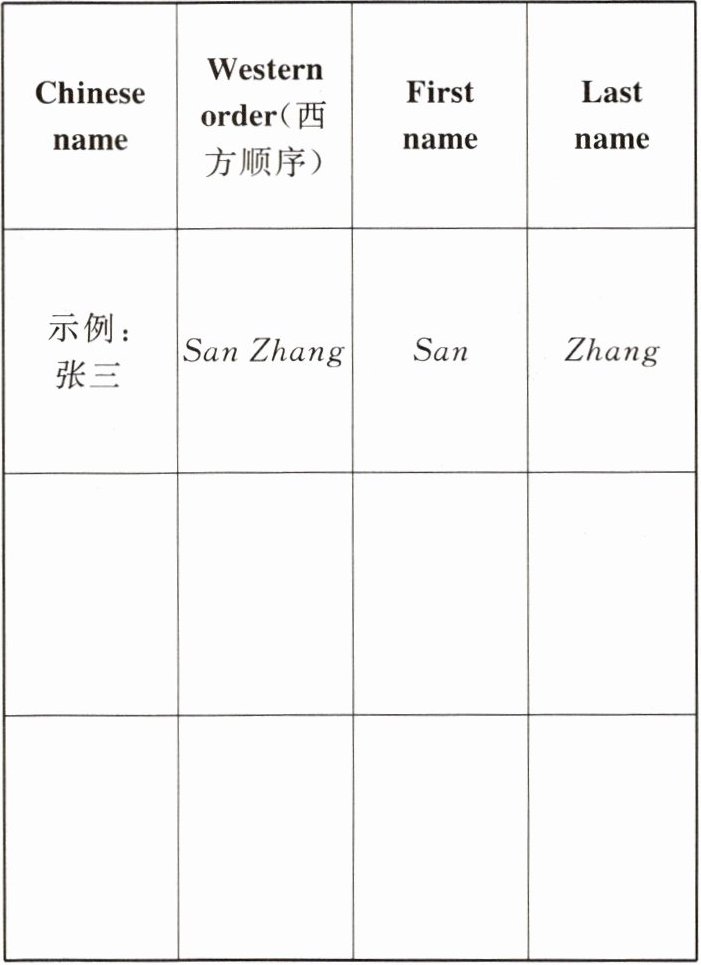
将你在班上认识的新同学按表格要求填空。
|Chinese name|Western order(西方顺序)|First name|Last name|
|示例:张三|San Zhang|San|Zhang|
| | | | |
| | | | |
| | | | |
答案:
【解析】:本题主要考查中西方姓名顺序的差异以及英文姓名的构成。中西方姓名顺序不同,西方姓名是名在前,姓在后;而中国姓名是姓在前,名在后。英文姓名中,名(first name)在前,姓(last name)在后。本题要求按照示例,将认识的新同学的中文名按照西方顺序进行填写,并分别写出名和姓。
【答案】:假设新同学有李四、王五、赵六,填写如下:
|Chinese name|Western order(西方顺序)|First name|Last name|
| ---- | ---- | ---- | ---- |
|示例:张三|San Zhang|San|Zhang|
|李四|Si Li|Si|Li|
|王五|Wu Wang|Wu|Wang|
|赵六|Liu Zhao|Liu|Zhao|
【答案】:假设新同学有李四、王五、赵六,填写如下:
|Chinese name|Western order(西方顺序)|First name|Last name|
| ---- | ---- | ---- | ---- |
|示例:张三|San Zhang|San|Zhang|
|李四|Si Li|Si|Li|
|王五|Wu Wang|Wu|Wang|
|赵六|Liu Zhao|Liu|Zhao|
查看更多完整答案,请扫码查看

