

 搜索
搜索
第36页
- 第1页
- 第2页
- 第3页
- 第4页
- 第5页
- 第6页
- 第7页
- 第8页
- 第9页
- 第10页
- 第11页
- 第12页
- 第13页
- 第14页
- 第15页
- 第16页
- 第17页
- 第18页
- 第19页
- 第20页
- 第21页
- 第22页
- 第23页
- 第24页
- 第25页
- 第26页
- 第27页
- 第28页
- 第29页
- 第30页
- 第31页
- 第32页
- 第33页
- 第34页
- 第35页
- 第36页
- 第37页
- 第38页
- 第39页
- 第40页
- 第41页
- 第42页
- 第43页
- 第44页
- 第45页
- 第46页
- 第47页
- 第48页
- 第49页
- 第50页
- 第51页
- 第52页
- 第53页
- 第54页
- 第55页
- 第56页
- 第57页
- 第58页
- 第59页
- 第60页
- 第61页
- 第62页
- 第63页
- 第64页
- 第65页
- 第66页
- 第67页
- 第68页
- 第69页
- 第70页
- 第71页
- 第72页
- 第73页
- 第74页
一、选出每组中画线部分发音不同的单词。
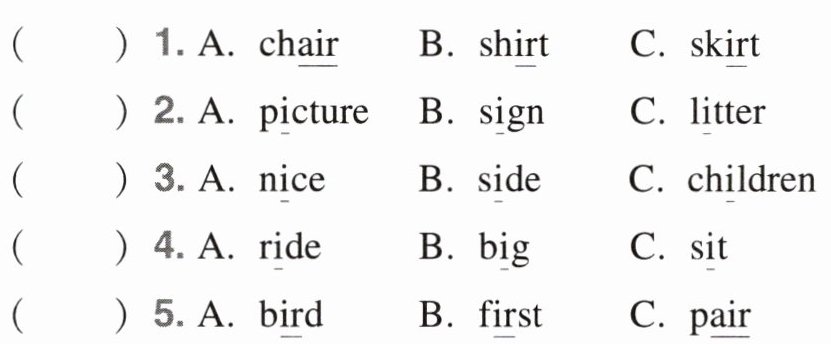
答案:
1. A 【点拨】B和C选项中ir发音为/ɜː/,而A选项中air的发音为/eə(r)/。
2. B 【点拨】A和C选项中i发音为/ɪ/,而B中i的发音为/aɪ/。
3. C 【点拨】A和B中i发音为/aɪ/,而C中i的发音为/ɪ/。
4. A 【点拨】B和C中i发音为/ɪ/,而A中i的发音为/aɪ/。
5. C 【点拨】A和B中ir发音为/ɜː/,而C中air的发音为/eə(r)/。
2. B 【点拨】A和C选项中i发音为/ɪ/,而B中i的发音为/aɪ/。
3. C 【点拨】A和B中i发音为/aɪ/,而C中i的发音为/ɪ/。
4. A 【点拨】B和C中i发音为/ɪ/,而A中i的发音为/aɪ/。
5. C 【点拨】A和B中ir发音为/ɜː/,而C中air的发音为/eə(r)/。
二、[天津滨海新区改编]用所给词的正确形式填空。
1. ________ (keep) your room clean, Peter.
2. We often ________ (do) housework with our parents.
3. Students should ask and answer questions ____________ (active).
4. Parents should take good care of ____________ (child).
5. Micky points to the sign to tell people, “No ____________ (litter)!”
1. ________ (keep) your room clean, Peter.
2. We often ________ (do) housework with our parents.
3. Students should ask and answer questions ____________ (active).
4. Parents should take good care of ____________ (child).
5. Micky points to the sign to tell people, “No ____________ (litter)!”
答案:
1. Keep 【点拨】祈使句句首的动词用原形。
2. do 【点拨】主语“We”非第三人称单数,动词用原形。
3. actively 【点拨】修饰动词要用副词。
4. children
5. littering 【点拨】No + 动词-ing形式,表示“禁止做某事”。
2. do 【点拨】主语“We”非第三人称单数,动词用原形。
3. actively 【点拨】修饰动词要用副词。
4. children
5. littering 【点拨】No + 动词-ing形式,表示“禁止做某事”。
三、阅读教材中的“Reading for knowledge”,完成下列各题。
(一)判断正(T)误(F)。
( )1. There is much litter in the sea.
( )2. The litter island is now six times as big as America.
( )3. These waste things get together in the sea and they become an island on the ground!
(二)选择正确的选项。
( )1. These waste things are bad for ____.
A. fish and birds B. people
C. Both A and B.
( )2. ________ can be recycled.
A. Cans, glass and banana skins
B. Medicine, plastic bottles and cans
C. Glass, paper and cans
(一)判断正(T)误(F)。
( )1. There is much litter in the sea.
( )2. The litter island is now six times as big as America.
( )3. These waste things get together in the sea and they become an island on the ground!
(二)选择正确的选项。
( )1. These waste things are bad for ____.
A. fish and birds B. people
C. Both A and B.
( )2. ________ can be recycled.
A. Cans, glass and banana skins
B. Medicine, plastic bottles and cans
C. Glass, paper and cans
答案:
三(一)1. T 2. F 3. F
(二)1. C 2. C
(二)1. C 2. C
四、新情境·绿色家园【主题情境:保护环境】完形填空。
Hi, everyone. My name 1. ________ Earth. Today is April 22nd, World Earth Day. It’s 2. ________ big day for me. Please do 3. ________ to protect me. You 4. ________ turn off lights if you leave the rooms. It is helpful in saving electricity (省电). You should turn off the tap (水龙头) if you don’t use it. It is helpful in saving 5. ________. You can learn to recycle (回收利用) things, like cans, bottles 6. ________ newspapers. You can also plant some trees and flowers. They can make me greener and cleaner. If you see rubbish 7. ________ the ground, you can pick it up. This can help keep me 8. ________. You can help to keep the air clean too. You can choose to take a bus, walk or ride a bike when you go out. If you can 9. ________ these good things to me, I will be good 10. ________ you, too.
( )1. A. am B. is C. are
( )2. A. a B. an C. /
( )3. A. less B. more C. many
( )4. A. mustn’t B. shouldn’t C. should
( )5. A. light B. water C. sound
( )6. A. and B. but C. not
( )7. A. in B. under C. on
( )8. A. messy B. clean C. dirty
( )9. A. do B. does C. doing
( )10. A. after B. at C. to
Hi, everyone. My name 1. ________ Earth. Today is April 22nd, World Earth Day. It’s 2. ________ big day for me. Please do 3. ________ to protect me. You 4. ________ turn off lights if you leave the rooms. It is helpful in saving electricity (省电). You should turn off the tap (水龙头) if you don’t use it. It is helpful in saving 5. ________. You can learn to recycle (回收利用) things, like cans, bottles 6. ________ newspapers. You can also plant some trees and flowers. They can make me greener and cleaner. If you see rubbish 7. ________ the ground, you can pick it up. This can help keep me 8. ________. You can help to keep the air clean too. You can choose to take a bus, walk or ride a bike when you go out. If you can 9. ________ these good things to me, I will be good 10. ________ you, too.
( )1. A. am B. is C. are
( )2. A. a B. an C. /
( )3. A. less B. more C. many
( )4. A. mustn’t B. shouldn’t C. should
( )5. A. light B. water C. sound
( )6. A. and B. but C. not
( )7. A. in B. under C. on
( )8. A. messy B. clean C. dirty
( )9. A. do B. does C. doing
( )10. A. after B. at C. to
答案:
四1. B
2. A 【点拨】a big day(重要的一天)。
3. B 【点拨】请做更多的事情来保护我。
4. C 【点拨】离开房间应该随手关灯。
5. B 【点拨】随手关水龙头可以节约用水。
6. A
7. C 【点拨】on the ground(在地上)。
8. B 【点拨】keep...clean(保持……干净)。
9. A 【点拨】情态动词can后跟动词原形。
10. C 【点拨】be good to为固定搭配,表示“对……友好”。
2. A 【点拨】a big day(重要的一天)。
3. B 【点拨】请做更多的事情来保护我。
4. C 【点拨】离开房间应该随手关灯。
5. B 【点拨】随手关水龙头可以节约用水。
6. A
7. C 【点拨】on the ground(在地上)。
8. B 【点拨】keep...clean(保持……干净)。
9. A 【点拨】情态动词can后跟动词原形。
10. C 【点拨】be good to为固定搭配,表示“对……友好”。
查看更多完整答案,请扫码查看

