

 搜索
搜索
第37页
- 第1页
- 第2页
- 第3页
- 第4页
- 第5页
- 第6页
- 第7页
- 第8页
- 第9页
- 第10页
- 第11页
- 第12页
- 第13页
- 第14页
- 第15页
- 第16页
- 第17页
- 第18页
- 第19页
- 第20页
- 第21页
- 第22页
- 第23页
- 第24页
- 第25页
- 第26页
- 第27页
- 第28页
- 第29页
- 第30页
- 第31页
- 第32页
- 第33页
- 第34页
- 第35页
- 第36页
- 第37页
- 第38页
- 第39页
- 第40页
- 第41页
- 第42页
- 第43页
- 第44页
- 第45页
- 第46页
- 第47页
- 第48页
- 第49页
- 第50页
- 第51页
- 第52页
- 第53页
- 第54页
- 第55页
- 第56页
- 第57页
- 第58页
- 第59页
- 第60页
- 第61页
- 第62页
- 第63页
- 第64页
- 第65页
- 第66页
- 第67页
- 第68页
- 第69页
- 第70页
- 第71页
- 第72页
- 第73页
- 第74页
- 第75页
- 第76页
- 第77页
- 第78页
- 第79页
- 第80页
- 第81页
- 第82页
- 第83页
- 第84页
- 第85页
- 第86页
- 第87页
- 第88页
- 第89页
- 第90页
- 第91页
- 第92页
- 第93页
- 第94页
- 第95页
- 第96页
- 第97页
- 第98页
- 第99页
- 第100页
- 第101页
- 第102页
- 第103页
- 第104页
- 第105页
- 第106页
- 第107页
- 第108页
- 第109页
- 第110页
- 第111页
- 第112页
- 第113页
- 第114页
- 第115页
- 第116页
- 第117页
- 第118页
- 第119页
- 第120页
- 第121页
- 第122页
- 第123页
- 第124页
- 第125页
- 第126页
- 第127页
- 第128页
- 第129页
- 第130页
- 第131页
- 第132页
五、阅读下面短文,从短文后的选项中选出可以填入空白处的最佳选项。选项中有一项为多余选项。
Confucius and Cicadas(蝉)
One day, Confucius led his students to the State of Chu. When crossing through a large forest, they saw an old man standing under a tree, catching cicadas with a bamboo stick. Confucius said, “__1__ You must have some special skills.”
“That's right!” the old man answered. “Cicadas are clever little insects. __2__ So people who want to catch cicadas must train their hands to hold a bamboo stick without shaking. If you can place three small balls on top of the bamboo stick without falling off, you might be able to catch cicadas. When five small balls are placed on top without falling off, catching cicadas is as easy as picking a ball up from the ground.”
He then added, “But that is not enough. __3__ Right now, I am standing under the tree like part of the tree, with my arm reaching out like part of a dry branch. __4__ When I am catching cicadas, I only watch the cicadas' wings. No matter what happens, I will focus on the wings.”
Hearing this, Confucius turned to his students and said, “No matter what you do, you can only succeed if you love what you are doing and pay enough attention to it. __5__ This is what this old man has taught us.”
A. You are very good at catching cicadas.
B. People must be good at hiding themselves.
C. Last but not least, one must be concentrated(集中的).
D. People must be more active while catching cicadas.
E. That is to say, whatever you do, you should focus on it.
F. If they hear the noise of the leaves in the wind, they will fly away.
1. ______ 2. ______ 3. ______ 4. ______ 5. ______
1.
Confucius and Cicadas(蝉)
One day, Confucius led his students to the State of Chu. When crossing through a large forest, they saw an old man standing under a tree, catching cicadas with a bamboo stick. Confucius said, “__1__ You must have some special skills.”
“That's right!” the old man answered. “Cicadas are clever little insects. __2__ So people who want to catch cicadas must train their hands to hold a bamboo stick without shaking. If you can place three small balls on top of the bamboo stick without falling off, you might be able to catch cicadas. When five small balls are placed on top without falling off, catching cicadas is as easy as picking a ball up from the ground.”
He then added, “But that is not enough. __3__ Right now, I am standing under the tree like part of the tree, with my arm reaching out like part of a dry branch. __4__ When I am catching cicadas, I only watch the cicadas' wings. No matter what happens, I will focus on the wings.”
Hearing this, Confucius turned to his students and said, “No matter what you do, you can only succeed if you love what you are doing and pay enough attention to it. __5__ This is what this old man has taught us.”
A. You are very good at catching cicadas.
B. People must be good at hiding themselves.
C. Last but not least, one must be concentrated(集中的).
D. People must be more active while catching cicadas.
E. That is to say, whatever you do, you should focus on it.
F. If they hear the noise of the leaves in the wind, they will fly away.
1. ______ 2. ______ 3. ______ 4. ______ 5. ______
1.
A
2. F
3. B
4. C
5. E
答案:
1. A 2. F 3. B 4. C 5. E
六、阅读理解。
How do you spend your free time? Playing sports or seeing movies? Do you want to live a different after-school life? How about mixing into elements of intangible cultural heritage(非物质文化遗产元素)? Here are four examples.
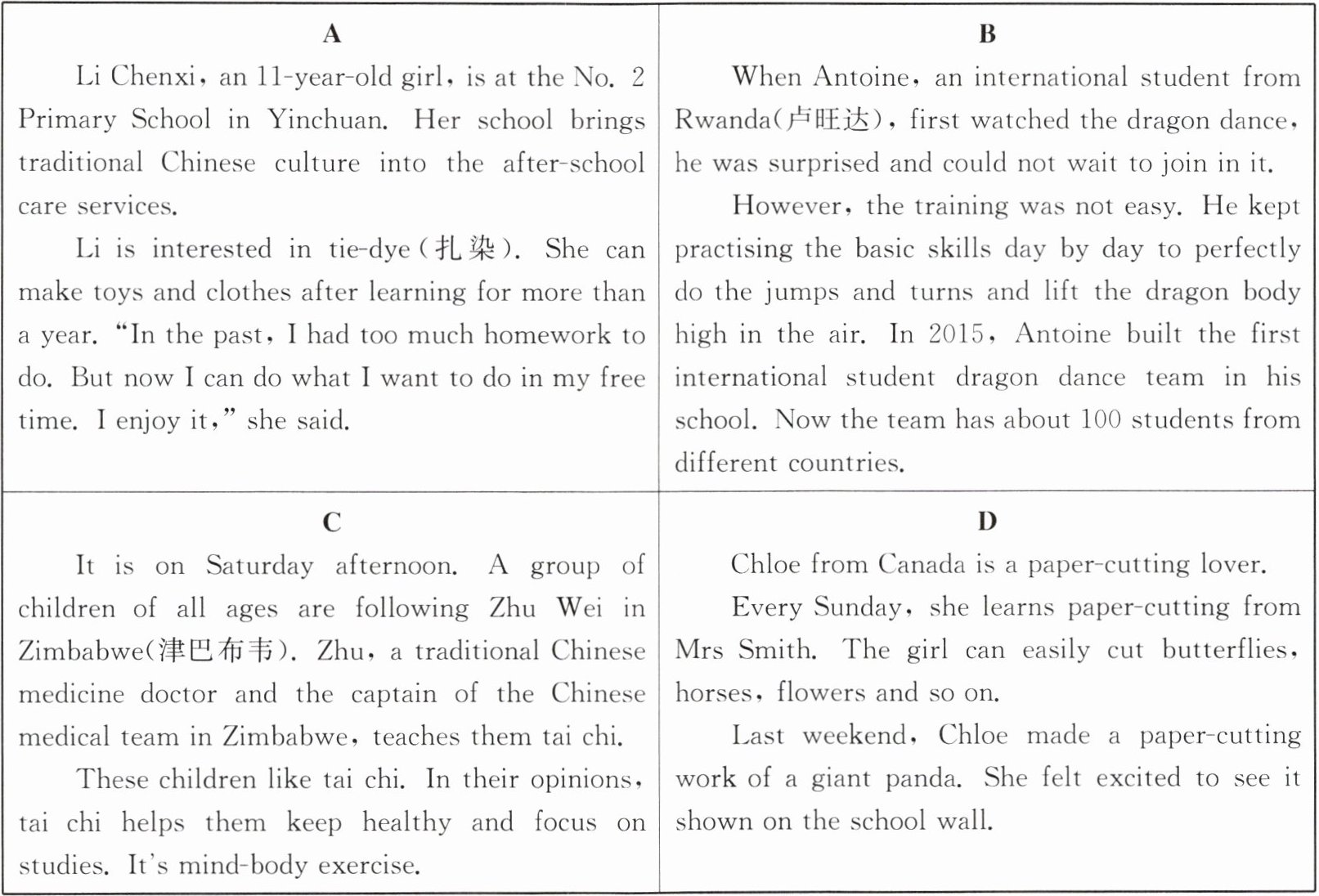
| A | B |
| Li Chenxi, an 11-year-old girl, is at the No. 2 Primary School in Yinchuan. Her school brings traditional Chinese culture into the after-school care services.
Li is interested in tie-dye(扎染). She can make toys and clothes after learning for more than a year. “In the past, I had too much homework to do. But now I can do what I want to do in my free time. I enjoy it,” she said. | When Antoine, an international student from Rwanda(卢旺达), first watched the dragon dance, he was surprised and could not wait to join in it.
However, the training was not easy. He kept practising the basic skills day by day to perfectly do the jumps and turns and lift the dragon body high in the air. In 2015, Antoine built the first international student dragon dance team in his school. Now the team has about 100 students from different countries. |
| C | D |
| It is on Saturday afternoon. A group of children of all ages are following Zhu Wei in Zimbabwe(津巴布韦). Zhu, a traditional Chinese medicine doctor and the captain of the Chinese medical team in Zimbabwe, teaches them tai chi.
These children like tai chi. In their opinions, tai chi helps them keep healthy and focus on studies. It's mind-body exercise. | Chloe from Canada is a paper-cutting lover.
Every Sunday, she learns paper-cutting from Mrs Smith. The girl can easily cut butterflies, horses, flowers and so on.
Last weekend, Chloe made a paper-cutting work of a giant panda. She felt excited to see it shown on the school wall. |
(
A. Toys and clothes.
B. A giant panda.
C. Animals and flowers.
D. Clothes for dragon dance.
(
A. He comes from America.
B. He practised hard on dragon dance.
C. He built a dragon dance team five years ago.
D. His dragon dance team is the second in his school.
(
① To make more friends. ② To learn about Chinese culture.
③ To be healthy and strong. ④ To help them study better.
A. ①②
B. ③④
C. ①③
D. ②④
(
A. Once a week.
B. Twice a week.
C. Once a month.
D. Twice a month.
How do you spend your free time? Playing sports or seeing movies? Do you want to live a different after-school life? How about mixing into elements of intangible cultural heritage(非物质文化遗产元素)? Here are four examples.
| A | B |
| Li Chenxi, an 11-year-old girl, is at the No. 2 Primary School in Yinchuan. Her school brings traditional Chinese culture into the after-school care services.
Li is interested in tie-dye(扎染). She can make toys and clothes after learning for more than a year. “In the past, I had too much homework to do. But now I can do what I want to do in my free time. I enjoy it,” she said. | When Antoine, an international student from Rwanda(卢旺达), first watched the dragon dance, he was surprised and could not wait to join in it.
However, the training was not easy. He kept practising the basic skills day by day to perfectly do the jumps and turns and lift the dragon body high in the air. In 2015, Antoine built the first international student dragon dance team in his school. Now the team has about 100 students from different countries. |
| C | D |
| It is on Saturday afternoon. A group of children of all ages are following Zhu Wei in Zimbabwe(津巴布韦). Zhu, a traditional Chinese medicine doctor and the captain of the Chinese medical team in Zimbabwe, teaches them tai chi.
These children like tai chi. In their opinions, tai chi helps them keep healthy and focus on studies. It's mind-body exercise. | Chloe from Canada is a paper-cutting lover.
Every Sunday, she learns paper-cutting from Mrs Smith. The girl can easily cut butterflies, horses, flowers and so on.
Last weekend, Chloe made a paper-cutting work of a giant panda. She felt excited to see it shown on the school wall. |
(
A
)1. What does Li Chenxi make using tie-dye?A. Toys and clothes.
B. A giant panda.
C. Animals and flowers.
D. Clothes for dragon dance.
(
B
)2. What can we learn about Antoine?A. He comes from America.
B. He practised hard on dragon dance.
C. He built a dragon dance team five years ago.
D. His dragon dance team is the second in his school.
(
B
)3. Why do children in Zimbabwe choose to practise tai chi?① To make more friends. ② To learn about Chinese culture.
③ To be healthy and strong. ④ To help them study better.
A. ①②
B. ③④
C. ①③
D. ②④
(
A
)4. How often does Chloe learn paper-cutting from Mrs Smith?A. Once a week.
B. Twice a week.
C. Once a month.
D. Twice a month.
答案:
1. A 2. B 3. B 4. A
查看更多完整答案,请扫码查看

