

 搜索
搜索
2025年活动单导学课程高中英语必修第二册译林版
注:目前有些书本章节名称可能整理的还不是很完善,但都是按照顺序排列的,请同学们按照顺序仔细查找。练习册 2025年活动单导学课程高中英语必修第二册译林版 答案主要是用来给同学们做完题方便对答案用的,请勿直接抄袭。
第62页
- 第1页
- 第2页
- 第3页
- 第4页
- 第5页
- 第6页
- 第7页
- 第8页
- 第9页
- 第10页
- 第11页
- 第12页
- 第13页
- 第14页
- 第15页
- 第16页
- 第17页
- 第18页
- 第19页
- 第20页
- 第21页
- 第22页
- 第23页
- 第24页
- 第25页
- 第26页
- 第27页
- 第28页
- 第29页
- 第30页
- 第31页
- 第32页
- 第33页
- 第34页
- 第35页
- 第36页
- 第37页
- 第38页
- 第39页
- 第40页
- 第41页
- 第42页
- 第43页
- 第44页
- 第45页
- 第46页
- 第47页
- 第48页
- 第49页
- 第50页
- 第51页
- 第52页
- 第53页
- 第54页
- 第55页
- 第56页
- 第57页
- 第58页
- 第59页
- 第60页
- 第61页
- 第62页
- 第63页
- 第64页
- 第65页
- 第66页
- 第67页
- 第68页
Activity 1 Lead-in 话题导入
1. What is your favourite work of literature? Why?
2. What qualities do you think a great work of literature should have?
1. What is your favourite work of literature? Why?
2. What qualities do you think a great work of literature should have?
答案:
1. My favourite work of literature is *Pride and Prejudice*. Because it has vivid characters, a fascinating plot, and profound insights into human nature and society.
2. A great work of literature should have qualities such as excellent language, rich themes, well - developed characters, and the ability to touch the readers' hearts and make them think.
2. A great work of literature should have qualities such as excellent language, rich themes, well - developed characters, and the ability to touch the readers' hearts and make them think.
Activity 2 First-reading—Read for main ideas and structure 一读,读大意和结构

答案:
1. 1-2 2. introduction 3. 3-5
4. qualities 5. 6
4. qualities 5. 6
Activity 3 Second-reading—Read for details 二读,读细节
Read the text again and answer the following questions.
1. What did the child hear? How did the man explain what the child heard?
2. What do we need to do in order to enter and enjoy the new world mentioned in the second paragraph?
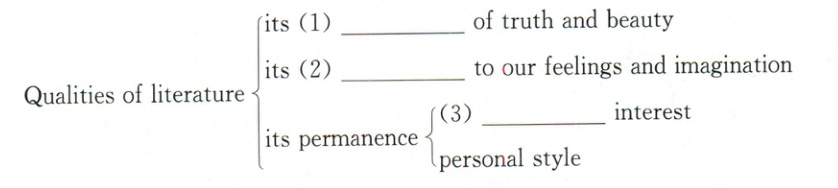
3. Finish the mind map.
4. Why does the author give the example of a poet?
5. What is universal about good literature according to the author?
6. What are the topic sentences of Paras. 3-5? How did the author support the topic sentences?
Read the text again and answer the following questions.
1. What did the child hear? How did the man explain what the child heard?
2. What do we need to do in order to enter and enjoy the new world mentioned in the second paragraph?
3. Finish the mind map.
4. Why does the author give the example of a poet?
5. What is universal about good literature according to the author?
6. What are the topic sentences of Paras. 3-5? How did the author support the topic sentences?
答案:
1. He heard strange, low, musical sounds.
The man explained that the child heard nothing strange, and that the shell caught a range of sounds too faint for human ears.
2. We need to love literature, and make an effort to explain it.
3.
(1) description
(2) appeal
(3) universal
4. He wants to prove that some truth and beauty remain unnoticed until a sensitive human soul brings them to our attention.
5. Good literature reflects the most basic of human nature—love and hate, joy and sadness, fear and hope.
6. Topic sentences:
The first quality of literature is its description of truth and beauty.
The second quality of literature is its appeal to our feelings and imagination.
The third quality of literature, coming out of the other two, is its permanence.
The author gives explanations and examples to support his opinion.
The man explained that the child heard nothing strange, and that the shell caught a range of sounds too faint for human ears.
2. We need to love literature, and make an effort to explain it.
3.
(1) description
(2) appeal
(3) universal
4. He wants to prove that some truth and beauty remain unnoticed until a sensitive human soul brings them to our attention.
5. Good literature reflects the most basic of human nature—love and hate, joy and sadness, fear and hope.
6. Topic sentences:
The first quality of literature is its description of truth and beauty.
The second quality of literature is its appeal to our feelings and imagination.
The third quality of literature, coming out of the other two, is its permanence.
The author gives explanations and examples to support his opinion.
查看更多完整答案,请扫码查看

