

 搜索
搜索
2025年人教金学典同步练习册同步解析与测评高中英语必修第一册
注:目前有些书本章节名称可能整理的还不是很完善,但都是按照顺序排列的,请同学们按照顺序仔细查找。练习册 2025年人教金学典同步练习册同步解析与测评高中英语必修第一册 答案主要是用来给同学们做完题方便对答案用的,请勿直接抄袭。
第115页
- 第1页
- 第2页
- 第3页
- 第4页
- 第5页
- 第6页
- 第7页
- 第8页
- 第9页
- 第10页
- 第11页
- 第12页
- 第13页
- 第14页
- 第15页
- 第16页
- 第17页
- 第18页
- 第19页
- 第20页
- 第21页
- 第22页
- 第23页
- 第24页
- 第25页
- 第26页
- 第27页
- 第28页
- 第29页
- 第30页
- 第31页
- 第32页
- 第33页
- 第34页
- 第35页
- 第36页
- 第37页
- 第38页
- 第39页
- 第40页
- 第41页
- 第42页
- 第43页
- 第44页
- 第45页
- 第46页
- 第47页
- 第48页
- 第49页
- 第50页
- 第51页
- 第52页
- 第53页
- 第54页
- 第55页
- 第56页
- 第57页
- 第58页
- 第59页
- 第60页
- 第61页
- 第62页
- 第63页
- 第64页
- 第65页
- 第66页
- 第67页
- 第68页
- 第69页
- 第70页
- 第71页
- 第72页
- 第73页
- 第74页
- 第75页
- 第76页
- 第77页
- 第78页
- 第79页
- 第80页
- 第81页
- 第82页
- 第83页
- 第84页
- 第85页
- 第86页
- 第87页
- 第88页
- 第89页
- 第90页
- 第91页
- 第92页
- 第93页
- 第94页
- 第95页
- 第96页
- 第97页
- 第98页
- 第99页
- 第100页
- 第101页
- 第102页
- 第103页
- 第104页
- 第105页
- 第106页
- 第107页
- 第108页
- 第109页
- 第110页
- 第111页
- 第112页
- 第113页
- 第114页
- 第115页
- 第116页
- 第117页
- 第118页
- 第119页
- 第120页
- 第121页
- 第122页
- 第123页
- 第124页
- 第125页
- 第126页
- 第127页
- 第128页
- 第129页
- 第130页
- 第131页
- 第132页
- 第133页
- 第134页
- 第135页
- 第136页
- 第137页
- 第138页
- 第139页
- 第140页
- 第141页
1. Read the passage and complete the exercises.
Ready for Disaster
Japan is located in the world’s most active earthquake zone, and the world considers the country the best prepared to deal with an earthquake emergency. Even so, the 11 March earthquake, which measured 9.0 on the Richter scale (里氏震级), followed by a strong tsunami minutes later, still left thousands of people dead. The calm the Japanese have shown since the earthquake has impressed the world. This is largely because the country takes earthquake education seriously.
From a young age, Japanese are taught how to survive an earthquake in many practical and creative ways. And schools in Japan organise earthquake drills (演习) every month. The local fire department also invites people onto special trucks where they can experience an artificial (人工的) earthquake. This way, they can become familiar with what an earthquake is like. However serious the earthquake is, there is no doubt that without the care the country takes to teach people about safety and protection, things would be much worse.
What can we learn to survive an earthquake? The American Red Cross introduced the Drop, Cover & Hold On method. It has been proven in the US to reduce earthquake-related injuries and deaths.
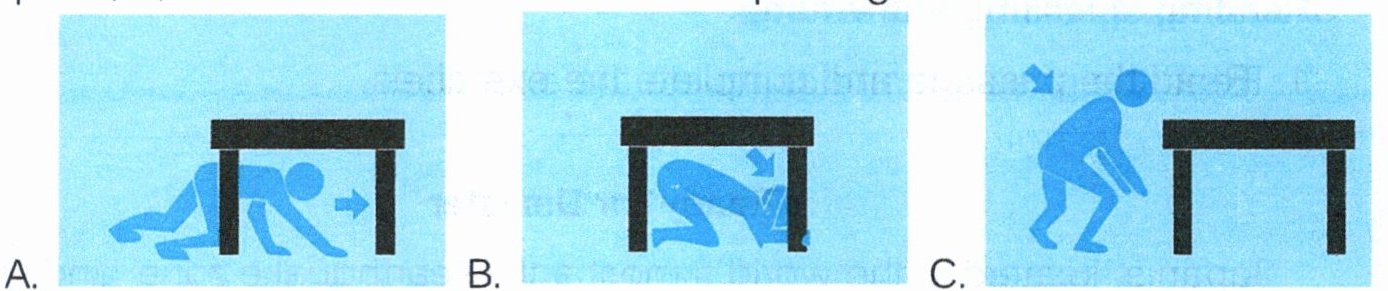
□ Drop: Drop down to the floor.
□ Cover: Take cover under or beside a strong piece of furniture. If that is not possible, look for cover against an interior (内部的) wall and protect your head with your arms. Avoid dangerous places near windows, hanging objects, and mirrors.
□ Hold on: If you take cover under or beside a strong piece of furniture, hold on to it and be prepared to move with it. Hold the position until the ground stops shaking and it is safe to move. Finally, in Japan all offices and many private houses have an earthquake emergency kit that includes food, water, medicine, a blanket, a flashlight, a whistle, a radio, and a knife.
It is clearly a good thing to be prepared ahead of a disaster.
(1) Here are the sketches for the three steps to survive an earthquake. Please put A, B, and C in the correct box in the passage.
(2) The underlined word “impressed” in paragraph 1 is closest in meaning to “
A. satisfied
B. excited
C. shocked
D. encouraged
(3) What does the underlined word “it” in paragraph 6 refer to?
A. A window.
B. A mirror.
C. A hanging object.
D. A strong piece of furniture.
(4) What does the world think of Japan when it comes to an earthquake emergency?
(5) Why do schools in Japan organise earthquake drills every month?
Ready for Disaster
Japan is located in the world’s most active earthquake zone, and the world considers the country the best prepared to deal with an earthquake emergency. Even so, the 11 March earthquake, which measured 9.0 on the Richter scale (里氏震级), followed by a strong tsunami minutes later, still left thousands of people dead. The calm the Japanese have shown since the earthquake has impressed the world. This is largely because the country takes earthquake education seriously.
From a young age, Japanese are taught how to survive an earthquake in many practical and creative ways. And schools in Japan organise earthquake drills (演习) every month. The local fire department also invites people onto special trucks where they can experience an artificial (人工的) earthquake. This way, they can become familiar with what an earthquake is like. However serious the earthquake is, there is no doubt that without the care the country takes to teach people about safety and protection, things would be much worse.
What can we learn to survive an earthquake? The American Red Cross introduced the Drop, Cover & Hold On method. It has been proven in the US to reduce earthquake-related injuries and deaths.
□ Drop: Drop down to the floor.
□ Cover: Take cover under or beside a strong piece of furniture. If that is not possible, look for cover against an interior (内部的) wall and protect your head with your arms. Avoid dangerous places near windows, hanging objects, and mirrors.
□ Hold on: If you take cover under or beside a strong piece of furniture, hold on to it and be prepared to move with it. Hold the position until the ground stops shaking and it is safe to move. Finally, in Japan all offices and many private houses have an earthquake emergency kit that includes food, water, medicine, a blanket, a flashlight, a whistle, a radio, and a knife.
It is clearly a good thing to be prepared ahead of a disaster.
(1) Here are the sketches for the three steps to survive an earthquake. Please put A, B, and C in the correct box in the passage.
(2) The underlined word “impressed” in paragraph 1 is closest in meaning to “
C
”.A. satisfied
B. excited
C. shocked
D. encouraged
(3) What does the underlined word “it” in paragraph 6 refer to?
A. A window.
B. A mirror.
C. A hanging object.
D. A strong piece of furniture.
(4) What does the world think of Japan when it comes to an earthquake emergency?
The world considers Japan the best prepared to deal with an earthquake emergency.
(5) Why do schools in Japan organise earthquake drills every month?
Schools in Japan organise earthquake drills every month in order to make their students more familiar with what an earthquake is like and to get students better prepared for actual earthquakes.
答案:
1.
(1) C. Drop A. Cover B. Hold on
(2) C 词义猜测题。根据画线词所在句子可知,在地震后日本人表现得很平静,这与大部分国家发生地震后人们的反应是不同的,这当然会使世界上其他地方的人感到震惊。故选C项。
(3) D 代词指代题。根据第六段中的“If you take cover under or beside a strong piece of furniture, hold on to it and be prepared to move with it”可知,如果你躲在结实的家具下面或旁边,要抓牢它。所以it指的是a strong piece of furniture。故选D项。
(4) The world considers Japan the best prepared to deal with an earthquake emergency.
(5) Schools in Japan organise earthquake drills every month in order to make their students more familiar with what an earthquake is like and to get students better prepared for actual earthquakes.
(1) C. Drop A. Cover B. Hold on
(2) C 词义猜测题。根据画线词所在句子可知,在地震后日本人表现得很平静,这与大部分国家发生地震后人们的反应是不同的,这当然会使世界上其他地方的人感到震惊。故选C项。
(3) D 代词指代题。根据第六段中的“If you take cover under or beside a strong piece of furniture, hold on to it and be prepared to move with it”可知,如果你躲在结实的家具下面或旁边,要抓牢它。所以it指的是a strong piece of furniture。故选D项。
(4) The world considers Japan the best prepared to deal with an earthquake emergency.
(5) Schools in Japan organise earthquake drills every month in order to make their students more familiar with what an earthquake is like and to get students better prepared for actual earthquakes.
查看更多完整答案,请扫码查看

