

 搜索
搜索
第83页
- 第1页
- 第2页
- 第3页
- 第4页
- 第5页
- 第6页
- 第7页
- 第8页
- 第9页
- 第10页
- 第11页
- 第12页
- 第13页
- 第14页
- 第15页
- 第16页
- 第17页
- 第18页
- 第19页
- 第20页
- 第21页
- 第22页
- 第23页
- 第24页
- 第25页
- 第26页
- 第27页
- 第28页
- 第29页
- 第30页
- 第31页
- 第32页
- 第33页
- 第34页
- 第35页
- 第36页
- 第37页
- 第38页
- 第39页
- 第40页
- 第41页
- 第42页
- 第43页
- 第44页
- 第45页
- 第46页
- 第47页
- 第48页
- 第49页
- 第50页
- 第51页
- 第52页
- 第53页
- 第54页
- 第55页
- 第56页
- 第57页
- 第58页
- 第59页
- 第60页
- 第61页
- 第62页
- 第63页
- 第64页
- 第65页
- 第66页
- 第67页
- 第68页
- 第69页
- 第70页
- 第71页
- 第72页
- 第73页
- 第74页
- 第75页
- 第76页
- 第77页
- 第78页
- 第79页
- 第80页
- 第81页
- 第82页
- 第83页
- 第84页
- 第85页
- 第86页
- 第87页
- 第88页
- 第89页
- 第90页
- 第91页
- 第92页
- 第93页
- 第94页
- 第95页
- 第96页
- 第97页
- 第98页
- 第99页
- 第100页
- 第101页
- 第102页
- 第103页
- 第104页
- 第105页
- 第106页
- 第107页
- 第108页
- 第109页
- 第110页
- 第111页
- 第112页
- 第113页
- 第114页
- 第115页
- 第116页
- 第117页
- 第118页
- 第119页
- 第120页
- 第121页
- 第122页
- 第123页
- 第124页
- 第125页
- 第126页
- 第127页
- 第128页
- 第129页
- 第130页
- 第131页
- 第132页
- 第133页
- 第134页
- 第135页
- 第136页
- 第137页
- 第138页
- 第139页
- 第140页
- 第141页
- 第142页
- 第143页
- 第144页
- 第145页
- 第146页
- 第147页
- 第148页
- 第149页
- 第150页
- 第151页
- 第152页
- 第153页
- 第154页
- 第155页
- 第156页
- 第157页
- 第158页
- 第159页
- 第160页
- 第161页
- 第162页
- 第163页
- 第164页
- 第165页
- 第166页
- 第167页
- 第168页
- 第169页
- 第170页
- 第171页
- 第172页
- 第173页
- 第174页
- 第175页
- 第176页
- 第177页
- 第178页
- 第179页
- 第180页
- 第181页
- 第182页
- 第183页
- 第184页
- 第185页
- 第186页
- 第187页
- 第188页
- 第189页
- 第190页
- 第191页
- 第192页
- 第193页
- 第194页
- 第195页
- 第196页
- 第197页
- 第198页
- 第199页
- 第200页
| | | Beauty in Common Things |
| :---: | :---: | :---: |
| Fact | | Traditional art forms show important things in life, such as love, beauty and family. |
| | Sky lanterns | Uses: First used to ask for help by Zhuge Kongming; today used at festivals and other celebrations. 2
| 1
| | Clay art | Appearance: Cute children or lively characters from a Chinese fairy tale or historical story; 4
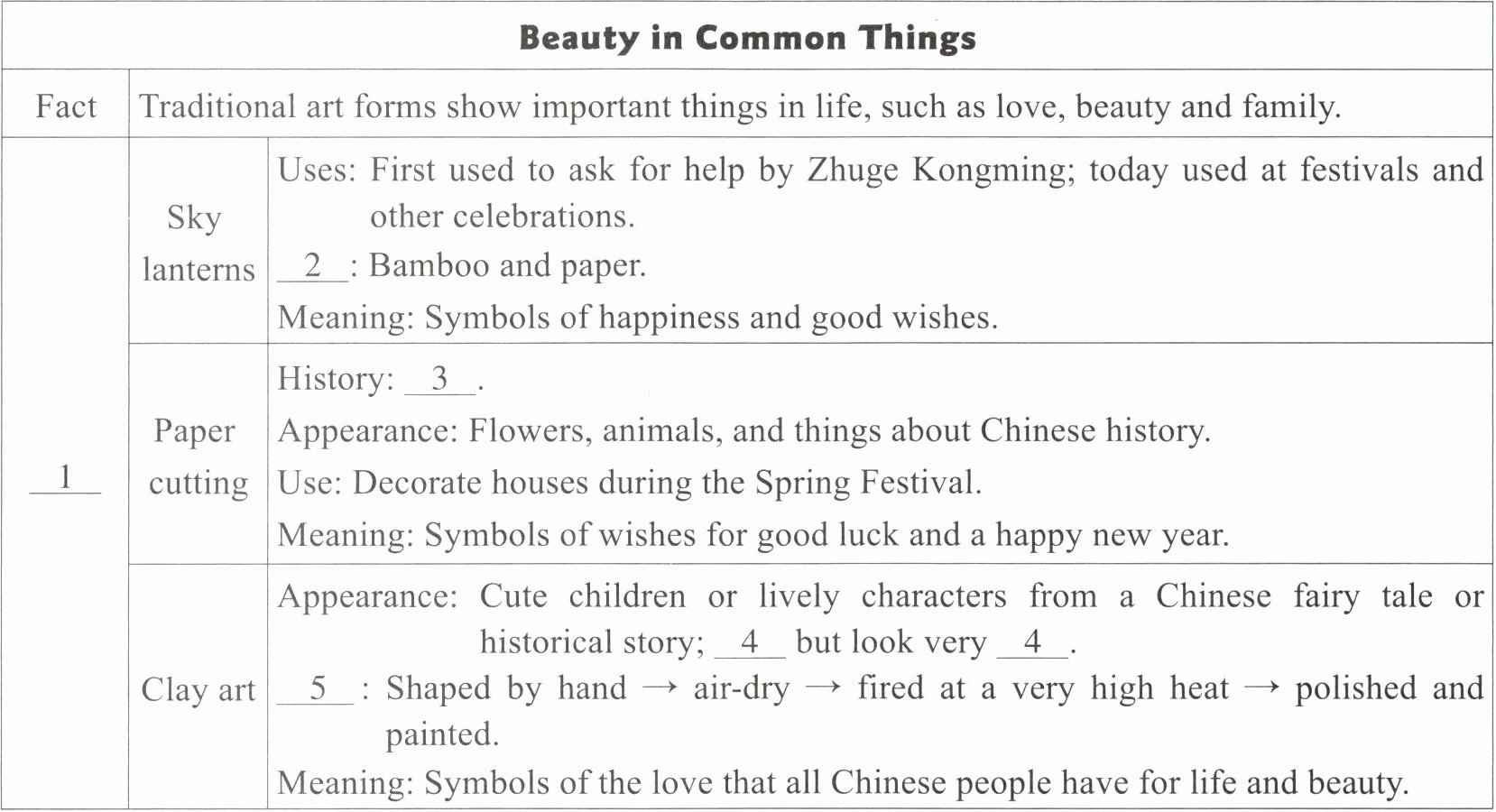
1. ______
2. ______
3. ______
4. ______
5. ______
| :---: | :---: | :---: |
| Fact | | Traditional art forms show important things in life, such as love, beauty and family. |
| | Sky lanterns | Uses: First used to ask for help by Zhuge Kongming; today used at festivals and other celebrations. 2
Materials
: Bamboo and paper. Meaning: Symbols of happiness and good wishes. || 1
Art forms
| Paper cutting | History: 3Over 1,500 years old
. Appearance: Flowers, animals, and things about Chinese history. Use: Decorate houses during the Spring Festival. Meaning: Symbols of wishes for good luck and a happy new year. || | Clay art | Appearance: Cute children or lively characters from a Chinese fairy tale or historical story; 4
simple; beautiful
. 5Process
: Shaped by hand → air-dry → fired at a very high heat → polished and painted. Meaning: Symbols of the love that all Chinese people have for life and beauty. |1. ______
Art forms
2. ______
Materials
3. ______
Over 1,500 years old
4. ______
simple; beautiful
5. ______
Process
答案:
【解析】:
这是一道根据课文内容补全图表的题目,考查对课文细节信息的理解和提取能力。解题的关键在于仔细阅读教材相关内容,准确找到与图表中各空对应的信息。
1. 对于第一个空,需要确定与“Paper cutting”对应的类别,从整体结构看,这里应该是大类别,结合常识和课文内容可知是“Art forms”。
2. 第二个空,根据“Sky lanterns”以及后面提到的“Bamboo and paper”,可知这里问的是制作材料,即“Materials”。
3. 第三个空,关于“Paper cutting”的历史,课文中应该有相关描述,找到对应内容填写即可。
4. 第四个空和第五个空,根据“Clay art”的描述“Appearance: Cute children or lively characters from a Chinese fairy tale or historical story; 4 but look very 4 .”,结合对陶艺特点的理解,可知是“simple”和“beautiful”;第五个空根据后面的制作步骤描述可知是“Process”。
【答案】:
1. Art forms
2. Materials
3. Over 1,500 years old
4. simple; beautiful
5. Process
这是一道根据课文内容补全图表的题目,考查对课文细节信息的理解和提取能力。解题的关键在于仔细阅读教材相关内容,准确找到与图表中各空对应的信息。
1. 对于第一个空,需要确定与“Paper cutting”对应的类别,从整体结构看,这里应该是大类别,结合常识和课文内容可知是“Art forms”。
2. 第二个空,根据“Sky lanterns”以及后面提到的“Bamboo and paper”,可知这里问的是制作材料,即“Materials”。
3. 第三个空,关于“Paper cutting”的历史,课文中应该有相关描述,找到对应内容填写即可。
4. 第四个空和第五个空,根据“Clay art”的描述“Appearance: Cute children or lively characters from a Chinese fairy tale or historical story; 4 but look very 4 .”,结合对陶艺特点的理解,可知是“simple”和“beautiful”;第五个空根据后面的制作步骤描述可知是“Process”。
【答案】:
1. Art forms
2. Materials
3. Over 1,500 years old
4. simple; beautiful
5. Process
二、根据首字母及句意写出完整单词。
1. Ice, snow and steam (水蒸气) are all different
2. After
3. Be careful! The
4. It took the workers two years to
5. At the festival, we can see many
6. Young people are
7. Could I use your
1. Ice, snow and steam (水蒸气) are all different
forms
of water.2. After
polishing
his glasses, he put them on and then continued to read.3. Be careful! The
heat
from the fire will burn your hand.4. It took the workers two years to
complete
the new bridge.5. At the festival, we can see many
balloons
in the sky.6. Young people are
lively
and active. They can accept new ideas very quickly.7. Could I use your
scissors
? I need to cut some paper to make a kite for my brother.
答案:
1. forms
2. polishing
3. heat
4. complete
5. balloons
6. lively
7. scissors
2. polishing
3. heat
4. complete
5. balloons
6. lively
7. scissors
Chinese knots, a symbol of traditional Chinese art, have a history of over 1,000 years. Coming in different kinds of shapes and colors, they 1.
Chinese knots 2.
are seen as
symbols of good luck, reunion, love, etc. So during traditional festivals and important events, they are easy to find.Chinese knots 2.
are made of
ropes of different colors. However, red ropes are most widely chosen. Chinese knots can be made 3. by hand
easily. What you need is just enough ropes. 4. To turn sth. into
Chinese knots, first, fold the rope in half and pinch (拧) the folded center to make a loop. Next cross the right rope over the left to form a simple knot. Then repeat to make a second knot 5. on top of
the first. Finally, adjust (调整) the loops to finish your works.
答案:
1. are seen as
2. are made of
3. by hand
4. To turn sth. into
5. on top of
2. are made of
3. by hand
4. To turn sth. into
5. on top of
( ) 1. Why does yunjin have a high collecting value?
( ) 2. What does the underlined word complex in Paragraph 2 mean?
( ) 3. Why did the Chinese government set up Nanjing Yunjin Research Institute?
( ) 4. Which can be the best title for the passage?
C
( ) 2. What does the underlined word complex in Paragraph 2 mean?
B
( ) 3. Why did the Chinese government set up Nanjing Yunjin Research Institute?
C
( ) 4. Which can be the best title for the passage?
C
答案:
【解析】:
这是一道英语阅读理解题,主要考查学生对英文短文内容的理解能力,以及对细节信息的提取和推理判断能力。题目包含四个选择题,每个题目都围绕短文内容展开,需要学生仔细阅读短文,根据短文中的信息进行作答。
1. 第一题是细节理解题,需要找到云锦具有高收藏价值的原因。根据短文第一段“The materials used in yunjin are valuable (贵重的), such as silk, gold and silver, resulting in its high collecting value.”可知,云锦使用贵重的材料制成,因此具有高收藏价值。
2. 第二题是词义猜测题,需要根据上下文推测“complex”一词的含义。根据短文第二段“The process is so long and complex that it takes two people all day to make a 5 cm-long brocade.”可知,制作云锦的过程既长又复杂,需要两个人一整天才能制作出5厘米长的锦缎。因此,“complex”在这里的意思是“复杂的,困难的”。
3. 第三题是细节理解题,需要找到中国政府成立南京云锦研究所的原因。根据短文最后一段“To pass down the skills of making yunjin, the Chinese government set up Nanjing Yunjin Research Institute in 1957”可知,中国政府成立南京云锦研究所的目的是为了传承云锦制作技艺。
4. 第四题是主旨大意题,需要选出最适合作为短文标题的选项。根据短文内容可知,本文主要介绍了云锦这种中国丝绸布料的象征,包括其历史、制作过程、用途以及传承等方面的内容。因此,最适合作为标题的选项是“The Greatest Symbol of Chinese Silk Cloth”。
【答案】:
1. C
2. B
3. C
4. C
这是一道英语阅读理解题,主要考查学生对英文短文内容的理解能力,以及对细节信息的提取和推理判断能力。题目包含四个选择题,每个题目都围绕短文内容展开,需要学生仔细阅读短文,根据短文中的信息进行作答。
1. 第一题是细节理解题,需要找到云锦具有高收藏价值的原因。根据短文第一段“The materials used in yunjin are valuable (贵重的), such as silk, gold and silver, resulting in its high collecting value.”可知,云锦使用贵重的材料制成,因此具有高收藏价值。
2. 第二题是词义猜测题,需要根据上下文推测“complex”一词的含义。根据短文第二段“The process is so long and complex that it takes two people all day to make a 5 cm-long brocade.”可知,制作云锦的过程既长又复杂,需要两个人一整天才能制作出5厘米长的锦缎。因此,“complex”在这里的意思是“复杂的,困难的”。
3. 第三题是细节理解题,需要找到中国政府成立南京云锦研究所的原因。根据短文最后一段“To pass down the skills of making yunjin, the Chinese government set up Nanjing Yunjin Research Institute in 1957”可知,中国政府成立南京云锦研究所的目的是为了传承云锦制作技艺。
4. 第四题是主旨大意题,需要选出最适合作为短文标题的选项。根据短文内容可知,本文主要介绍了云锦这种中国丝绸布料的象征,包括其历史、制作过程、用途以及传承等方面的内容。因此,最适合作为标题的选项是“The Greatest Symbol of Chinese Silk Cloth”。
【答案】:
1. C
2. B
3. C
4. C
查看更多完整答案,请扫码查看

