

 搜索
搜索
第39页
- 第1页
- 第2页
- 第3页
- 第4页
- 第5页
- 第6页
- 第7页
- 第8页
- 第9页
- 第10页
- 第11页
- 第12页
- 第13页
- 第14页
- 第15页
- 第16页
- 第17页
- 第18页
- 第19页
- 第20页
- 第21页
- 第22页
- 第23页
- 第24页
- 第25页
- 第26页
- 第27页
- 第28页
- 第29页
- 第30页
- 第31页
- 第32页
- 第33页
- 第34页
- 第35页
- 第36页
- 第37页
- 第38页
- 第39页
- 第40页
- 第41页
- 第42页
- 第43页
- 第44页
- 第45页
- 第46页
- 第47页
- 第48页
- 第49页
- 第50页
- 第51页
- 第52页
- 第53页
- 第54页
- 第55页
- 第56页
- 第57页
- 第58页
- 第59页
- 第60页
- 第61页
- 第62页
- 第63页
- 第64页
- 第65页
- 第66页
- 第67页
- 第68页
1. 下列过程与水解反应无关的是 (
A.热的纯碱溶液去除油脂
B.重油在高温、高压和催化剂作用下转化为小分子烃
C.蛋白质在酶的作用下转化为氨基酸
D.向沸水中滴入饱和$ FeCl_3 $溶液制备$ Fe(OH)_3 $胶体
B
)A.热的纯碱溶液去除油脂
B.重油在高温、高压和催化剂作用下转化为小分子烃
C.蛋白质在酶的作用下转化为氨基酸
D.向沸水中滴入饱和$ FeCl_3 $溶液制备$ Fe(OH)_3 $胶体
答案:
B
2. 某小组进行实验,向 10 mL 蒸馏水中加入$ 0.4 g I_2,$充分振荡,溶液呈浅棕色,再加入 0.2 g 锌粒,溶液颜色加深;最终紫黑色晶体消失,溶液褪色。已知$ I_3⁻(aq)$为棕色,下列关于颜色变化的解释错误的是 (
|选项|颜色变化|解释|
|A|溶液呈浅棕色|$I_2 $在水中溶解度较小|
|B|溶液颜色加深|发生了反应$: I_2 + I⁻ ⇌ I_3⁻$|
|C|紫黑色晶体消失|$I_2(aq)$的消耗使溶解平衡$ I_2(s) ⇌ I_2(aq)$右移|
|D|溶液褪色|Zn 与有色物质发生了置换反应|
D
)|选项|颜色变化|解释|
|A|溶液呈浅棕色|$I_2 $在水中溶解度较小|
|B|溶液颜色加深|发生了反应$: I_2 + I⁻ ⇌ I_3⁻$|
|C|紫黑色晶体消失|$I_2(aq)$的消耗使溶解平衡$ I_2(s) ⇌ I_2(aq)$右移|
|D|溶液褪色|Zn 与有色物质发生了置换反应|
答案:
D
3. 常温下,下列有关电解质溶液的说法正确的是 (
$A. H_2SO_3 $溶液中加入固体 NaOH 后离子浓度一定是$ c(H_2SO_3) > c(HSO_3⁻) > c(SO_3^2⁻)$
B. 20.0 mL 0.2 mol/L HF 溶液中加入 10.0 mL 0.2 mol/L NaOH 溶液后 pH = 5,则 HF 的$ Kₐ > 10⁻^5$
B. 20.0 mL 0.2 mol/L HF 溶液中加入 10.0 mL 0.2 mol/L NaOH 溶液后 pH = 5,则 HF 的$ Kₐ > 10⁻^5$
C. 用 0.1 mol/L 氨水滴定 10 mL 浓度均为 0.1 mol/L 的 HCl 和$ CH_3COOH $的混合液,当溶液呈中性时,氨水滴入量大于$ 10 mL,c(NH_4⁺) < c(Cl⁻)$
D. 0.8 mol/L 氨水和$ 0.1 mol/L NH_4NO_3 $溶液等体积混合(溶液混合引起的体积变化可忽略$):c(NH_3·H_2O) + c(CO_3^2⁻) + c(OH⁻) = 0.3 mol/L + c(H_2CO_3) + c(H⁺)$
B
)$A. H_2SO_3 $溶液中加入固体 NaOH 后离子浓度一定是$ c(H_2SO_3) > c(HSO_3⁻) > c(SO_3^2⁻)$
B. 20.0 mL 0.2 mol/L HF 溶液中加入 10.0 mL 0.2 mol/L NaOH 溶液后 pH = 5,则 HF 的$ Kₐ > 10⁻^5$
B. 20.0 mL 0.2 mol/L HF 溶液中加入 10.0 mL 0.2 mol/L NaOH 溶液后 pH = 5,则 HF 的$ Kₐ > 10⁻^5$
C. 用 0.1 mol/L 氨水滴定 10 mL 浓度均为 0.1 mol/L 的 HCl 和$ CH_3COOH $的混合液,当溶液呈中性时,氨水滴入量大于$ 10 mL,c(NH_4⁺) < c(Cl⁻)$
D. 0.8 mol/L 氨水和$ 0.1 mol/L NH_4NO_3 $溶液等体积混合(溶液混合引起的体积变化可忽略$):c(NH_3·H_2O) + c(CO_3^2⁻) + c(OH⁻) = 0.3 mol/L + c(H_2CO_3) + c(H⁺)$
答案:
B 解析: A. $ \mathrm{H}_{2} \mathrm{SO}_{3} $溶液中加入固体$ \mathrm{NaOH} $,溶液中离子浓度与$ \mathrm{NaOH} $的加入量有关,所以无法确定溶液中离子浓度大小,选项 A 错误; B. $ 20.0 \mathrm{~mL} \ 0.2 \mathrm{~mol} \cdot \mathrm{L}^{-1} \mathrm{HF} $溶液中加入$ 10.0 \mathrm{~mL} \ 0.2 \mathrm{~mol} \cdot \mathrm{L}^{-1} \mathrm{NaOH} $溶液后,生成$ 0.002 \mathrm{~mol} \mathrm{NaF} $,剩余$ 0.002 \mathrm{~mol} \mathrm{HF} $,相当于等物质量浓度的$ \mathrm{NaF} $和$ \mathrm{HF} $混合,此时$ \mathrm{pH}=5 $,所以$ \mathrm{HF} $的电离程度大于$ \mathrm{F}^{-} $的水解,所以$ c\left(\mathrm{~F}^{-}\right)>c(\mathrm{HF}) $, $ K_{\mathrm{a}}=\frac{c\left(\mathrm{H}^{+}\right) \cdot c\left(\mathrm{~F}^{-}\right)}{c(\mathrm{HF})}=\frac{c\left(\mathrm{~F}^{-}\right)}{c(\mathrm{HF})} × 10^{-5}>10^{-5} $,选项 B 正确; C. 用$ 0.1 \mathrm{~mol} \cdot \mathrm{L}^{-1} $氨水滴定$ 10 \mathrm{~mL} $浓度均为$ 0.1 \mathrm{~mol} \cdot \mathrm{L}^{-1} $的$ \mathrm{HCl} $和$ \mathrm{CH}_{3} \mathrm{COOH} $的混合液,当溶液呈中性时,此时$ c\left(\mathrm{H}^{+}\right)=c\left(\mathrm{OH}^{-}\right) $,溶液中阳离子还有$ \mathrm{NH}_{4}^{+} $,阴离子还有$ \mathrm{Cl}^{-} $和$ \mathrm{CH}_{3} \mathrm{COO}^{-} $,根据电荷守恒可知,$ c\left(\mathrm{NH}_{4}^{+}\right)=c\left(\mathrm{Cl}^{-}\right)+c\left(\mathrm{CH}_{3} \mathrm{COO}^{-}\right) $,所以$ c\left(\mathrm{NH}_{4}^{+}\right)>c\left(\mathrm{Cl}^{-}\right) $,选项 C 错误; D. $ 0.8 \mathrm{~mol} \cdot \mathrm{L}^{-1} $氨水和$ 0.2 \mathrm{~mol} \cdot \mathrm{L}^{-1} \mathrm{NH}_{4} \mathrm{HCO}_{3} $溶液等体积混合,根据物料守恒有$ c\left(\mathrm{NH}_{3} \cdot \mathrm{H}_{2} \mathrm{O}\right)+c\left(\mathrm{NH}_{4}^{+}\right)=5\left[c\left(\mathrm{CO}_{3}^{2-}\right)+c\left(\mathrm{H}_{2} \mathrm{CO}_{3}\right)+c\left(\mathrm{HCO}_{3}^{-}\right)\right] $,根据电荷守恒有$ c\left(\mathrm{NH}_{4}^{+}\right)+c\left(\mathrm{H}^{+}\right)=2 c\left(\mathrm{CO}_{3}^{2-}\right)+c\left(\mathrm{HCO}_{3}^{-}\right)+c\left(\mathrm{OH}^{-}\right) $,两式相减消$ c\left(\mathrm{NH}_{4}^{+}\right) $为$ c\left(\mathrm{NH}_{3} \cdot \mathrm{H}_{2} \mathrm{O}\right)+c\left(\mathrm{OH}^{-}\right)=3 c\left(\mathrm{CO}_{3}^{2-}\right)+5 c\left(\mathrm{H}_{2} \mathrm{CO}_{3}\right)+4 c\left(\mathrm{HCO}_{3}^{-}\right)+c\left(\mathrm{H}^{+}\right) $,两边加上$ c\left(\mathrm{CO}_{3}^{2-}\right) $有$ c\left(\mathrm{NH}_{3} \cdot \mathrm{H}_{2} \mathrm{O}\right)+c\left(\mathrm{OH}^{-}\right)+c\left(\mathrm{CO}_{3}^{2-}\right)=4 c\left(\mathrm{CO}_{3}^{2-}\right)+5 c\left(\mathrm{H}_{2} \mathrm{CO}_{3}\right)+4 c\left(\mathrm{HCO}_{3}^{-}\right)+c\left(\mathrm{H}^{+}\right) $,混合后含 C 元素的物质的量浓度为$ c\left(\mathrm{CO}_{3}^{2-}\right)+c\left(\mathrm{HCO}_{3}^{-}\right)+c\left(\mathrm{H}_{2} \mathrm{CO}_{3}\right)=0.1 \mathrm{~mol} \cdot \mathrm{L}^{-1} $,带入得,$ c\left(\mathrm{NH}_{3} \cdot \mathrm{H}_{2} \mathrm{O}\right)+c\left(\mathrm{CO}_{3}^{2-}\right)+c\left(\mathrm{OH}^{-}\right)=0.4 \mathrm{~mol} \cdot \mathrm{L}^{-1}+c\left(\mathrm{H}_{2} \mathrm{CO}_{3}\right)+c\left(\mathrm{H}^{+}\right) $,选项 D 错误。
4. 常温下,向$ 0.1 mol·L⁻^1 $的$ H_3PO_4 $溶液中滴入 NaOH 溶液,随着 pH 变化溶液中浓度最大的含磷微粒如图所示。
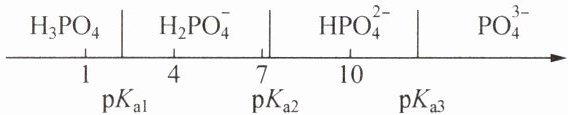
下列说法正确的是 (
$A. pH = pKₐ_2 + 1 $时$,10c(H_2PO_4⁻) = c(HPO_4^2⁻)$
$B. 2pH = pKₐ_1 + pKₐ_2 $时$,c(H_2PO_4⁻) > c(H_3PO_4) > c(HPO_4^2⁻)$
$C. pH = pKₐ_1 $时$,c(H⁺) = c(H_2PO_4⁻) + 2c(HPO_4^2⁻) + 3c(PO_4^3⁻) + c(OH⁻)$
D. 若用$ 0.5 mol·L⁻^1 $的$ H_3PO_4 $溶液进行实验$,pKₐ_1 $将向左移动
下列说法正确的是 (
A
)$A. pH = pKₐ_2 + 1 $时$,10c(H_2PO_4⁻) = c(HPO_4^2⁻)$
$B. 2pH = pKₐ_1 + pKₐ_2 $时$,c(H_2PO_4⁻) > c(H_3PO_4) > c(HPO_4^2⁻)$
$C. pH = pKₐ_1 $时$,c(H⁺) = c(H_2PO_4⁻) + 2c(HPO_4^2⁻) + 3c(PO_4^3⁻) + c(OH⁻)$
D. 若用$ 0.5 mol·L⁻^1 $的$ H_3PO_4 $溶液进行实验$,pKₐ_1 $将向左移动
答案:
A 解析: A. $ 10 c\left(\mathrm{H}_{2} \mathrm{PO}_{4}^{-}\right)=c\left(\mathrm{HPO}_{4}^{2-}\right) $时,$ K_{\mathrm{a} 2}=\frac{c\left(\mathrm{HPO}_{4}^{2-}\right) c\left(\mathrm{H}^{+}\right)}{c\left(\mathrm{H}_{2} \mathrm{PO}_{4}^{-}\right)}=\frac{10 c\left(\mathrm{H}_{2} \mathrm{PO}_{4}^{-}\right) c\left(\mathrm{H}^{+}\right)}{c\left(\mathrm{H}_{2} \mathrm{PO}_{4}^{-}\right)}=10 c\left(\mathrm{H}^{+}\right) $,则$ \mathrm{pH}=\mathrm{p} K_{\mathrm{a} 2}+1 $, A 正确; B. $ 2 \mathrm{pH}=\mathrm{p} K_{\mathrm{a} 1}+\mathrm{p} K_{\mathrm{a} 2} $时,$ \mathrm{pH}=\frac{\mathrm{p} K_{\mathrm{a} 1}+\mathrm{p} K_{\mathrm{a} 2}}{2} $,此时溶液中主要含有$ \mathrm{H}_{2} \mathrm{PO}_{4}^{-} $,溶液显酸性,其电离程度大于水解程度,故$ c\left(\mathrm{H}_{2} \mathrm{PO}_{4}^{-}\right)>c\left(\mathrm{HPO}_{4}^{2-}\right)>c\left(\mathrm{H}_{3} \mathrm{PO}_{4}\right) $, B 错误; C. $ \mathrm{pH}=\mathrm{p} K_{\mathrm{a} 1} $时,根据电荷守恒可知,$ c\left(\mathrm{H}^{+}\right)+c\left(\mathrm{Na}^{+}\right)=c\left(\mathrm{H}_{2} \mathrm{PO}_{4}^{-}\right)+2 c\left(\mathrm{HPO}_{4}^{2-}\right)+3 c\left(\mathrm{PO}_{4}^{3-}\right)+c\left(\mathrm{OH}^{-}\right) $, C 错误; D. 平衡常数只受温度的影响,故$ \mathrm{p} K_{\mathrm{a} 1} $不移动,D 错误。
5. 室温下,通过下列实验探究 NaHS 溶液的性质。
实验 1: 向$ 0.1 mol·L⁻^1 NaHS $溶液中滴加几滴酚酞试剂,溶液变红
实验 2: 向$ 0.1 mol·L⁻^1 NaHS $溶液中通入过量氯气,无淡黄色沉淀产生
实验 3: 向$ 0.1 mol·L⁻^1 NaHS $溶液中加入等体积$ 0.1 mol·L⁻^1 NaOH $溶液充分混合
实验 4: 向$ 0.1 mol·L⁻^1 NaHS $溶液中滴加过量$ CuSO_4 $溶液,产生黑色沉淀
下列有关说法正确的是 (
A.实验 1 证明$: Kₐ_2(H_2S) > K_w / Kₐ_1(H_2S)$
B.实验 2 证明: HS⁻ 不能被$ Cl_2 $氧化
C.实验 3 中所得溶液中$: c(Na⁺) - c(S^2⁻) - c(HS⁻) - c(H_2S) = 0.05 mol·L⁻^1$
D.实验 4 反应静置后的上层清液中有$ c(Cu^2⁺)·c(S^2⁻) > K_sp(CuS)$
实验 1: 向$ 0.1 mol·L⁻^1 NaHS $溶液中滴加几滴酚酞试剂,溶液变红
实验 2: 向$ 0.1 mol·L⁻^1 NaHS $溶液中通入过量氯气,无淡黄色沉淀产生
实验 3: 向$ 0.1 mol·L⁻^1 NaHS $溶液中加入等体积$ 0.1 mol·L⁻^1 NaOH $溶液充分混合
实验 4: 向$ 0.1 mol·L⁻^1 NaHS $溶液中滴加过量$ CuSO_4 $溶液,产生黑色沉淀
下列有关说法正确的是 (
C
)A.实验 1 证明$: Kₐ_2(H_2S) > K_w / Kₐ_1(H_2S)$
B.实验 2 证明: HS⁻ 不能被$ Cl_2 $氧化
C.实验 3 中所得溶液中$: c(Na⁺) - c(S^2⁻) - c(HS⁻) - c(H_2S) = 0.05 mol·L⁻^1$
D.实验 4 反应静置后的上层清液中有$ c(Cu^2⁺)·c(S^2⁻) > K_sp(CuS)$
答案:
C 解析:$ K_{\mathrm{a} 2}\left(\mathrm{H}_{2} \mathrm{~S}\right) $是$ \mathrm{HS}^{-} $的电离平衡常数,表示$ \mathrm{HS}^{-} $电离程度,$ K_{\mathrm{b}}=\frac{K_{\mathrm{w}}}{K_{\mathrm{a} 1}\left(\mathrm{H}_{2} \mathrm{~S}\right)} $是$ \mathrm{HS}^{-} $的水解平衡常数,表示$ \mathrm{HS}^{-} $水解程度,实验 1 证明溶液呈碱性,说明$ \mathrm{HS}^{-} $的水解程度大于电离程度,则$ K_{\mathrm{a} 2}\left(\mathrm{H}_{2} \mathrm{~S}\right)<K_{\mathrm{w}} / K_{\mathrm{a} 1}\left(\mathrm{H}_{2} \mathrm{~S}\right) $, A 项错误; 氯气具有强氧化性,$ \mathrm{NaHS} $溶液中通入过量氯气时,氯气把$ \mathrm{HS}^{-} $氧化成硫酸根离子,因此无淡黄色沉淀产生, B 项错误; 设两溶液按体积$ V $混合,混合后,根据$ \mathrm{Na} $元素守恒得$ c\left(\mathrm{Na}^{+}\right)=\frac{0.1 \mathrm{~mol} \cdot \mathrm{L}^{-1} × V+0.1 \mathrm{~mol} \cdot \mathrm{L}^{-1} × V}{2 V}=0.1 \mathrm{~mol} \cdot \mathrm{L}^{-1} $,根据 S 元素守恒得$ c\left(\mathrm{~S}^{-}\right)+c\left(\mathrm{HS}^{-}\right)+c\left(\mathrm{H}_{2} \mathrm{~S}\right)=\frac{0.1 \mathrm{~mol} \cdot \mathrm{L}^{-1} × V}{2 V}=0.05 \mathrm{~mol} \cdot \mathrm{L}^{-1} $,故$ c\left(\mathrm{Na}^{+}\right)-c\left(\mathrm{~S}^{-}\right)-c\left(\mathrm{HS}^{-}\right)-c\left(\mathrm{H}_{2} \mathrm{~S}\right)=0.05 \mathrm{~mol} \cdot \mathrm{L}^{-1} $, C 项正确; 实验 4 反应静置后的上层清液为饱和溶液,刚好达到平衡状态,有$ c\left(\mathrm{Cu}^{2+}\right) \cdot c\left(\mathrm{~S}^{2-}\right)=K_{\mathrm{sp}}(\mathrm{CuS}) $, D 项错误。
查看更多完整答案,请扫码查看

