

 搜索
搜索
第56页
- 第2页
- 第3页
- 第4页
- 第5页
- 第6页
- 第7页
- 第8页
- 第9页
- 第10页
- 第11页
- 第12页
- 第13页
- 第14页
- 第15页
- 第16页
- 第17页
- 第18页
- 第19页
- 第20页
- 第21页
- 第22页
- 第23页
- 第24页
- 第25页
- 第26页
- 第27页
- 第28页
- 第29页
- 第30页
- 第31页
- 第32页
- 第33页
- 第34页
- 第35页
- 第36页
- 第37页
- 第38页
- 第39页
- 第40页
- 第41页
- 第42页
- 第43页
- 第44页
- 第45页
- 第46页
- 第47页
- 第48页
- 第49页
- 第50页
- 第51页
- 第52页
- 第53页
- 第54页
- 第55页
- 第56页
- 第57页
- 第58页
- 第59页
- 第60页
- 第61页
- 第62页
- 第63页
- 第64页
- 第65页
- 第66页
- 第67页
- 第68页
Ⅰ.根据句意及汉语注释完成单词
1. What are people supposed to do when they meet in
2. I
3. Tom is used to
4. Maria was sad because she made some
5. Guess what! The plane took off on time but I arrived an hour later than I
1. What are people supposed to do when they meet in
Japan
?2. I
greeted
(和……打招呼)my teacher with a smile on my way to school this morning.3. Tom is used to
kissing
(亲吻)his mother on the face every night before going to bed.4. Maria was sad because she made some
mistakes
(错误)at the dinner party last night.5. Guess what! The plane took off on time but I arrived an hour later than I
expected
.
答案:
1.Japan 2.greeted 3.kissing 4.mistakes 5.expected
Ⅱ.用方框中所给词语的适当形式填空,每词仅用一次
invite custom hand bow be supposed to
1. People
2. It's difficult to get used to different
3. Everyone except Mary
4. Shaking
5. The patient full of tears in his eyes said thanks and
invite custom hand bow be supposed to
1. People
are supposed to
hug when they meet each other in some areas.2. It's difficult to get used to different
customs
in different countries.3. Everyone except Mary
was invited
to the party last week.4. Shaking
hands
with each other is common in some important meetings.5. The patient full of tears in his eyes said thanks and
bowed
to the doctors and nurses who saved his life.
答案:
1.are supposed to 2.customs 3.was invited 4.hands 5.bowed
Ⅲ.用合适的词完成句子,每空限填一词
1. You are expected to arrive
2. Yesterday, I cooked dinner on my own
3. —In my country, we greet people by bowing. How
—We also bow.
4. We worked hard to prepare. The performance finally started
5. You can make a call first
1. You are expected to arrive
at
7:30 every morning.2. Yesterday, I cooked dinner on my own
for
the first time.3. —In my country, we greet people by bowing. How
about
you?—We also bow.
4. We worked hard to prepare. The performance finally started
on
time.5. You can make a call first
if/when
you are not sure whether your friends are at home or not.
答案:
1.at 2.for 3.about 4.on 5.if/when
Ⅳ.语法填空
Eating habits are different in different countries. The Chinese have a saying, "Eat good things for breakfast, eat a big meal for lunch, 1.
Eating habits are different in different countries. The Chinese have a saying, "Eat good things for breakfast, eat a big meal for lunch, 1.
but/and
eat less for dinner." Many Americans agree that one should start the day with a good breakfast, but their 2. ideas
(idea) about lunch and dinner are different. Most Americans only give 3. themselves
(they) a short time for lunch. So they eat a small lunch. 4. After/When/If
they finish work, they will have more time to eat a big dinner. Also, a nice dinner at home 5. with
all the family members talking about their day is a good way to take a rest after a long day of work. Eating at restaurants is also different. In China, people like to talk and laugh while they 6. are eating
(eat). Very often you can hear people talking and laughing loudly, and they are just having 7. a
good time. In America, it is not like this. Americans want a quiet place 8. to enjoy
(someone) a good meal. They want to be far away from the 9. noisy
(noise) outside world. If someone is talking loudly, the manager of the restaurant will look at him or her 10. angrily
(angry). If some people are talking too loudly, the manager of the restaurant may come out and ask them to be quiet.
答案:
1.but/and 2.ideas 3.themselves 4.After/When/If 5.with 6.are eating 7.a8.to enjoy 9.noisy 10.angrily
Ⅴ.阅读理解
Every year, thousands of children arrive in Britain. We ask some new arrivals what they like best about their new lives and what's different from home.
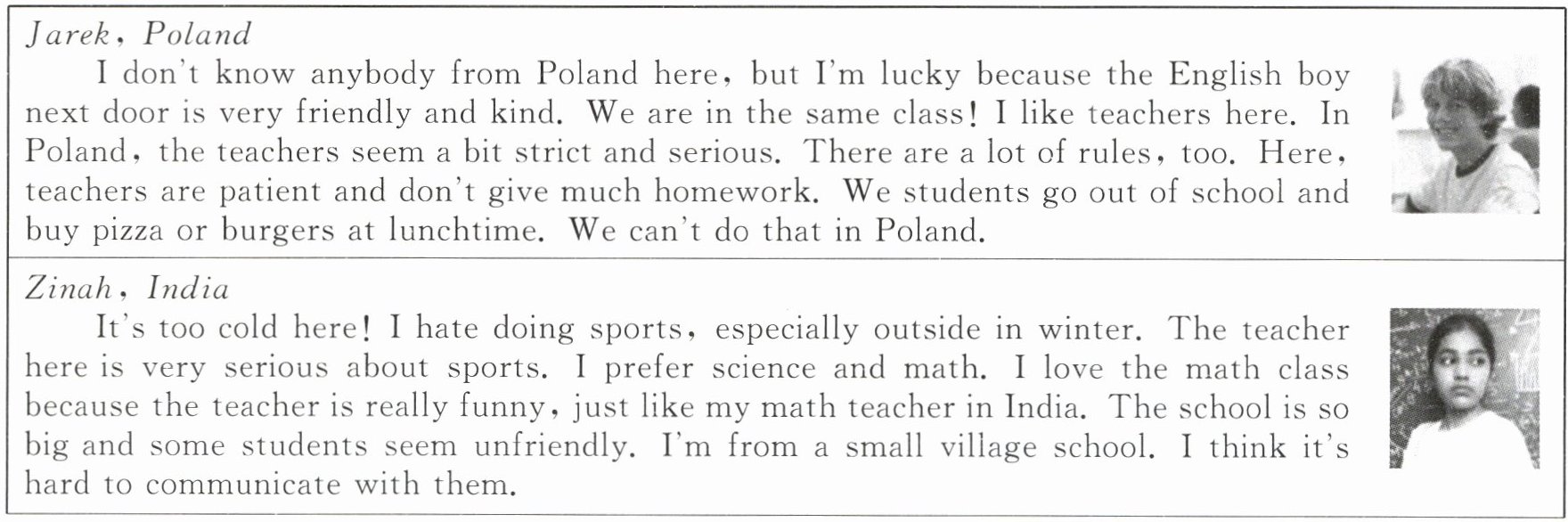

(
A. Luck.
B. Zinah.
C. Jarek.
D. Daisy.
(
A. Cold.
B. Strict.
C. Patient.
D. Humorous.
(
A. A sports magazine.
B. An education website.
C. A geography textbook.
D. A business newspaper.
Every year, thousands of children arrive in Britain. We ask some new arrivals what they like best about their new lives and what's different from home.
(
C
)1. Among the above four children, who probably likes the new school life best?A. Luck.
B. Zinah.
C. Jarek.
D. Daisy.
(
D
)2. In Zinah's eyes, what might her math teacher in India be like?A. Cold.
B. Strict.
C. Patient.
D. Humorous.
(
B
)3. Where is the text probably taken from?A. A sports magazine.
B. An education website.
C. A geography textbook.
D. A business newspaper.
答案:
1.C 2.D3.B
查看更多完整答案,请扫码查看

