

 搜索
搜索
第28页
- 第2页
- 第3页
- 第4页
- 第5页
- 第6页
- 第7页
- 第8页
- 第9页
- 第10页
- 第11页
- 第12页
- 第13页
- 第14页
- 第15页
- 第16页
- 第17页
- 第18页
- 第19页
- 第20页
- 第21页
- 第22页
- 第23页
- 第24页
- 第25页
- 第26页
- 第27页
- 第28页
- 第29页
- 第30页
- 第31页
- 第32页
- 第33页
- 第34页
- 第35页
- 第36页
- 第37页
- 第38页
- 第39页
- 第40页
- 第41页
- 第42页
- 第43页
- 第44页
- 第45页
- 第46页
- 第47页
- 第48页
- 第49页
- 第50页
- 第51页
- 第52页
- 第53页
- 第54页
- 第55页
- 第56页
- 第57页
- 第58页
- 第59页
- 第60页
- 第61页
- 第62页
- 第63页
- 第64页
- 第65页
- 第66页
- 第67页
- 第68页
Ⅰ. 根据句意及汉语注释完成单词
1. There are all kinds of machines and
2. I'd like to live in the
3. Many students have
4. Mr. Li speaks good French because he used to live in
5. You can see many beautiful
1. There are all kinds of machines and
products
(产品)in the factory.2. I'd like to live in the
local
(当地)people's houses while traveling.3. Many students have
mobile
(可移动)phones to keep in touch with their parents.4. Mr. Li speaks good French because he used to live in
France
(法国)with his uncle.5. You can see many beautiful
handbags
(小手提包)in Miss Lin's Shop.
答案:
1.products 2.local 3.mobile 4.France 5.handbags
Ⅱ. 用方框中所给词语的适当形式填空,每词仅用一次
go see make no matter interest
1. Is the cup
2.
3. Since they live on the same floor,they can hardly avoid
4. Tim found it
5. Before
go see make no matter interest
1. Is the cup
made
of bamboo?2.
No matter
what John may say,I won't believe him.3. Since they live on the same floor,they can hardly avoid
seeing
each other.4. Tim found it
interesting
to learn to skate.5. Before
going
into a Japanese house,we'd better take off our shoes.
答案:
1.made 2.No matter 3.seeing 4.interesting 5.going
Ⅲ. 用合适的介词完成句子,每空限填一词
1. Uncle Wang is good
2. Linda bought a scarf
3. The police are continuing their search
4. Jean,how do you feel
5.
1. Uncle Wang is good
at
inventing useful machines.2. Linda bought a scarf
for
her mother last week.3. The police are continuing their search
for
the killer.4. Jean,how do you feel
about
the things made in America?5.
In
fact,Carla does everything more carefully than her brother.
答案:
1.at 2.for 3.for 4.about 5.In
Ⅳ. 词汇运用
阅读下面短文,根据首字母或括号内所给汉语注释写出单词的正确形式(每空一词)。
When you come across a Chinese character(汉字)that you don't know,what do you do? You might look it 1. u
To learn pinyin,the first step is to know how to pronounce each letter in pinyin 4.
But most importantly,what you need is good feedback. A good partner is someone who can point out your mistakes no 7. m
If you are studying by yourself,buy a small dictionary for 9.
阅读下面短文,根据首字母或括号内所给汉语注释写出单词的正确形式(每空一词)。
When you come across a Chinese character(汉字)that you don't know,what do you do? You might look it 1. u
up
in a dictionary and find its pinyin. Pinyin is 2. wwidely
taught in China to help schoolkids learn Chinese. It is 3. known/famous
(出名)as a useful tool for Chinese people to learn standard pronunciation in their early education.To learn pinyin,the first step is to know how to pronounce each letter in pinyin 4.
correctly/properly/right
(正确)and the meaning of the tone marks. Then you have to 5. practice/practise
(练习)again and again. Start with single syllables(单音节)and do that a lot and then go on to the next 6. process
(过程)— syllable pairs. Slowly move on to larger groups.But most importantly,what you need is good feedback. A good partner is someone who can point out your mistakes no 7. m
matter
when you make a mistake. Find a Chinese whose pronunciation is quite perfect. If you take Chinese classes,the teacher will probably give you some 8. materials
(材料)to read every class. Read them carefully.If you are studying by yourself,buy a small dictionary for 9.
everyday
(日常)use. Meanwhile,try to meet native Chinese people and ask them to give you feedback so that you can 10. aavoid
some mistakes. Otherwise,try to be self-critical and listen very carefully. Good listening is helpful for its true pronunciation.
答案:
1.up 2.widely 3.known/famous 4.correctly/properly/right 5.practice/practise 6.process 7.matter 8.materials 9.everyday 10.avoid
Ⅴ. 阅读理解
The seven key elements (元素)
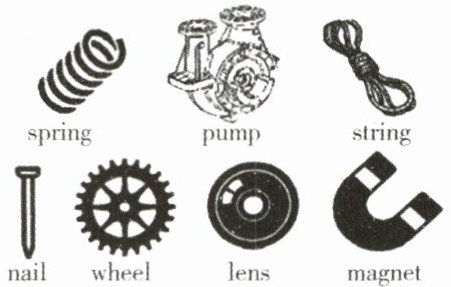
When I was about five,like most children,I was curious(好奇的)about everything. Sitting in front of my crayons,I wanted to "discover" what was inside them. So I cut one into two. Sadly,I found nothing but more crayons. When I was a little older,I was interested in the inner parts of pens,televisions and so on. In fact,my childhood interest in the building blocks(构成要素)of things led me to work in engineering.
I spent six years as part of the team that designed a tall building in Europe. After having explored the big,I decided to turn to the small. I realized it was the seven key elements that form the basis of the modern world:the spring,the pump,the string,the nail,the wheel,the lens and the magnet. They have created and changed our technology,and they have also had a big influence on our history,society,communication,transportation,arts and culture. For example,the speaker on my phone through which I could hear the voices depended on a magnet. Even as I thought about more larger objects — factories,cars,satellites and so on — again and again,I came back to the same seven key elements.
Look around yourself and ask questions about what you see:awaken(唤起)that childhood curiosity. Hopefully,this will encourage you to explore the world of engineering,and this is something that will lead you to form a better understanding of the building blocks of our world.
(
A. By using sayings.
B. By asking questions.
C. By listing numbers.
D. By sharing experiences.
(
A. The inner parts of pens.
B. The seven key elements.
C. The speaker on the phone.
D. The public transportation.
(
A. They help us design tall buildings.
B. They are used to make a lot of money.
C. They encourage people to study hard.
D. They play an important role in the world.
(
A. To introduce what forms the modern world.
B. To tell how important childhood curiosity is for the future.
C. To show what success he has got in the field of engineering.
D. To express how deeply he loves the building blocks of things.
The seven key elements (元素)
When I was about five,like most children,I was curious(好奇的)about everything. Sitting in front of my crayons,I wanted to "discover" what was inside them. So I cut one into two. Sadly,I found nothing but more crayons. When I was a little older,I was interested in the inner parts of pens,televisions and so on. In fact,my childhood interest in the building blocks(构成要素)of things led me to work in engineering.
I spent six years as part of the team that designed a tall building in Europe. After having explored the big,I decided to turn to the small. I realized it was the seven key elements that form the basis of the modern world:the spring,the pump,the string,the nail,the wheel,the lens and the magnet. They have created and changed our technology,and they have also had a big influence on our history,society,communication,transportation,arts and culture. For example,the speaker on my phone through which I could hear the voices depended on a magnet. Even as I thought about more larger objects — factories,cars,satellites and so on — again and again,I came back to the same seven key elements.
Look around yourself and ask questions about what you see:awaken(唤起)that childhood curiosity. Hopefully,this will encourage you to explore the world of engineering,and this is something that will lead you to form a better understanding of the building blocks of our world.
(
D
)1. How does the writer begin the text?A. By using sayings.
B. By asking questions.
C. By listing numbers.
D. By sharing experiences.
(
B
)2. What does the underlined phrase "the small" in Paragraph 2 refer to?A. The inner parts of pens.
B. The seven key elements.
C. The speaker on the phone.
D. The public transportation.
(
D
)3. What can we know about the seven elements according to the text?A. They help us design tall buildings.
B. They are used to make a lot of money.
C. They encourage people to study hard.
D. They play an important role in the world.
(
B
)4. What is the writer's purpose in writing this text?A. To introduce what forms the modern world.
B. To tell how important childhood curiosity is for the future.
C. To show what success he has got in the field of engineering.
D. To express how deeply he loves the building blocks of things.
答案:
1.D 2.B 3.D 4.B
查看更多完整答案,请扫码查看

