

 搜索
搜索
第46页
- 第1页
- 第2页
- 第3页
- 第4页
- 第5页
- 第6页
- 第7页
- 第8页
- 第9页
- 第10页
- 第11页
- 第12页
- 第13页
- 第14页
- 第15页
- 第16页
- 第17页
- 第18页
- 第19页
- 第20页
- 第21页
- 第22页
- 第23页
- 第24页
- 第25页
- 第26页
- 第27页
- 第28页
- 第29页
- 第30页
- 第31页
- 第32页
- 第33页
- 第34页
- 第35页
- 第36页
- 第37页
- 第38页
- 第39页
- 第40页
- 第41页
- 第42页
- 第43页
- 第44页
- 第45页
- 第46页
- 第47页
- 第48页
- 第49页
- 第50页
- 第51页
- 第52页
- 第53页
- 第54页
- 第55页
- 第56页
- 第57页
- 第58页
- 第59页
- 第60页
- 第61页
- 第62页
- 第63页
- 第64页
- 第65页
- 第66页
- 第67页
- 第68页
- 第69页
- 第70页
- 第71页
- 第72页
- 第73页
- 第74页
- 第75页
- 第76页
- 第77页
- 第78页
- 第79页
- 第80页
- 第81页
- 第82页
- 第83页
- 第84页
- 第85页
- 第86页
- 第87页
- 第88页
- 第89页
- 第90页
- 第91页
- 第92页
- 第93页
- 第94页
- 第95页
- 第96页
- 第97页
- 第98页
- 第99页
- 第100页
- 第101页
- 第102页
- 第103页
- 第104页
- 第105页
- 第106页
- 第107页
- 第108页
- 第109页
- 第110页
- 第111页
- 第112页
- 第113页
- 第114页
- 第115页
- 第116页
- 第117页
一、选词或用所给词的适当形式填空。
1. The Chinese
2. He usually watches news
3. Can you
4. Many years ago, Lily
5. Put away your toys, or Mum
1. The Chinese
invented
(did/invented) paper.2. He usually watches news
on
(in/on) the Internet. But sometimes he listens to the radio ______for
(of/for) news.3. Can you
spell
(speak/spell) the word “change” and make a sentence ______with
(with/to) it?4. Many years ago, Lily
walked
(walk) to work. But now she usually ______takes
(take) the metro to work.5. Put away your toys, or Mum
will get
(get) ______angry
(angry).
答案:
1. invented
2. on;for
3. spell;with
4. walked;takes
5. will get;angry
解析
1. 句意为“中国人发明了纸”,“发明”用 invent,动作发生在过去,用过去式 invented;did 是助动词,此处需实义动词,故填 invented。
2. “在互联网上”用固定搭配 on the Internet;“听收音机获取新闻”用 for 表目的,故填 on;for。
3. 前半句“拼写单词‘change’”用 spell(拼写),speak 后接语言;后半句“用它造句”用 with(用),to 表方向,故填 spell;with。
4. 前半句“许多年前”用一般过去时,walk 的过去式为 walked;后半句“现在通常”用一般现在时,主语 she 是第三人称单数,take 变 takes,故填 walked;takes。
5. 前半句是祈使句表条件,后半句用一般将来时 will get;“变得生气”用 get angry(angry 是形容词作表语),故填 will get;angry。
二、选择合适的选项完成句子,有一项多余。
A. look out of B. laugh at C. move away
D. all over the world E. climbed up
F. look out
1. At last, I
2. With the Internet, we can make friends from
3. Don’t
4. Let’s
5. I
A. look out of B. laugh at C. move away
D. all over the world E. climbed up
F. look out
1. At last, I
E
the mountain. The air was very fresh there.2. With the Internet, we can make friends from
D
.3. Don’t
B
him. He is just a little boy. Everyone will make mistakes(错误).4. Let’s
C
the old desk and put a new one here.5. I
A
the door and see a dog playing outside.
答案:
1.E 2.D 3.B 4.C 5.A
解析
1. 句意为“最后,我爬上了山”,“爬山”用 climbed up,选 E。
2. “通过互联网,我们能交到来自全世界的朋友”,all over the world 表示“全世界”,选 D。
3. 由“每个人都会犯错”可知,此处是“不要嘲笑他”,laugh at 表示“嘲笑”,选 B。
4. “把旧桌子移开,放一张新的在这里”,move away 表示“移开”,选 C。
5. “我朝门外看,看到一只狗在外面玩”,look out of 表示“朝……外看”,选 A。
三、文化意识图文匹配。
(
(
(
(
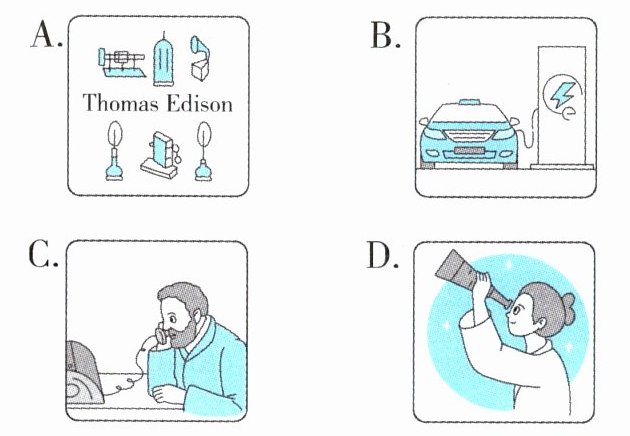
(
D
)1. Wang Zhenyi was a great Chinese scientist. She studied about the stars.(
C
)2. Mr Bell invented the telephone.(
A
)3. He invented the light bulb. He made over 1,000 inventions in his life.(
B
)4. Now China is playing a leading role in electric cars.
答案:
1.D 2.C 3.A 4.B
四、根据首字母及上下文提示,补全对话和短文。
1. A: Bobby, don’t look
B: Yes, Miss Fox.
A:
B: It was great fun.
A:
B: I
2. 传统文化 Once upon a time, there was a man. He thought he was very
One day, he saw a nice
1. A: Bobby, don’t look
out
of the window. Listen to
me carefully.B: Yes, Miss Fox.
A:
How
was
your weekend?B: It was great fun.
A:
What
did you do
?B: I
made
a cake with my mum. Then we visited
my grandparents and gave
the cake to them
.2. 传统文化 Once upon a time, there was a man. He thought he was very
clever
, but he always did foolish things.One day, he saw a nice
bell
on his neighbour’s(邻居的) door. He liked/loved
it very much. He wanted to take
it to his home, but people might(可能) hear the bell. The man thought hard
. Then he had a “good” idea. The man covered(遮住) his ears and touched the bell. The bell rang. The neighbour opened
the door and asked angrily, “What are you doing here?”
答案:
1.out;to;How was;What;do;made;visited;gave;them
第一空(out):结合固定搭配“look out of”,表示“朝……外看”,符合“不要朝窗外看”的语境,故填 out。
第二空(to):“listen”是不及物动词,后接宾语需加介词“to”,“listen to sb.”表示“听某人说”,为固定用法,故填 to。
第三、四空(How was):根据答句“It was great fun.”可知,问句是询问周末过得如何,用“How was your weekend?”,时态与答句一致用一般过去时,故填 How was。
第五、六空(What;do):答句描述了具体做的事情,问句需询问“你做了什么”,用“What did you do?”,助动词 did 后接动词原形,故填 What;do。
第七空(made):结合首字母 m 和“a cake”,可知是“做蛋糕”,用动词 make,动作发生在过去,用一般过去时 made,故填 made。
第八空(visited):首字母 v 搭配“my grandparents”,表示“看望祖父母”,用 visit 的过去式 visited,故填 visited。
第九空(gave):“give sth. to sb.”表示“把某物给某人”,结合语境“把蛋糕给祖父母”,用 give 的过去式 gave,故填 gave。
第十空(them):指代前文的“my grandparents”,作介词 to 的宾语,用宾格 them,故填 them。
2. 传统文化 Once upon a time, there was a man. He thought he was very c______, but he always did foolish things.
One day, he saw a nice b______ on his neighbour’s(邻居的) door. He l______ it very much. He wanted to t______ it to his home, but people might(可能) hear the bell. The man thought h______. Then he had a “good” idea. The man covered(遮住) his ears and touched the bell. The bell rang. The neighbour o______ the door and asked angrily, “What are you doing here?”
One day, he saw a nice b______ on his neighbour’s(邻居的) door. He l______ it very much. He wanted to t______ it to his home, but people might(可能) hear the bell. The man thought h______. Then he had a “good” idea. The man covered(遮住) his ears and touched the bell. The bell rang. The neighbour o______ the door and asked angrily, “What are you doing here?”
答案:
2.clever;bell;liked/loved;take;hard;opened
第一空:由转折词 but 后的“foolish things”(傻事)可知,前文需对应“聪明的”,首字母 c 开头,故填 clever。
第二空:结合后文多次出现的“The bell”,以及“on his neighbour’s door”(邻居门上),可知是“铃铛”,首字母 b 开头,故填 bell。
第三空:根据“wanted to take it to his home”(想把它带回家),可知他“非常喜欢这只铃铛”,用 like/love 的过去式 liked/loved,符合过去时态语境,故填 liked/loved。
第四空:“want to do sth.”表示“想要做某事”,结合语境“想把铃铛带回家”,首字母 t 开头,用动词原形 take,故填 take。
第五空:“think hard”是固定搭配,表示“仔细思考”,符合“他认真思考后想出主意”的语境,首字母 h 开头,故填 hard。
第六空:结合“the door”和“asked angrily”,可知是“邻居打开门”,用 open 的过去式 opened,符合过去时态,故填 opened。
查看更多完整答案,请扫码查看

