

 搜索
搜索
第23页
- 第1页
- 第2页
- 第3页
- 第4页
- 第5页
- 第6页
- 第7页
- 第8页
- 第9页
- 第10页
- 第11页
- 第12页
- 第13页
- 第14页
- 第15页
- 第16页
- 第17页
- 第18页
- 第19页
- 第20页
- 第21页
- 第22页
- 第23页
- 第24页
- 第25页
- 第26页
- 第27页
- 第28页
- 第29页
- 第30页
- 第31页
- 第32页
- 第33页
- 第34页
- 第35页
- 第36页
- 第37页
- 第38页
- 第39页
- 第40页
- 第41页
- 第42页
- 第43页
- 第44页
- 第45页
- 第46页
- 第47页
- 第48页
- 第49页
- 第50页
- 第51页
- 第52页
- 第53页
- 第54页
- 第55页
- 第56页
- 第57页
- 第58页
- 第59页
- 第60页
- 第61页
- 第62页
- 第63页
- 第64页
- 第65页
- 第66页
- 第67页
- 第68页
- 第69页
- 第70页
- 第71页
- 第72页
- 第73页
- 第74页
- 第75页
- 第76页
- 第77页
- 第78页
- 第79页
- 第80页
- 第81页
- 第82页
- 第83页
- 第84页
- 第85页
- 第86页
- 第87页
- 第88页
- 第89页
- 第90页
- 第91页
- 第92页
- 第93页
- 第94页
- 第95页
- 第96页
- 第97页
- 第98页
- 第99页
- 第100页
- 第101页
- 第102页
- 第103页
- 第104页
- 第105页
- 第106页
- 第107页
- 第108页
- 第109页
- 第110页
- 第111页
- 第112页
- 第113页
- 第114页
- 第115页
- 第116页
- 第117页
- 第118页
- 第119页
五、(2025·南通市启秀中学月考)阅读理解。
新素养 文化认同 ① Foreigners like growing flowers in the garden and enjoy the nice smell in spring. However, Chinese people prefer growing vegetables and get a harvest (收获) in autumn. For Chinese, bottles, even plastic bags are perfect for growing vegetables.
② It's said that there is a "vegetable gene(基因)" in every Chinese people. After all, they have farmed for thousands of years and gained rich experience in growing vegetables.
③ A group of parents of Chinese students once grew vegetables at Yale University in the USA. This area used to be covered with weeds(杂草). To help change the situation, these Chinese parents worked together and finally turned weeds into vegetables.
④ Africa is such a poor place. Many hard-working and kind-hearted Chinese workers went there to help. They helped build roads as well as taught Africans how to farm. All kinds of fruit and vegetables have been grown in Africa.
⑤ The soldiers(士兵) on the islands of the South China Sea also created a vegetable garden through their own efforts(努力). It used to be difficult for the soldiers to eat fresh vegetables on the islands. But recently, they harvested 750 kg of vegetables on sandy beaches. Everyone was excited.
⑥ With the development of the science and technology in China, Chinese people have grown vegetables all over the world, from Europe to Africa. The days of planting potatoes on Mars(火星) will not be far away.
1. How does the writer start the passage?
A. By listing some numbers.
B. By asking some questions.
C. By telling different jokes(玩笑).
D. By comparing different facts.
2. Which of the following is NOT the fact to show Chinese people's "vegetable gene"?
A. Chinese people have much farming experience for planting.
B. Chinese people have already planted potatoes in outer space, such as on Mars.
C. Chinese soldiers on the islands of the South China Sea harvested 750 kg of vegetables.
D. Parents of Chinese students at Yale University turned weeds into vegetables.
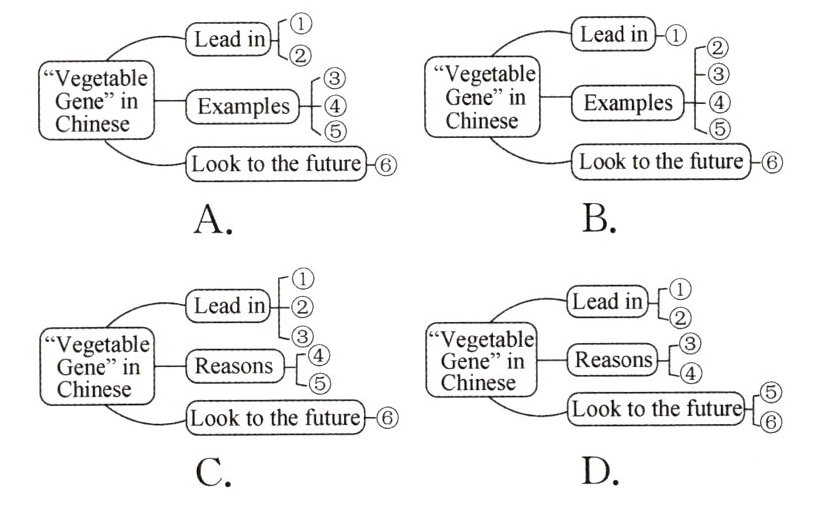
3. 新考法 篇章结构 Which of the following best shows the structure of the passage?
A.
B.
C.
D.
4. 新考法 情感基调 What tone(语气) does the writer use in this passage?
A. Polite.
B. Proud(自豪的).
C. Sad.
D. Bored.
新素养 文化认同 ① Foreigners like growing flowers in the garden and enjoy the nice smell in spring. However, Chinese people prefer growing vegetables and get a harvest (收获) in autumn. For Chinese, bottles, even plastic bags are perfect for growing vegetables.
② It's said that there is a "vegetable gene(基因)" in every Chinese people. After all, they have farmed for thousands of years and gained rich experience in growing vegetables.
③ A group of parents of Chinese students once grew vegetables at Yale University in the USA. This area used to be covered with weeds(杂草). To help change the situation, these Chinese parents worked together and finally turned weeds into vegetables.
④ Africa is such a poor place. Many hard-working and kind-hearted Chinese workers went there to help. They helped build roads as well as taught Africans how to farm. All kinds of fruit and vegetables have been grown in Africa.
⑤ The soldiers(士兵) on the islands of the South China Sea also created a vegetable garden through their own efforts(努力). It used to be difficult for the soldiers to eat fresh vegetables on the islands. But recently, they harvested 750 kg of vegetables on sandy beaches. Everyone was excited.
⑥ With the development of the science and technology in China, Chinese people have grown vegetables all over the world, from Europe to Africa. The days of planting potatoes on Mars(火星) will not be far away.
1. How does the writer start the passage?
A. By listing some numbers.
B. By asking some questions.
C. By telling different jokes(玩笑).
D. By comparing different facts.
2. Which of the following is NOT the fact to show Chinese people's "vegetable gene"?
A. Chinese people have much farming experience for planting.
B. Chinese people have already planted potatoes in outer space, such as on Mars.
C. Chinese soldiers on the islands of the South China Sea harvested 750 kg of vegetables.
D. Parents of Chinese students at Yale University turned weeds into vegetables.
3. 新考法 篇章结构 Which of the following best shows the structure of the passage?
A.
B.
C.
D.
4. 新考法 情感基调 What tone(语气) does the writer use in this passage?
A. Polite.
B. Proud(自豪的).
C. Sad.
D. Bored.
答案:
1. D 【解析】根据第一段中“Foreigners like growing flowers in the garden... However, Chinese people prefer growing vegetables and get a harvest in autumn.”可知,外国人喜欢种花,然而中国人喜欢种菜,作者通过对比这两种事实来引出下文内容。
2. B 【解析】根据第六段中“The days of planting potatoes on Mars will not be far away.”可知,在外太空种植马铃薯并未实现,B 项与事实不符。
3. A 【解析】通读全文可知,第一、二两段引出中国人有“蔬菜基因”这一话题;紧接着第三至第五段通过列举三个事实证明中国人的“蔬菜基因”;第六段总结全文,展望未来,阐明科技的发展助力中国人在各地种菜。因此 A 项符合文章结构。
4. B 【解析】本文介绍了中国人有“蔬菜基因”,并讲述了中国人在不同地方种菜的成就,如改造荒地、援助非洲、海岛蔬菜丰收,字里行间都透露出对中国人的种菜能力感到自豪。
2. B 【解析】根据第六段中“The days of planting potatoes on Mars will not be far away.”可知,在外太空种植马铃薯并未实现,B 项与事实不符。
3. A 【解析】通读全文可知,第一、二两段引出中国人有“蔬菜基因”这一话题;紧接着第三至第五段通过列举三个事实证明中国人的“蔬菜基因”;第六段总结全文,展望未来,阐明科技的发展助力中国人在各地种菜。因此 A 项符合文章结构。
4. B 【解析】本文介绍了中国人有“蔬菜基因”,并讲述了中国人在不同地方种菜的成就,如改造荒地、援助非洲、海岛蔬菜丰收,字里行间都透露出对中国人的种菜能力感到自豪。
查看更多完整答案,请扫码查看

