

 搜索
搜索
第57页
- 第2页
- 第3页
- 第4页
- 第5页
- 第6页
- 第7页
- 第8页
- 第9页
- 第10页
- 第11页
- 第12页
- 第13页
- 第14页
- 第15页
- 第16页
- 第17页
- 第18页
- 第19页
- 第20页
- 第21页
- 第22页
- 第23页
- 第24页
- 第25页
- 第26页
- 第27页
- 第28页
- 第29页
- 第30页
- 第31页
- 第32页
- 第33页
- 第34页
- 第35页
- 第36页
- 第37页
- 第38页
- 第39页
- 第40页
- 第41页
- 第42页
- 第43页
- 第44页
- 第45页
- 第46页
- 第47页
- 第48页
- 第49页
- 第50页
- 第51页
- 第52页
- 第53页
- 第54页
- 第55页
- 第56页
- 第57页
- 第58页
- 第59页
- 第60页
- 第61页
- 第62页
- 第63页
- 第64页
- 第65页
- 第66页
- 第67页
- 第68页
- 第69页
- 第70页
- 第71页
- 第72页
- 第73页
- 第74页
- 第75页
- 第76页
- 第77页
- 第78页
- 第79页
- 第80页
- 第81页
- 第82页
- 第83页
- 第84页
- 第85页
- 第86页
- 第87页
- 第88页
- 第89页
- 第90页
- 第91页
- 第92页
- 第93页
- 第94页
- 第95页
- 第96页
- 第97页
- 第98页
- 第99页
- 第100页
- 第101页
- 第102页
- 第103页
- 第104页
- 第105页
- 第106页
- 第107页
- 第108页
- 第109页
- 第110页
- 第111页
- 第112页
- 第113页
- 第114页
- 第115页
- 第116页
- 第117页
- 第118页
- 第119页
- 第120页
- 第121页
- 第122页
- 第123页
- 第124页
- 第125页
- 第126页
- 第127页
- 第128页
- 第129页
- 第130页
- 第131页
- 第132页
- 第133页
- 第134页
- 第135页
- 第136页
- 第137页
- 第138页
- 第139页
- 第140页
- 第141页
- 第142页
- 第143页
- 第144页
- 第145页
- 第146页
- 第147页
- 第148页
- 第149页
- 第150页
- 第151页
- 第152页
- 第153页
- 第154页
- 第155页
- 第156页
- 第157页
- 第158页
- 第159页
- 第160页
Ⅰ.短文阅读(每小题 2 分,满分 6 分)
When Justin Tong was a child, other kids felt sorry for him. His parents always had him doing lots of housework, such as carrying out the rubbish and sending newspapers. But when he grew up, he was better off than his childhood friends and lived a happier and healthier life.
This is the finding of a 40 - year study that followed the lives of 456 children in London. It showed that the children who had worked hard in childhood had a richer and a happier future. “Children who worked in the home or community gained competence (能力) and came to feel they were worthwhile members of society,” said Daniel Brown, the psychologist(心理学家) who made the discovery. “And because they felt good about themselves, others felt good about them.”
Brown’s study followed these children in great detail (细节). Interviews were repeated at ages 25, 31 and 47. Under Brown, the researchers compared the children’s mental - health scores with their childhood - activity scores. Points were awarded for part - time jobs, housework, effort in school, and ability to deal with problems.
Working is important at any age. Childhood activities help a child develop responsibility independence(独立), confidence and competence—the underpinnings(基础) of emotional(情感的) health.
Yet work isn’t everything. As Tolstoy once said, “One can live magnificently(出色地) in this world if one knows how to work and how to love, to work for the person one loves and to love one’s work.”
(
A. He enjoyed a happy life.
B. He felt sorry for the other kids.
C. He always sold newspapers.
D. He seldom collected rubbish.
(
A. Children who enjoy happier and richer lives.
B. Children who work in the home or community.
C. Children who take part in Daniel Brown’s study.
D. Children who feel good about people around them.
(
A. By giving housework and praise(赞扬).
B. By interviewing and giving scores.
C. By setting goals and showing love.
D. By solving problems and testing them.
When Justin Tong was a child, other kids felt sorry for him. His parents always had him doing lots of housework, such as carrying out the rubbish and sending newspapers. But when he grew up, he was better off than his childhood friends and lived a happier and healthier life.
This is the finding of a 40 - year study that followed the lives of 456 children in London. It showed that the children who had worked hard in childhood had a richer and a happier future. “Children who worked in the home or community gained competence (能力) and came to feel they were worthwhile members of society,” said Daniel Brown, the psychologist(心理学家) who made the discovery. “And because they felt good about themselves, others felt good about them.”
Brown’s study followed these children in great detail (细节). Interviews were repeated at ages 25, 31 and 47. Under Brown, the researchers compared the children’s mental - health scores with their childhood - activity scores. Points were awarded for part - time jobs, housework, effort in school, and ability to deal with problems.
Working is important at any age. Childhood activities help a child develop responsibility independence(独立), confidence and competence—the underpinnings(基础) of emotional(情感的) health.
Yet work isn’t everything. As Tolstoy once said, “One can live magnificently(出色地) in this world if one knows how to work and how to love, to work for the person one loves and to love one’s work.”
(
A
)1. What do we know about Justin Tong?A. He enjoyed a happy life.
B. He felt sorry for the other kids.
C. He always sold newspapers.
D. He seldom collected rubbish.
(
B
)2. Who will probably succeed in the future according to Paragraph 2?A. Children who enjoy happier and richer lives.
B. Children who work in the home or community.
C. Children who take part in Daniel Brown’s study.
D. Children who feel good about people around them.
(
B
)3. How did Brown follow the children in his study?A. By giving housework and praise(赞扬).
B. By interviewing and giving scores.
C. By setting goals and showing love.
D. By solving problems and testing them.
答案:
Ⅰ.1.A 2.B 3.B
Ⅱ.任务型阅读(每小题 2 分,满分 6 分)
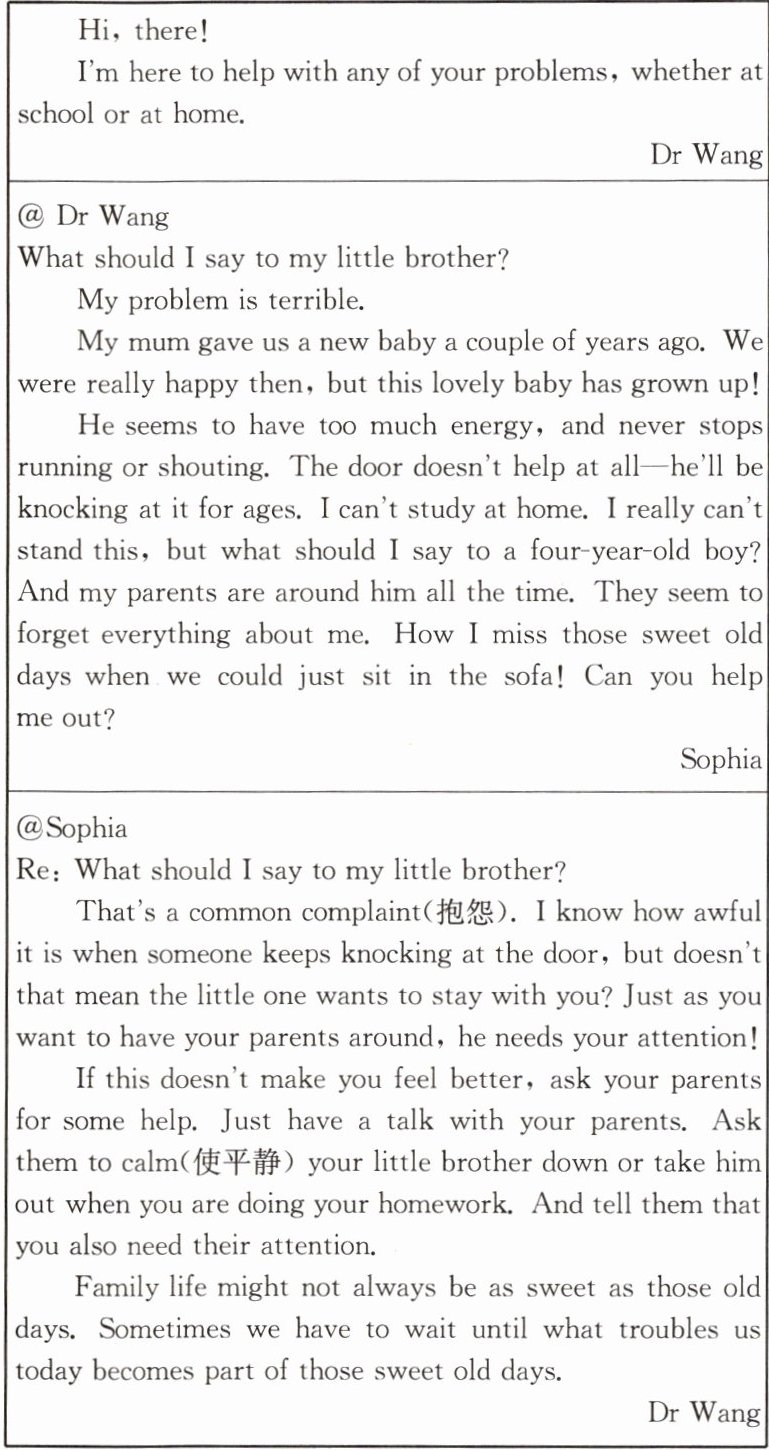
1. Was Sophia happy to have a little brother at first? (不超过 10 个词)
________
2. How old is Sophia’s little brother now? (不超过 10 个词)
________
3. What should Sophia ask her parents to do when she is doing her homework, according to Dr Wang? (不超过 10 个词)
________
1. Was Sophia happy to have a little brother at first? (不超过 10 个词)
________
2. How old is Sophia’s little brother now? (不超过 10 个词)
________
3. What should Sophia ask her parents to do when she is doing her homework, according to Dr Wang? (不超过 10 个词)
________
答案:
Ⅱ.1.Yes(, she was).
2.He’s four years old. /Four years old.
3.Calm her little brother down or take him out.
2.He’s four years old. /Four years old.
3.Calm her little brother down or take him out.
查看更多完整答案,请扫码查看

