

 搜索
搜索
第24页
- 第2页
- 第3页
- 第4页
- 第5页
- 第6页
- 第7页
- 第8页
- 第9页
- 第10页
- 第11页
- 第12页
- 第13页
- 第14页
- 第15页
- 第16页
- 第17页
- 第18页
- 第19页
- 第20页
- 第21页
- 第22页
- 第23页
- 第24页
- 第25页
- 第26页
- 第27页
- 第28页
- 第29页
- 第30页
- 第31页
- 第32页
- 第33页
- 第34页
- 第35页
- 第36页
- 第37页
- 第38页
- 第39页
- 第40页
- 第41页
- 第42页
- 第43页
- 第44页
- 第45页
- 第46页
- 第47页
- 第48页
- 第49页
- 第50页
- 第51页
- 第52页
- 第53页
- 第54页
- 第55页
- 第56页
- 第57页
- 第58页
- 第59页
- 第60页
- 第61页
- 第62页
- 第63页
- 第64页
- 第65页
- 第66页
- 第67页
- 第68页
- 第69页
- 第70页
- 第71页
- 第72页
- 第73页
- 第74页
- 第75页
- 第76页
- 第77页
- 第78页
- 第79页
- 第80页
- 第81页
- 第82页
- 第83页
- 第84页
- 第85页
- 第86页
- 第87页
- 第88页
- 第89页
- 第90页
- 第91页
- 第92页
- 第93页
- 第94页
- 第95页
- 第96页
- 第97页
- 第98页
- 第99页
- 第100页
- 第101页
- 第102页
- 第103页
- 第104页
- 第105页
- 第106页
- 第107页
- 第108页
- 第109页
- 第110页
- 第111页
- 第112页
- 第113页
- 第114页
- 第115页
- 第116页
- 第117页
- 第118页
- 第119页
- 第120页
- 第121页
- 第122页
- 第123页
- 第124页
- 第125页
- 第126页
- 第127页
- 第128页
- 第129页
- 第130页
- 第131页
- 第132页
- 第133页
- 第134页
- 第135页
- 第136页
- 第137页
- 第138页
- 第139页
- 第140页
- 第141页
- 第142页
- 第143页
- 第144页
- 第145页
- 第146页
- 第147页
- 第148页
- 第149页
- 第150页
- 第151页
- 第152页
- 第153页
- 第154页
- 第155页
- 第156页
- 第157页
- 第158页
- 第159页
- 第160页
Ⅰ. 完形填空(每小题 1 分,满分 10 分)
When you hear the word hero, you may think of someone like Mahatma Gandhi or Nelson Mandela. But there are also “everyday” heroes — they may not be well - known(众所周知的) to the public, but they do what they can to help 1 people's lives as well. Everyday heroes are normal(正常的) people who are working to make the world a better place. 2 them is Robert Lee.
Lee grew up in New York City. 3 his family was not rich, he learnt from a young age the importance of 4 the waste of food. When in college, he was part of a student group that gave out leftover(剩余的) food to homeless people. After he left university, Lee and a friend set up an organisation (组织) called Rescuing Leftover Cuisine (RLC). Its purpose is to collect 5 food from restaurants and send it for free to shelters(收容所) and food kitchens. Volunteers 6 the food from restaurants around the city and hand it out to those in need.
RLC operates simply. Using an app developed by Lee's team, restaurants 7 how much leftover food they have each day. Then volunteers are sent to fetch it.
So far, Lee and his team have successfully 8 over 150, 000 kilograms of food, serving almost 300, 000 9 to people who need them. Lee has shown that a 10 action(行动) can help people around us greatly.
(
B. share
C. improve
D. describe
(
B. Beside
C. Among
D. Opposite
(
B. As
C. When
D. Though
(
B. avoiding
C. valuing
D. training
(
B. cheap
C. uncooked
D. unsold
(
B. go over
C. pay for
D. throw away
(
B. notice
C. discuss
D. wonder
(
B. grown
C. lost
D. bought
(
B. meals
C. rooms
D. seats
(
B. secret
C. social
D. rude
When you hear the word hero, you may think of someone like Mahatma Gandhi or Nelson Mandela. But there are also “everyday” heroes — they may not be well - known(众所周知的) to the public, but they do what they can to help 1 people's lives as well. Everyday heroes are normal(正常的) people who are working to make the world a better place. 2 them is Robert Lee.
Lee grew up in New York City. 3 his family was not rich, he learnt from a young age the importance of 4 the waste of food. When in college, he was part of a student group that gave out leftover(剩余的) food to homeless people. After he left university, Lee and a friend set up an organisation (组织) called Rescuing Leftover Cuisine (RLC). Its purpose is to collect 5 food from restaurants and send it for free to shelters(收容所) and food kitchens. Volunteers 6 the food from restaurants around the city and hand it out to those in need.
RLC operates simply. Using an app developed by Lee's team, restaurants 7 how much leftover food they have each day. Then volunteers are sent to fetch it.
So far, Lee and his team have successfully 8 over 150, 000 kilograms of food, serving almost 300, 000 9 to people who need them. Lee has shown that a 10 action(行动) can help people around us greatly.
(
C
)1. A. interviewB. share
C. improve
D. describe
(
C
)2. A. UnderB. Beside
C. Among
D. Opposite
(
B
)3. A. IfB. As
C. When
D. Though
(
B
)4. A. acceptingB. avoiding
C. valuing
D. training
(
D
)5. A. coldB. cheap
C. uncooked
D. unsold
(
A
)6. A. pick upB. go over
C. pay for
D. throw away
(
A
)7. A. reportB. notice
C. discuss
D. wonder
(
A
)8. A. savedB. grown
C. lost
D. bought
(
B
)9. A. jobsB. meals
C. rooms
D. seats
(
A
)10. A. smallB. secret
C. social
D. rude
答案:
Ⅰ.1.C 2.C 3.B 4.B 5.D 6.A 7.A 8.A 9.B 10.A
Ⅱ. 图表阅读(每小题 2 分,满分 6 分)
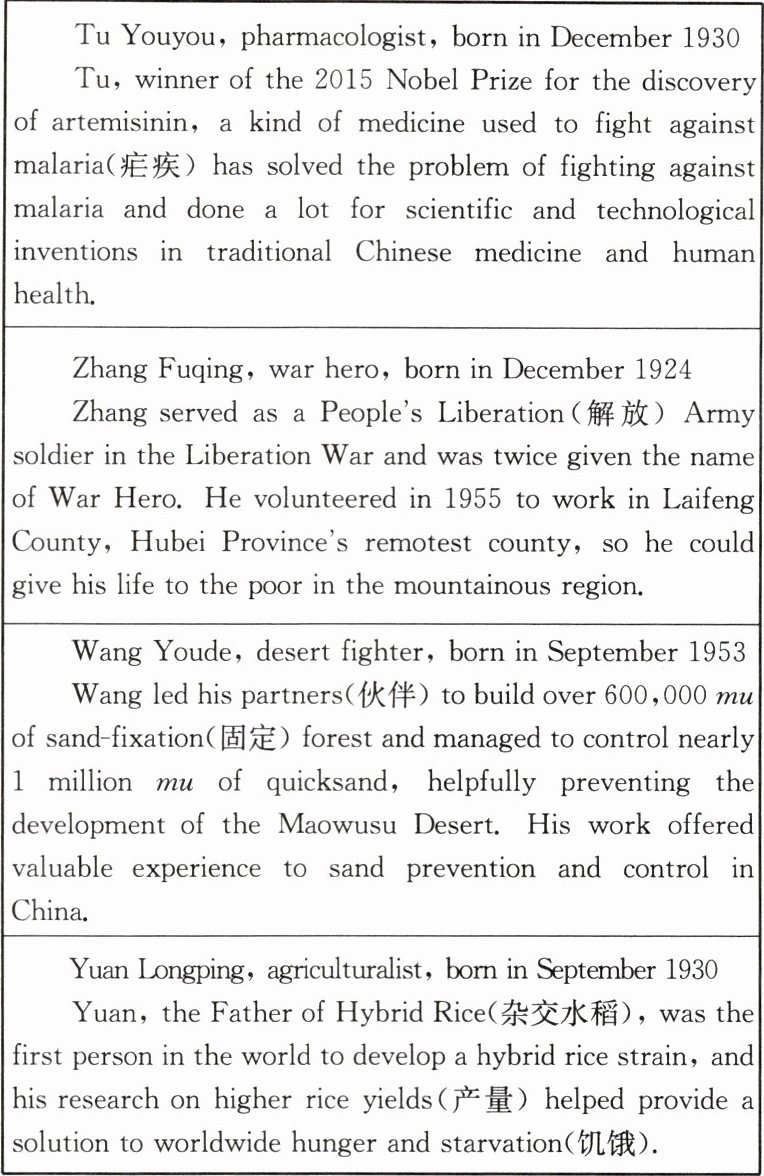
(
A. Discovering artemisinin.
B. Serving the people in the poor region.
C. Preventing and controlling sand.
D. Developing a hybrid rice strain.
(
A. He is doing a research on higher rice yields.
B. He is protecting the environment.
C. He is working on the inventions in human health.
D. He is trying to help poor people to be rich.
(
A. Zhang Fuqing is a desert fighter.
B. Tu Youyou is a war hero.
C. Wang Youde is the winner of the Nobel Prize.
D. Yuan Longping is the Father of Hybrid Rice.
(
A
)1. Which of the following is Tu Youyou's great achievement(成就)?A. Discovering artemisinin.
B. Serving the people in the poor region.
C. Preventing and controlling sand.
D. Developing a hybrid rice strain.
(
B
)2. What is Wang Youde doing for our country?A. He is doing a research on higher rice yields.
B. He is protecting the environment.
C. He is working on the inventions in human health.
D. He is trying to help poor people to be rich.
(
D
)3. Which is TRUE according to the passage?A. Zhang Fuqing is a desert fighter.
B. Tu Youyou is a war hero.
C. Wang Youde is the winner of the Nobel Prize.
D. Yuan Longping is the Father of Hybrid Rice.
答案:
Ⅱ.1.A 2.B 3.D
查看更多完整答案,请扫码查看

