

 搜索
搜索
2025年同步练习册山东人民出版社高中英语选择性必修第一册外研版B专版
注:目前有些书本章节名称可能整理的还不是很完善,但都是按照顺序排列的,请同学们按照顺序仔细查找。练习册 2025年同步练习册山东人民出版社高中英语选择性必修第一册外研版B专版 答案主要是用来给同学们做完题方便对答案用的,请勿直接抄袭。
第20页
- 第1页
- 第2页
- 第3页
- 第4页
- 第5页
- 第6页
- 第7页
- 第8页
- 第9页
- 第10页
- 第11页
- 第12页
- 第13页
- 第14页
- 第15页
- 第16页
- 第17页
- 第18页
- 第19页
- 第20页
- 第21页
- 第22页
- 第23页
- 第24页
- 第25页
- 第26页
- 第27页
- 第28页
- 第29页
- 第30页
- 第31页
- 第32页
- 第33页
- 第34页
- 第35页
- 第36页
- 第37页
- 第38页
- 第39页
- 第40页
- 第41页
- 第42页
- 第43页
- 第44页
- 第45页
- 第46页
- 第47页
- 第48页
- 第49页
- 第50页
- 第51页
- 第52页
- 第53页
- 第54页
- 第55页
- 第56页
- 第57页
- 第58页
- 第59页
- 第60页
- 第61页
- 第62页
- 第63页
- 第64页
- 第65页
- 第66页
- 第67页
- 第68页
- 第69页
- 第70页
- 第71页
- 第72页
- 第73页
- 第74页
- 第75页
- 第76页
- 第77页
- 第78页
- 第79页
- 第80页
- 第81页
- 第82页
- 第83页
- 第84页
- 第85页
- 第86页
- 第87页
- 第88页
- 第89页
- 第90页
- 第91页
- 第92页
- 第93页
- 第94页
- 第95页
- 第96页
- 第97页
- 第98页
- 第99页
- 第100页
○学以致用
假定你是李华,你的英国笔友Eric正在学习中国相声,他想请你为他介绍一位相声演员。请根据提示信息给他回信,向他介绍著名的相声演员马三立。
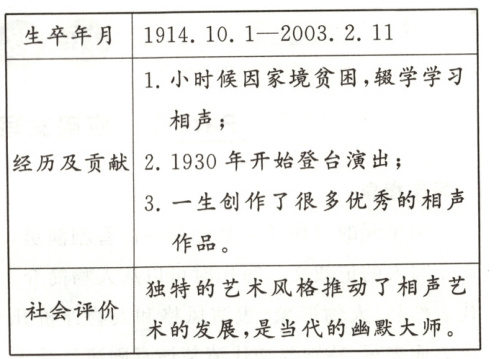
注意:1. 词数80左右;
2. 可以适当增加细节,以使行文连贯。
参考词汇:相声crosstalk
假定你是李华,你的英国笔友Eric正在学习中国相声,他想请你为他介绍一位相声演员。请根据提示信息给他回信,向他介绍著名的相声演员马三立。
注意:1. 词数80左右;
2. 可以适当增加细节,以使行文连贯。
参考词汇:相声crosstalk
Dear Eric,
I’m glad to hear that you’re interested in Chinese crosstalk and I’m writing to introduce Ma Sanli, one of the most famous Chinese performing artists of crosstalk.
Ma Sanli was born on October 1, 1914 and died on February 11, 2003. At an early age, he dropped out of school to learn crosstalk because of the poverty of his family. It was in 1930 that he started to perform on stage.
During his whole life, he created a large number of excellent works, many of which are still popular among people now. His unique style has a positive effect on the development of Chinese crosstalk and he is considered as a master of humour. You can appreciate his works on the Chinese artist website.
Wish you great progress in your learning of Chinese crosstalk.
Yours,
Li Hua
答案:
【参考范文】
Dear Eric,
I’m glad to hear that you’re interested in Chinese crosstalk and I’m writing to introduce Ma Sanli, one of the most famous Chinese performing artists of crosstalk.
Ma Sanli was born on October 1, 1914 and died on February 11, 2003. At an early age, he dropped out of school to learn crosstalk because of the poverty of his family. It was in 1930 that he started to perform on stage.
During his whole life, he created a large number of excellent works, many of which are still popular among people now. His unique style has a positive effect on the development of Chinese crosstalk and he is considered as a master of humour. You can appreciate his works on the Chinese artist website.
Wish you great progress in your learning of Chinese crosstalk.
Yours,
Li Hua
Dear Eric,
I’m glad to hear that you’re interested in Chinese crosstalk and I’m writing to introduce Ma Sanli, one of the most famous Chinese performing artists of crosstalk.
Ma Sanli was born on October 1, 1914 and died on February 11, 2003. At an early age, he dropped out of school to learn crosstalk because of the poverty of his family. It was in 1930 that he started to perform on stage.
During his whole life, he created a large number of excellent works, many of which are still popular among people now. His unique style has a positive effect on the development of Chinese crosstalk and he is considered as a master of humour. You can appreciate his works on the Chinese artist website.
Wish you great progress in your learning of Chinese crosstalk.
Yours,
Li Hua
阅读下面文章,完成任务。
I looked around at the other patients waiting to see the doctor. Maybe they all had more romantic plans for the evening on this special day, but for now the group seemed anti - social. Three people had their heads down, staring at cellphones. Another was absorbed in a magazine. The receptionist tapped at her computer. Everyone was in their own little world.
But I couldn't judge them for it. I would probably be buried in my cellphone too, if I hadn't forgotten to charge it before I left home. It would have been nice to strike up a conversation to pass the time on this day, a day of love and friendship. Instead I sat patiently in my plastic chair as a couple of new people took distant seats.
“Roberta? The doctor's ready for you,” the nurse called. At least I'll have some kind c human connection, I thought.
My checkup went well. I breezed out of the office to my little Honda in a space right out front. I got in and turned the key. Nothing. Oh, no. Not again. I'd sent the car to the garage several times already for this very problem and thought it had finally been fixed.
I reached for my cellphone to call AAA—then remembered. It was dead, like my car. I would have to use the phone inside. A few people glanced up when I came back into the waiting room, then quickly went back to what they were doing. I went straight to the reception desk, but the receptionist was not there. So I turned back to the people in the waiting room.
“I wouldn't normally do this,” I said to the group, hoping that I sounded apologetic. Several people turned towards me to listen. “But my car won't start...”
The nurse popped her head into the room. “You in trouble, Roberta?” she said. “I'll go and take a look.” I followed the nurse outside. As I passed through the door. I felt someone was behind me.
任务一:阅读文章,回答问题。
What does the article mainly talk about?
_________
任务二:梳理故事情节,完成故事山(Story Mountain)。
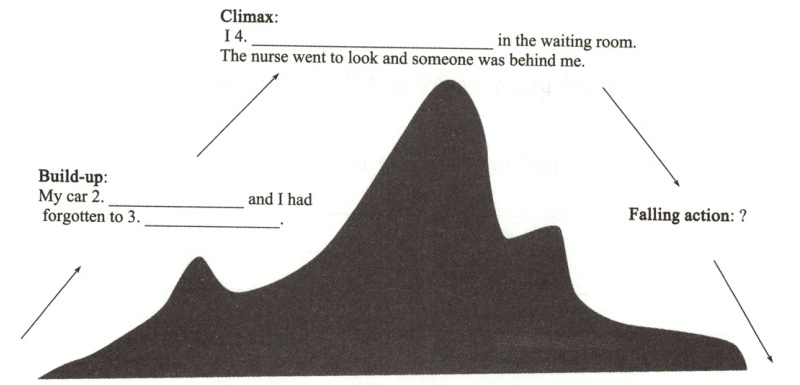
任务三:回答下面问题,并根据段落开头提示语,构思完善故事发展情节。
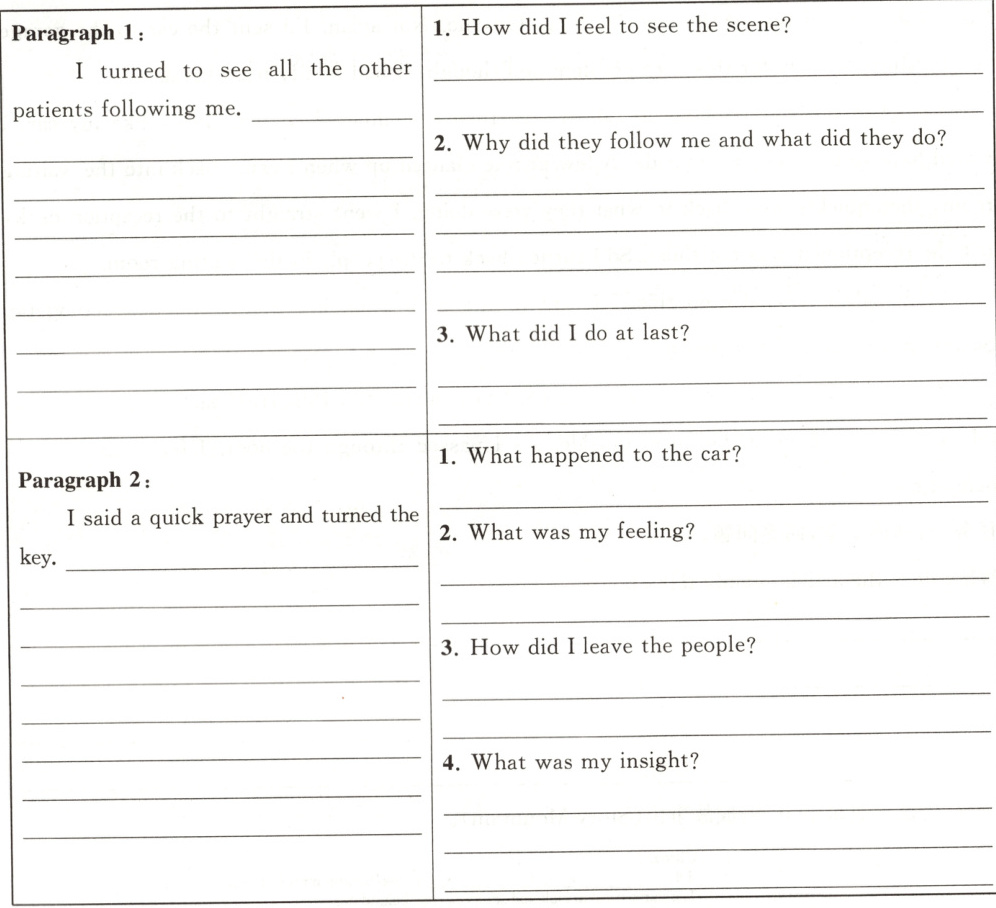
任务四:根据材料内容和任务三中构思的故事发展情节续写两段,使之构成一篇完整的短文。
注意:续写词数应为150左右。
I turned to see all the other patients following me. _________
I said a quick prayer and turned the key. _________
I looked around at the other patients waiting to see the doctor. Maybe they all had more romantic plans for the evening on this special day, but for now the group seemed anti - social. Three people had their heads down, staring at cellphones. Another was absorbed in a magazine. The receptionist tapped at her computer. Everyone was in their own little world.
But I couldn't judge them for it. I would probably be buried in my cellphone too, if I hadn't forgotten to charge it before I left home. It would have been nice to strike up a conversation to pass the time on this day, a day of love and friendship. Instead I sat patiently in my plastic chair as a couple of new people took distant seats.
“Roberta? The doctor's ready for you,” the nurse called. At least I'll have some kind c human connection, I thought.
My checkup went well. I breezed out of the office to my little Honda in a space right out front. I got in and turned the key. Nothing. Oh, no. Not again. I'd sent the car to the garage several times already for this very problem and thought it had finally been fixed.
I reached for my cellphone to call AAA—then remembered. It was dead, like my car. I would have to use the phone inside. A few people glanced up when I came back into the waiting room, then quickly went back to what they were doing. I went straight to the reception desk, but the receptionist was not there. So I turned back to the people in the waiting room.
“I wouldn't normally do this,” I said to the group, hoping that I sounded apologetic. Several people turned towards me to listen. “But my car won't start...”
The nurse popped her head into the room. “You in trouble, Roberta?” she said. “I'll go and take a look.” I followed the nurse outside. As I passed through the door. I felt someone was behind me.
任务一:阅读文章,回答问题。
What does the article mainly talk about?
_________
任务二:梳理故事情节,完成故事山(Story Mountain)。
任务三:回答下面问题,并根据段落开头提示语,构思完善故事发展情节。
任务四:根据材料内容和任务三中构思的故事发展情节续写两段,使之构成一篇完整的短文。
注意:续写词数应为150左右。
I turned to see all the other patients following me. _________
I said a quick prayer and turned the key. _________
答案:
任务一
The article mainly talks about that the author saw the doctor on a special day, and noticed most people were staring at their cellphones without caring about him. After checkup, the author found that his car was wrong and his cellphone was dead, he had to turn to people in the waiting room for help.
任务二
1. went well
2. wouldn’t start
3. charge my cellphone
4. turned back to the people
任务三
Paragraph 1:
1. A bit puzzled.
2. They follow me to help me. One checked the engine, another fetched the tool from his car and began to twist it. The others just volunteered to take his turn.
3. I expressed my gratitude and tried my car.
Paragraph 2:
1. The car came back to life, its engine working merrily.
2. No beautiful words could describe my earnest gratitude to the group seeming anti-social minutes before.
3. Waving goodbye to those lovely and helpful people, I headed for home with great delight and satisfaction.
4. Indeed, it wasn’t an ordinary day, but a day full of love and friendship, which would inspire me to provide necessary help to those in need.
任务四
【参考范文】
I turned to see all the other patients following me. A bit puzzled, I went to my car and slid into the driver’s seat. One of them called, “Pop your hood!” So I pressed the button. Several others bent forward, most probably leaning in to check the engine. “The screw is loose,” one assured me. “Trust me. I used to be a mechanic.” Having fetched the tool from his car, he began to twist it. It was not long before he straightened up to rest, rubbing his back. Unexpectedly, the other patients just volunteered to take his turn despite their own health condition. When the “mechanic” gave a thumbs-up, everyone called out together, “Try it now!”
I said a quick prayer and turned the key. The engine turned over immediately. A cheer went up. Several hands shut the hood. “Don’t make any stops on the way home,” the “mechanic” said. “Keep the car running till the battery gets a good charge.” I backed my car out of the space, then paused to wave at the crowd of people who’d saved the day. My Honda never stalled again. It turns out that my waiting room team had done a better job than my garage ever did. I guess that’s just what happens when people come together.
The article mainly talks about that the author saw the doctor on a special day, and noticed most people were staring at their cellphones without caring about him. After checkup, the author found that his car was wrong and his cellphone was dead, he had to turn to people in the waiting room for help.
任务二
1. went well
2. wouldn’t start
3. charge my cellphone
4. turned back to the people
任务三
Paragraph 1:
1. A bit puzzled.
2. They follow me to help me. One checked the engine, another fetched the tool from his car and began to twist it. The others just volunteered to take his turn.
3. I expressed my gratitude and tried my car.
Paragraph 2:
1. The car came back to life, its engine working merrily.
2. No beautiful words could describe my earnest gratitude to the group seeming anti-social minutes before.
3. Waving goodbye to those lovely and helpful people, I headed for home with great delight and satisfaction.
4. Indeed, it wasn’t an ordinary day, but a day full of love and friendship, which would inspire me to provide necessary help to those in need.
任务四
【参考范文】
I turned to see all the other patients following me. A bit puzzled, I went to my car and slid into the driver’s seat. One of them called, “Pop your hood!” So I pressed the button. Several others bent forward, most probably leaning in to check the engine. “The screw is loose,” one assured me. “Trust me. I used to be a mechanic.” Having fetched the tool from his car, he began to twist it. It was not long before he straightened up to rest, rubbing his back. Unexpectedly, the other patients just volunteered to take his turn despite their own health condition. When the “mechanic” gave a thumbs-up, everyone called out together, “Try it now!”
I said a quick prayer and turned the key. The engine turned over immediately. A cheer went up. Several hands shut the hood. “Don’t make any stops on the way home,” the “mechanic” said. “Keep the car running till the battery gets a good charge.” I backed my car out of the space, then paused to wave at the crowd of people who’d saved the day. My Honda never stalled again. It turns out that my waiting room team had done a better job than my garage ever did. I guess that’s just what happens when people come together.
查看更多完整答案,请扫码查看

