

 搜索
搜索
2026年点金训练精讲巧练高中英语选择性必修第二册外研版
注:目前有些书本章节名称可能整理的还不是很完善,但都是按照顺序排列的,请同学们按照顺序仔细查找。练习册 2026年点金训练精讲巧练高中英语选择性必修第二册外研版 答案主要是用来给同学们做完题方便对答案用的,请勿直接抄袭。
第98页
- 第1页
- 第2页
- 第3页
- 第4页
- 第5页
- 第6页
- 第7页
- 第8页
- 第9页
- 第10页
- 第11页
- 第12页
- 第13页
- 第14页
- 第15页
- 第16页
- 第17页
- 第18页
- 第19页
- 第20页
- 第21页
- 第22页
- 第23页
- 第24页
- 第25页
- 第26页
- 第27页
- 第28页
- 第29页
- 第30页
- 第31页
- 第32页
- 第33页
- 第34页
- 第35页
- 第36页
- 第37页
- 第38页
- 第39页
- 第40页
- 第41页
- 第42页
- 第43页
- 第44页
- 第45页
- 第46页
- 第47页
- 第48页
- 第49页
- 第50页
- 第51页
- 第52页
- 第53页
- 第54页
- 第55页
- 第56页
- 第57页
- 第58页
- 第59页
- 第60页
- 第61页
- 第62页
- 第63页
- 第64页
- 第65页
- 第66页
- 第67页
- 第68页
- 第69页
- 第70页
- 第71页
- 第72页
- 第73页
- 第74页
- 第75页
- 第76页
- 第77页
- 第78页
- 第79页
- 第80页
- 第81页
- 第82页
- 第83页
- 第84页
- 第85页
- 第86页
- 第87页
- 第88页
- 第89页
- 第90页
- 第91页
- 第92页
- 第93页
- 第94页
- 第95页
- 第96页
- 第97页
- 第98页
- 第99页
- 第100页
- 第101页
- 第102页
- 第103页
- 第104页
- 第105页
- 第106页
- 第107页
- 第108页
- 第109页
- 第110页
- 第111页
- 第112页
- 第113页
- 第114页
- 第115页
- 第116页
- 第117页
- 第118页
- 第119页
一、单元重构
请根据本单元所学内容,完成思维导图。
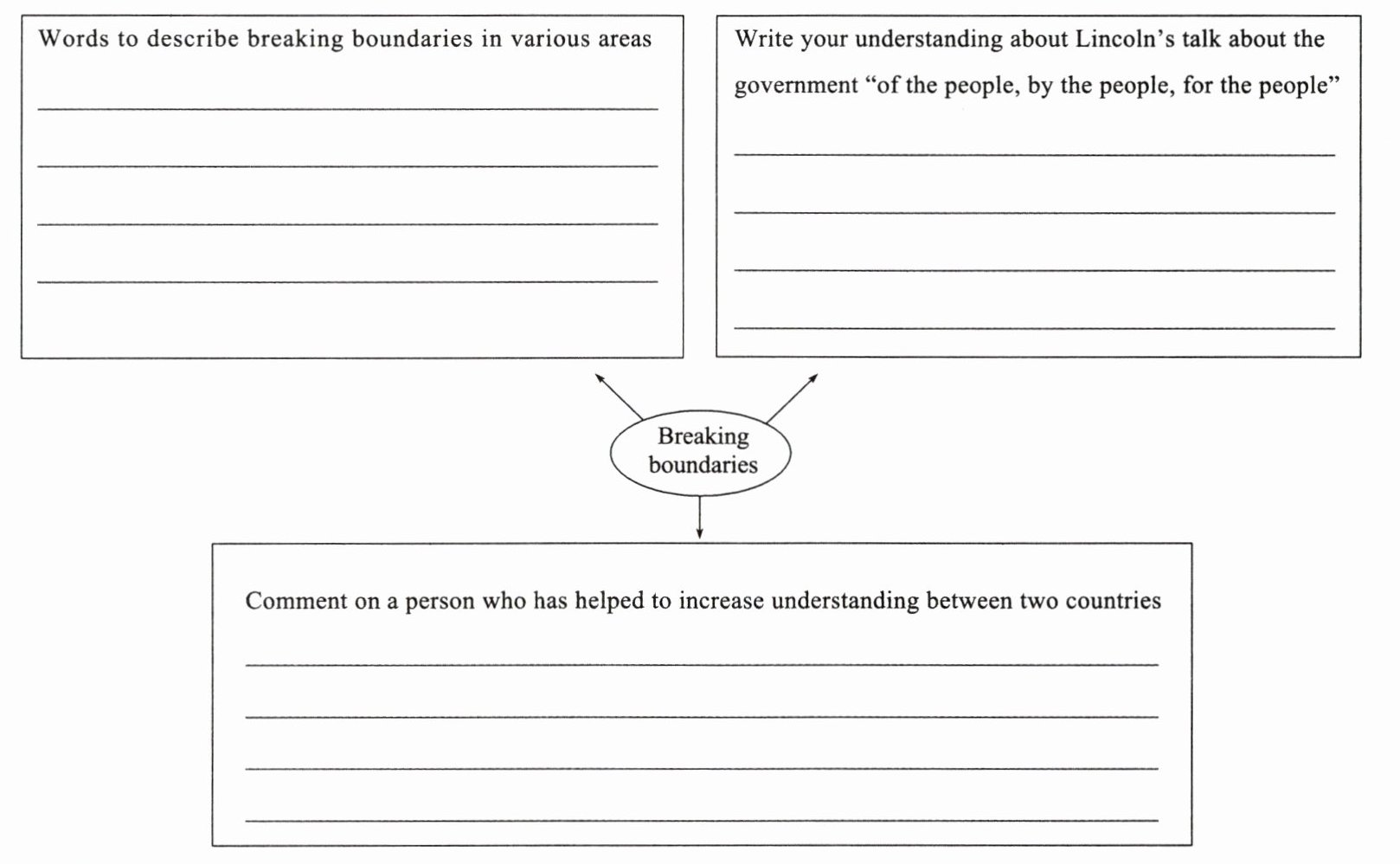
\oval{Breaking boundaries}
请根据本单元所学内容,完成思维导图。
\oval{Breaking boundaries}
答案:
第一部分:Words to describe breaking boundaries in various areas
- Science and Technology:Innovation, discovery, paradigm - shift, breakthrough.
- Social and Cultural:Inclusion, diversity - promotion, tradition - re - evaluation, cultural - exchange - enhancement.
- Personal Growth:Self - discovery, skill - expansion, comfort - zone - leaving, mindset - transformation.
第二部分:Write your understanding about Lincoln's talk about the government “of the people, by the people, for the people”
This phrase emphasizes that the government should be composed of the people (representing their interests), operated by the people (through democratic means such as voting and participation in governance), and exist for the benefit of the people (providing services, protecting rights, and promoting the general welfare). It is a fundamental principle of democratic governance that highlights the central role of the people in a just and functional government system.
第三部分:Comment on a person who has helped to increase understanding between two countries
For example, consider Nelson Mandela. He not only fought for racial equality within South Africa but also became a global symbol of reconciliation. His efforts in building a new South Africa after apartheid showed the world the power of forgiveness and understanding. He engaged with the international community, sharing South Africa's story of struggle and hope. His visits to different countries and his speeches promoted cross - cultural understanding. He broke down the boundaries of racism and mistrust, showing that different ethnic and national groups can co - exist and thrive together. His work increased understanding between South Africa and the rest of the world, as well as between different racial and ethnic groups within South Africa.
- Science and Technology:Innovation, discovery, paradigm - shift, breakthrough.
- Social and Cultural:Inclusion, diversity - promotion, tradition - re - evaluation, cultural - exchange - enhancement.
- Personal Growth:Self - discovery, skill - expansion, comfort - zone - leaving, mindset - transformation.
第二部分:Write your understanding about Lincoln's talk about the government “of the people, by the people, for the people”
This phrase emphasizes that the government should be composed of the people (representing their interests), operated by the people (through democratic means such as voting and participation in governance), and exist for the benefit of the people (providing services, protecting rights, and promoting the general welfare). It is a fundamental principle of democratic governance that highlights the central role of the people in a just and functional government system.
第三部分:Comment on a person who has helped to increase understanding between two countries
For example, consider Nelson Mandela. He not only fought for racial equality within South Africa but also became a global symbol of reconciliation. His efforts in building a new South Africa after apartheid showed the world the power of forgiveness and understanding. He engaged with the international community, sharing South Africa's story of struggle and hope. His visits to different countries and his speeches promoted cross - cultural understanding. He broke down the boundaries of racism and mistrust, showing that different ethnic and national groups can co - exist and thrive together. His work increased understanding between South Africa and the rest of the world, as well as between different racial and ethnic groups within South Africa.
二、拓展阅读
阅读下面的文章,完成后面的题目。
Chinese Scientist Wins 2015 Nobel Prize
Tu Youyou has become the first female scientist of the People's Republic of China to receive a Nobel Prize, awarded for her contribution to the fight against malaria, one of the deadliest diseases in human history. Thanks to her discovery of qinghaosu, malaria patients all over the world now have had a greatly increased chance of survival.
Born in 1930, in Ningbo, Zhejiang Province, Tu studied medicine at university in Beijing between 1951 and 1955. After graduation, she worked at the China Academy of Chinese Medical Sciences. She completed further training courses in traditional Chinese medicine, acquiring a broad knowledge of both traditional Chinese medicine and Western medicine.
Tu’s education was soon to prove very useful. In the 1960s, many people were dying of malaria, and in 1969 Tu became head of a team that intended to find a cure for the disease. She collected over 2,000 traditional Chinese medical recipes for malaria treatment and made hundreds of extracts from different herbs. When they failed to produce any promising results, Tu referred to the ancient books of traditional Chinese medicine again. Inspired by an over 1,600-
year-old text about preparing qinghao extract with cold water, Tu redesigned the experiments and tried extracting the herb at a low temperature in order not to damage its effective part. On 4 October 1971, after 190 failures, she succeeded in making qinghao extract that could treat malaria in mice.
However, it was hard to produce enough qinghao extract for large trials because research resources were limited. Tu and her team managed to find solutions to the problem. When there was no research equipment, they had to extract herbs using household water containers. They worked day and night and their health began to suffer because of the poor conditions, but they never gave up.
Even with large amounts of qinghao extract produced, however, they still faced another problem. The trials on patients were likely to be postponed because they did not have sufficient safety data. To speed up the process and ensure its safety, Tu and her team volunteered to test qinghao extract on themselves first.
The efforts of Tu and her team finally paid off. In November 1972, through trial and error, they successfully discovered qinghaosu—the most effective part of the qinghao extract. As a key part of many malaria medicines, qinghaosu has since benefited about 200 million malaria patients. More than 40 years after its discovery, Tu was eventually awarded a Nobel Prize for her work. In her Nobel Lecture, she encouraged scientists to further explore the treasure house of traditional Chinese medicine and raise it to a higher level. Perhaps the next generation of scientists, drawing on the wisdom of traditional Chinese medicine, will indeed discover more medicines beneficial to global health care.
1. In the 1960s, what was Tu Youyou's role in the fight against malaria?
A. She was just a normal researcher.
B. She was in charge of patient care.
C. She provided financial support.
D. She became head of a research team.
2. What inspired Tu Youyou to redesign the experiments?
A. Western medical theories.
B. A modern research paper.
C. An ancient Chinese medicine book.
D. Her own previous experience.
3. Why was it difficult to produce enough qinghao extract for large trials?
A. Because the herb was rare.
B. Because research resources were limited.
C. Because the extraction method was too complex.
D. Because there was no demand for it.
4. What did Tu Youyou encourage scientists to do in her Nobel Lecture?
A. To focus on Western medicine only.
B. To abandon traditional Chinese medicine.
C. To further explore traditional Chinese medicine.
D. To stop malaria research.
阅读下面的文章,完成后面的题目。
Chinese Scientist Wins 2015 Nobel Prize
Tu Youyou has become the first female scientist of the People's Republic of China to receive a Nobel Prize, awarded for her contribution to the fight against malaria, one of the deadliest diseases in human history. Thanks to her discovery of qinghaosu, malaria patients all over the world now have had a greatly increased chance of survival.
Born in 1930, in Ningbo, Zhejiang Province, Tu studied medicine at university in Beijing between 1951 and 1955. After graduation, she worked at the China Academy of Chinese Medical Sciences. She completed further training courses in traditional Chinese medicine, acquiring a broad knowledge of both traditional Chinese medicine and Western medicine.
Tu’s education was soon to prove very useful. In the 1960s, many people were dying of malaria, and in 1969 Tu became head of a team that intended to find a cure for the disease. She collected over 2,000 traditional Chinese medical recipes for malaria treatment and made hundreds of extracts from different herbs. When they failed to produce any promising results, Tu referred to the ancient books of traditional Chinese medicine again. Inspired by an over 1,600-
year-old text about preparing qinghao extract with cold water, Tu redesigned the experiments and tried extracting the herb at a low temperature in order not to damage its effective part. On 4 October 1971, after 190 failures, she succeeded in making qinghao extract that could treat malaria in mice.
However, it was hard to produce enough qinghao extract for large trials because research resources were limited. Tu and her team managed to find solutions to the problem. When there was no research equipment, they had to extract herbs using household water containers. They worked day and night and their health began to suffer because of the poor conditions, but they never gave up.
Even with large amounts of qinghao extract produced, however, they still faced another problem. The trials on patients were likely to be postponed because they did not have sufficient safety data. To speed up the process and ensure its safety, Tu and her team volunteered to test qinghao extract on themselves first.
The efforts of Tu and her team finally paid off. In November 1972, through trial and error, they successfully discovered qinghaosu—the most effective part of the qinghao extract. As a key part of many malaria medicines, qinghaosu has since benefited about 200 million malaria patients. More than 40 years after its discovery, Tu was eventually awarded a Nobel Prize for her work. In her Nobel Lecture, she encouraged scientists to further explore the treasure house of traditional Chinese medicine and raise it to a higher level. Perhaps the next generation of scientists, drawing on the wisdom of traditional Chinese medicine, will indeed discover more medicines beneficial to global health care.
1. In the 1960s, what was Tu Youyou's role in the fight against malaria?
A. She was just a normal researcher.
B. She was in charge of patient care.
C. She provided financial support.
D. She became head of a research team.
2. What inspired Tu Youyou to redesign the experiments?
A. Western medical theories.
B. A modern research paper.
C. An ancient Chinese medicine book.
D. Her own previous experience.
3. Why was it difficult to produce enough qinghao extract for large trials?
A. Because the herb was rare.
B. Because research resources were limited.
C. Because the extraction method was too complex.
D. Because there was no demand for it.
4. What did Tu Youyou encourage scientists to do in her Nobel Lecture?
A. To focus on Western medicine only.
B. To abandon traditional Chinese medicine.
C. To further explore traditional Chinese medicine.
D. To stop malaria research.
答案:
1∼4 DCBC
查看更多完整答案,请扫码查看

