

 搜索
搜索
2025年红对勾练吧九年级英语全一册冀教版
注:目前有些书本章节名称可能整理的还不是很完善,但都是按照顺序排列的,请同学们按照顺序仔细查找。练习册 2025年红对勾练吧九年级英语全一册冀教版 答案主要是用来给同学们做完题方便对答案用的,请勿直接抄袭。
第52页
- 第1页
- 第2页
- 第3页
- 第4页
- 第5页
- 第6页
- 第7页
- 第8页
- 第9页
- 第10页
- 第11页
- 第12页
- 第13页
- 第14页
- 第15页
- 第16页
- 第17页
- 第18页
- 第19页
- 第20页
- 第21页
- 第22页
- 第23页
- 第24页
- 第25页
- 第26页
- 第27页
- 第28页
- 第29页
- 第30页
- 第31页
- 第32页
- 第33页
- 第34页
- 第35页
- 第36页
- 第37页
- 第38页
- 第39页
- 第40页
- 第41页
- 第42页
- 第43页
- 第44页
- 第45页
- 第46页
- 第47页
- 第48页
- 第49页
- 第50页
- 第51页
- 第52页
- 第53页
- 第54页
- 第55页
- 第56页
- 第57页
- 第58页
- 第59页
- 第60页
- 第61页
- 第62页
- 第63页
- 第64页
- 第65页
- 第66页
- 第67页
- 第68页
- 第69页
- 第70页
- 第71页
- 第72页
- 第73页
- 第74页
- 第75页
- 第76页
- 第77页
- 第78页
- 第79页
- 第80页
- 第81页
- 第82页
- 第83页
- 第84页
- 第85页
- 第86页
- 第87页
- 第88页
- 第89页
- 第90页
- 第91页
- 第92页
- 第93页
- 第94页
- 第95页
- 第96页
- 第97页
- 第98页
- 第99页
- 第100页
- 第101页
- 第102页
- 第103页
- 第104页
- 第105页
- 第106页
- 第107页
- 第108页
- 第109页
- 第110页
- 第111页
- 第112页
- 第113页
- 第114页
- 第115页
- 第116页
- 第117页
- 第118页
- 第119页
- 第120页
- 第121页
- 第122页
- 第123页
- 第124页
- 第125页
- 第126页
- 第127页
- 第128页
- 第129页
- 第130页
- 第131页
- 第132页
Ⅱ. 阅读理解【主题:人与社会 中秋节】
The Mid-Autumn Festival has a history of more than 2 000 years. All the celebrations of the Mid-Autumn Festival show the happiness and excitement of people. The main celebrations during the Mid-Autumn Festival are admiring the moon, eating moon cakes together and making Chinese Mid-Autumn Festival lanterns.
In some places in China people celebrate the festival in different ways. In Chaozhou, Guangdong Province, people eat taro (芋头) to celebrate the festival, because the taro harvest happens at the same time. They eat taro and hope the harvest is good in the next year. In Nanjing, people cook duck with sweet-scented osmanthus (桂花), because Nanjing people think sweet-scented osmanthus is a symbol of peace. In some places people make fires inside towers to celebrate the festival, because they think the fire is a symbol of good business.
In the history of Chinese literature, many poets gave words to the moon of Mid-Autumn night. The following is one of the best of those poems.
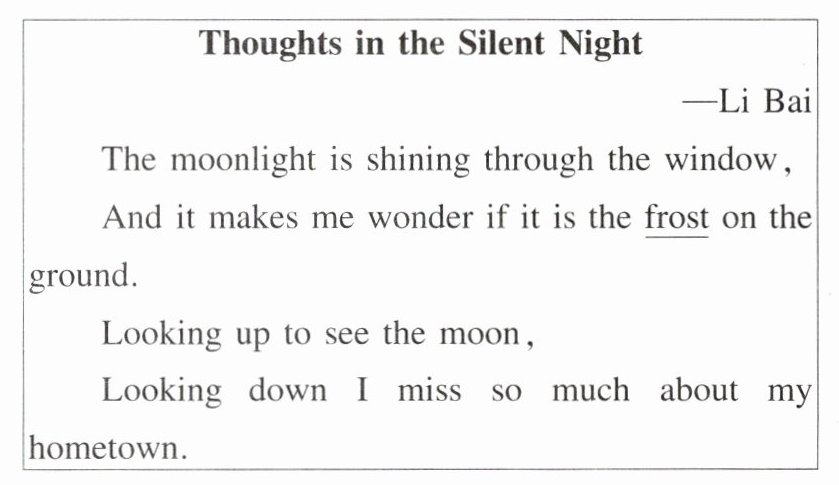
Li Bai used his lines to show his homesickness (乡愁) at the Moon Festival.
1. What do all the celebrations of the Mid-Autumn Festival show?
A. The peace of people.
B. The differences of people.
C. The importance of the festival.
D. The happiness and excitement of people.
(
2. Why do people make fires inside towers to celebrate the festival in some places?
A. Because they think the fire is a symbol of peace.
B. Because they think the fire is a symbol of good business.
C. Because they hope the harvest is good in the next year.
D. Because they hope they will be healthier in the next year.
(
3. What did Li Bai write to show his homesickness at the Moon Festival?
A. A story of Moon.
B. A poem named *Thoughts in the Silent Night*.
C. A song called *Thoughts in the Silent Night*.
D. A joke.
(
The Mid-Autumn Festival has a history of more than 2 000 years. All the celebrations of the Mid-Autumn Festival show the happiness and excitement of people. The main celebrations during the Mid-Autumn Festival are admiring the moon, eating moon cakes together and making Chinese Mid-Autumn Festival lanterns.
In some places in China people celebrate the festival in different ways. In Chaozhou, Guangdong Province, people eat taro (芋头) to celebrate the festival, because the taro harvest happens at the same time. They eat taro and hope the harvest is good in the next year. In Nanjing, people cook duck with sweet-scented osmanthus (桂花), because Nanjing people think sweet-scented osmanthus is a symbol of peace. In some places people make fires inside towers to celebrate the festival, because they think the fire is a symbol of good business.
In the history of Chinese literature, many poets gave words to the moon of Mid-Autumn night. The following is one of the best of those poems.
Li Bai used his lines to show his homesickness (乡愁) at the Moon Festival.
1. What do all the celebrations of the Mid-Autumn Festival show?
A. The peace of people.
B. The differences of people.
C. The importance of the festival.
D. The happiness and excitement of people.
(
D
)2. Why do people make fires inside towers to celebrate the festival in some places?
A. Because they think the fire is a symbol of peace.
B. Because they think the fire is a symbol of good business.
C. Because they hope the harvest is good in the next year.
D. Because they hope they will be healthier in the next year.
(
B
)3. What did Li Bai write to show his homesickness at the Moon Festival?
A. A story of Moon.
B. A poem named *Thoughts in the Silent Night*.
C. A song called *Thoughts in the Silent Night*.
D. A joke.
(
B
)
答案:
1. D 2. B 3. B
Ⅲ. 补全对话
(A and B are talking about their school life this term.)
A: How is your school life this term, John?
B: It's still busy but more wonderful and relaxing.
A: Really? 1.
B: Because we have different kinds of clubs.
A: Good. 2.
B: We have a poem club, a sports club, a singing club...Ah, so many of them!
A: Fantastic! Which club are you in?
B: 3.
A: Oh? Why didn't you join the singing club? You are good at singing.
B: Yes. But I am practicing it at a singing school.
A: Do you go there once a week?
B: 4.
A: I see. You have a colourful life in and out of school.
B: I think so, too. Oh, it's time to go home. Bye for now!
A: 5.
(A and B are talking about their school life this term.)
A: How is your school life this term, John?
B: It's still busy but more wonderful and relaxing.
A: Really? 1.
Why?
B: Because we have different kinds of clubs.
A: Good. 2.
What clubs do you have?
B: We have a poem club, a sports club, a singing club...Ah, so many of them!
A: Fantastic! Which club are you in?
B: 3.
The poem club.
I want to learn about Chinese poems.A: Oh? Why didn't you join the singing club? You are good at singing.
B: Yes. But I am practicing it at a singing school.
A: Do you go there once a week?
B: 4.
Yes, I do./Yes.
I only go there on Sunday afternoon.A: I see. You have a colourful life in and out of school.
B: I think so, too. Oh, it's time to go home. Bye for now!
A: 5.
See you.
答案:
1. Why? 2. What clubs do you have? 3. The poem club. 4. Yes, I do./Yes. 5. See you.
查看更多完整答案,请扫码查看

