

 搜索
搜索
2025年奔跑吧少年九年级英语全一册外研版
注:目前有些书本章节名称可能整理的还不是很完善,但都是按照顺序排列的,请同学们按照顺序仔细查找。练习册 2025年奔跑吧少年九年级英语全一册外研版 答案主要是用来给同学们做完题方便对答案用的,请勿直接抄袭。
第54页
- 第2页
- 第3页
- 第4页
- 第5页
- 第6页
- 第7页
- 第8页
- 第9页
- 第10页
- 第11页
- 第12页
- 第13页
- 第14页
- 第15页
- 第16页
- 第17页
- 第18页
- 第19页
- 第20页
- 第21页
- 第22页
- 第23页
- 第24页
- 第25页
- 第26页
- 第27页
- 第28页
- 第29页
- 第30页
- 第31页
- 第32页
- 第33页
- 第34页
- 第35页
- 第36页
- 第37页
- 第38页
- 第39页
- 第40页
- 第41页
- 第42页
- 第43页
- 第44页
- 第45页
- 第46页
- 第47页
- 第48页
- 第49页
- 第50页
- 第51页
- 第52页
- 第53页
- 第54页
- 第55页
- 第56页
- 第57页
- 第58页
- 第59页
- 第60页
- 第61页
- 第62页
- 第63页
- 第64页
- 第65页
- 第66页
- 第67页
- 第68页
- 第69页
- 第70页
- 第71页
- 第72页
- 第73页
- 第74页
- 第75页
- 第76页
- 第77页
- 第78页
- 第79页
- 第80页
Ⅰ Complete the sentences with the proper forms of the words given.
1. An environmentally friendly library ______ (build) in this city in the near future.
2. Some photos of the moon in the Space Club ______ (show) next week.
3. More and more robots ______ (use) to do difficult work in the future.
4. If you don't have a driver's licence, you ______ (not allow) to drive a car.
5. A talk on Chinese inventions ______ (give) in the hall next Monday.
1. An environmentally friendly library ______ (build) in this city in the near future.
2. Some photos of the moon in the Space Club ______ (show) next week.
3. More and more robots ______ (use) to do difficult work in the future.
4. If you don't have a driver's licence, you ______ (not allow) to drive a car.
5. A talk on Chinese inventions ______ (give) in the hall next Monday.
答案:
1. will be built 2. will be shown 3. will be used
4. will not/won't be allowed 5. will be given
4. will not/won't be allowed 5. will be given
Ⅱ Complete the sentences with proper words.
6. They felt ______ impossible to finish the work in such a short time.
7. The students put ______ posters about the science fair all around the school last week.
8. Thousands ______ books are available in the library for students to read.
9. Before computers, engineers had to calculate (计算) everything ______ hand.
10. We will wait ______ see if this new robot can really help at home.
6. They felt ______ impossible to finish the work in such a short time.
7. The students put ______ posters about the science fair all around the school last week.
8. Thousands ______ books are available in the library for students to read.
9. Before computers, engineers had to calculate (计算) everything ______ hand.
10. We will wait ______ see if this new robot can really help at home.
答案:
6. it 7. up
8. of 9. by 10. and
8. of 9. by 10. and
Ⅲ Rewrite the sentences as required.
11. Nobody will tell us what to do next. (改为被动语态)
______
12. Computers will be used more than books in the future. (改为主动语态)
______
13. You should hand in your paper after class. (改为被动语态)
______
14. Speak loudly in order to let everyone hear you clearly. (改为同义句)
Speak loudly so that you will ______ ______ clearly by everyone.
15. We will interview that hero this weekend. (对画线部分提问)
______
11. Nobody will tell us what to do next. (改为被动语态)
______
12. Computers will be used more than books in the future. (改为主动语态)
______
13. You should hand in your paper after class. (改为被动语态)
______
14. Speak loudly in order to let everyone hear you clearly. (改为同义句)
Speak loudly so that you will ______ ______ clearly by everyone.
15. We will interview that hero this weekend. (对画线部分提问)
______
答案:
11. We won't be told by anybody what to do next.
12. We will use computers more than books in the future.
13. Your paper should be handed in after class.
14. be heard
15. Who will we interview this weekend?
12. We will use computers more than books in the future.
13. Your paper should be handed in after class.
14. be heard
15. Who will we interview this weekend?
Ⅳ Complete the passage with proper words based on the grammar learnt in this unit.
What will the future look like with the help of new inventions? In the future, many new inventions 16. ______ (develop) to solve the problems we face today. For example, clean energy sources like solar and wind power 17. ______ (use) more widely to reduce pollution. Self-driving cars 18. ______ (introduce) in many cities, making transport safer and more efficient.
In medicine, new treatments 19. ______ (discover) to cure diseases that are currently incurable. Robots 20. ______ (design) to help with household chores, allowing people to have more free time. Smart homes 21. ______ (build) to automatically control lighting, temperature and security.
In education, virtual reality (VR) technology 22. ______ (apply) to create more interactive learning experiences. Besides, new communication tools 23. ______ (create) to connect people from different parts of the world quickly.
Finally, environmental protection 24. ______ (improve) with inventions that can clean oceans and reduce waste. If we work together, the world 25. ______ (make) a better place in the future!
What will the future look like with the help of new inventions? In the future, many new inventions 16. ______ (develop) to solve the problems we face today. For example, clean energy sources like solar and wind power 17. ______ (use) more widely to reduce pollution. Self-driving cars 18. ______ (introduce) in many cities, making transport safer and more efficient.
In medicine, new treatments 19. ______ (discover) to cure diseases that are currently incurable. Robots 20. ______ (design) to help with household chores, allowing people to have more free time. Smart homes 21. ______ (build) to automatically control lighting, temperature and security.
In education, virtual reality (VR) technology 22. ______ (apply) to create more interactive learning experiences. Besides, new communication tools 23. ______ (create) to connect people from different parts of the world quickly.
Finally, environmental protection 24. ______ (improve) with inventions that can clean oceans and reduce waste. If we work together, the world 25. ______ (make) a better place in the future!
答案:
16. will be developed 17. will be used 18. will be introduced
19. will be discovered 20. will be designed 21. will be built
22. will be applied 23. will be created 24. will be improved
25. will be made
19. will be discovered 20. will be designed 21. will be built
22. will be applied 23. will be created 24. will be improved
25. will be made
Ⅴ Read the passage and finish the following tasks.
Picture the scene—students pass their schoolwork through different hands, from their group leader to the class representative, and finally to the teacher. This process can sometimes go wrong and take a lot of time.
To deal with this problem, a boy from Shenzhen invented a smart homework collection robot. This robot won him first prize in the 20th Guangdong Provincial Children's Invention Awards.
The robot uses radio frequency identification (RFID, 射频识别) technology—a reader and a special tag that can share information without touching each other. Each student's notebook has a special RFID tag with their name and the subject. A student only needs to place their notebook on the robot, and the machine "sees" the notebook, reads its tag, and takes it out of the name list. Teachers can check homework submission by connecting their phones with the robot through Wi-Fi.
The robot is the second-generation model made by the boy. He is now planning to develop a third-generation model using ultra-high-frequency radio technology to read lots of RFID tags from far away. This means the robot can read information from a thick stack of notebooks at once. Zhang believes this is the key to how AI can make life easier for us.
Task A: Fill in the mind map according to the passage.
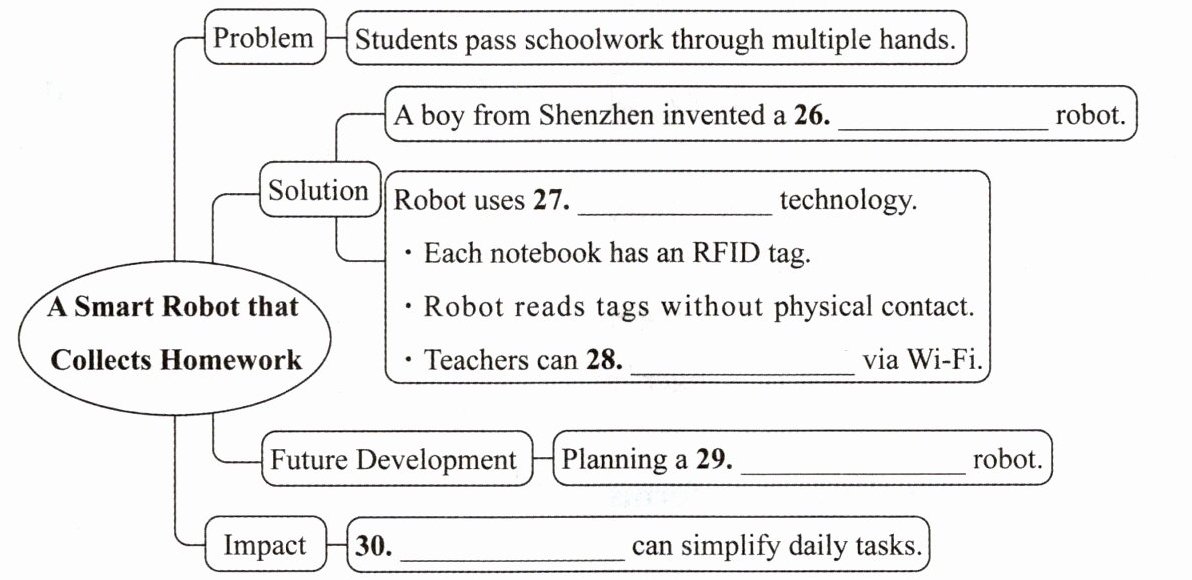
Task B: Choose the best answers.
()31. 新考法 写作手法 The writer introduces the main topic of the passage by ______.
A. telling a story
B. showing a book
C. asking a question
D. describing a scene
()32. Which of the following is TRUE about the robot?
A. The robot uses radio frequency identification technology.
B. The machine can "see" the notebook and read its tag from far away.
C. Each student's notebook has a special RFID tag with their name and the address.
D. A smart boy won 2nd prize in Guangdong Provincial Children's Invention Awards.
Task C: According to the passage, why does the writer write this passage?
33. ______
Task D: According to the passage, what words can you use to describe the boy?
34. ______
Task E: Find beautiful sentences in the passage and write them down.
35. ______
Picture the scene—students pass their schoolwork through different hands, from their group leader to the class representative, and finally to the teacher. This process can sometimes go wrong and take a lot of time.
To deal with this problem, a boy from Shenzhen invented a smart homework collection robot. This robot won him first prize in the 20th Guangdong Provincial Children's Invention Awards.
The robot uses radio frequency identification (RFID, 射频识别) technology—a reader and a special tag that can share information without touching each other. Each student's notebook has a special RFID tag with their name and the subject. A student only needs to place their notebook on the robot, and the machine "sees" the notebook, reads its tag, and takes it out of the name list. Teachers can check homework submission by connecting their phones with the robot through Wi-Fi.
The robot is the second-generation model made by the boy. He is now planning to develop a third-generation model using ultra-high-frequency radio technology to read lots of RFID tags from far away. This means the robot can read information from a thick stack of notebooks at once. Zhang believes this is the key to how AI can make life easier for us.
Task A: Fill in the mind map according to the passage.
Task B: Choose the best answers.
()31. 新考法 写作手法 The writer introduces the main topic of the passage by ______.
A. telling a story
B. showing a book
C. asking a question
D. describing a scene
()32. Which of the following is TRUE about the robot?
A. The robot uses radio frequency identification technology.
B. The machine can "see" the notebook and read its tag from far away.
C. Each student's notebook has a special RFID tag with their name and the address.
D. A smart boy won 2nd prize in Guangdong Provincial Children's Invention Awards.
Task C: According to the passage, why does the writer write this passage?
33. ______
Task D: According to the passage, what words can you use to describe the boy?
34. ______
Task E: Find beautiful sentences in the passage and write them down.
35. ______
答案:
31—32 DA
33. The writer writes this passage to introduce a smart homework collection robot invented by a student, explaining how it solves the problem of collecting homework and can make life easier. (答案不唯一, 言之有理即可)
34. The boy is smart and creative. (答案不唯一, 言之有理即可)
35. Zhang believes this is the key to how AI can make life easier for us. (答案不唯一, 言之有理即可)
33. The writer writes this passage to introduce a smart homework collection robot invented by a student, explaining how it solves the problem of collecting homework and can make life easier. (答案不唯一, 言之有理即可)
34. The boy is smart and creative. (答案不唯一, 言之有理即可)
35. Zhang believes this is the key to how AI can make life easier for us. (答案不唯一, 言之有理即可)
查看更多完整答案,请扫码查看

