

 搜索
搜索
第98页
- 第1页
- 第2页
- 第3页
- 第4页
- 第5页
- 第6页
- 第7页
- 第8页
- 第9页
- 第10页
- 第11页
- 第12页
- 第13页
- 第14页
- 第15页
- 第16页
- 第17页
- 第18页
- 第19页
- 第20页
- 第21页
- 第22页
- 第23页
- 第24页
- 第25页
- 第26页
- 第27页
- 第28页
- 第29页
- 第30页
- 第31页
- 第32页
- 第33页
- 第34页
- 第35页
- 第36页
- 第37页
- 第38页
- 第39页
- 第40页
- 第41页
- 第42页
- 第43页
- 第44页
- 第45页
- 第46页
- 第47页
- 第48页
- 第49页
- 第50页
- 第51页
- 第52页
- 第53页
- 第54页
- 第55页
- 第56页
- 第57页
- 第58页
- 第59页
- 第60页
- 第61页
- 第62页
- 第63页
- 第64页
- 第65页
- 第66页
- 第67页
- 第68页
- 第69页
- 第70页
- 第71页
- 第72页
- 第73页
- 第74页
- 第75页
- 第76页
- 第77页
- 第78页
- 第79页
- 第80页
- 第81页
- 第82页
- 第83页
- 第84页
- 第85页
- 第86页
- 第87页
- 第88页
- 第89页
- 第90页
- 第91页
- 第92页
- 第93页
- 第94页
- 第95页
- 第96页
- 第97页
- 第98页
- 第99页
- 第100页
- 第101页
- 第102页
- 第103页
- 第104页
- 第105页
- 第106页
- 第107页
- 第108页
- 第109页
- 第110页
- 第111页
- 第112页
- 第113页
- 第114页
- 第115页
- 第116页
- 第117页
- 第118页
- 第119页
- 第120页
- 第121页
- 第122页
- 第123页
- 第124页
- 第125页
- 第126页
- 第127页
- 第128页
- 第129页
- 第130页
- 第131页
- 第132页
- 第133页
- 第134页
- 第135页
- 第136页
- 第137页
- 第138页
- 第139页
- 第140页
- 第141页
- 第142页
- 第143页
(
A.live; live
B.alive; live
C.live; lively
D.alive; lively
B
) 1.This one-hour documentary brings birds ______ on screen when it's covered ______.A.live; live
B.alive; live
C.live; lively
D.alive; lively
答案:
B
(
A.the number of; the number of
B.a number of; the number of
C.a number of; a number of
D.the number of; a number of
B
) 2.There are ______ shops near our school, and ______ of the shops is getting larger and larger.A.the number of; the number of
B.a number of; the number of
C.a number of; a number of
D.the number of; a number of
答案:
B
(
A.to go; to ride
B.go; riding
C.going; to ride
D.go; to ride
D
) 3.Rather than ______ to school by bus, he preferred ______ a bike.A.to go; to ride
B.go; riding
C.going; to ride
D.go; to ride
答案:
D
(
—Yes. And it included an interview ______ a government officer.
A.for; with
B.about; by
C.on; with
D.by; on
C
) 4.—There was a report ______ the housing situation in yesterday's newspaper.—Yes. And it included an interview ______ a government officer.
A.for; with
B.about; by
C.on; with
D.by; on
答案:
C
(
A.is directed; worth
B.directed; worth
C.is directed; is worth
D.directed; is worth
D
) 5.I think the new film ______ by Mr Zhang ______ seeing.A.is directed; worth
B.directed; worth
C.is directed; is worth
D.directed; is worth
答案:
D
(
A.feeling scared; full of
B.to feel scared; full of
C.feeling scared; filled of
D.to feel scared; filled with
A
) 6.I don't mind ______ because I like films ______ horror and mysteries.A.feeling scared; full of
B.to feel scared; full of
C.feeling scared; filled of
D.to feel scared; filled with
答案:
A
(
A.how; unless
B.what; unless
C.how; if
D.what; until
A
) 7.You could hardly imagine ______ amazing the Great Wall was ______ you saw it with your own eyes.A.how; unless
B.what; unless
C.how; if
D.what; until
答案:
A
(
A.when he would travel to Hong Kong
B.how he goes to Shanghai
C.where he has spent his holidays
D.why did he visit Hangzhou
A
) 8.Did your father tell you ______?A.when he would travel to Hong Kong
B.how he goes to Shanghai
C.where he has spent his holidays
D.why did he visit Hangzhou
答案:
A
三、任务型阅读
Poetry is the forgotten child of literature. Few people read it for pleasure. In Western high schools, poetry is seldom taught because it is considered to be out of date and have little to do with the life of today's students.
In China, however, poetry is still an important part of the curriculum (课程). Recently, the Ministry of Education has increased the number of ancient Chinese poems for students to memorize and recite, from 14 to 72. Why is it important to learn poems?
First of all, poetry is a necessary part of learning traditional Chinese culture. It is a path to understanding your history and your society. It is also the key to understanding the thoughts and feelings that are common to everyone but we may be unable to express—the joy of Li Bai dancing with the moon, for example. Everyone has feelings of joy, love, loneliness, sadness and even anger, and a good poem can help us put those feelings into words and bring us self-understanding.
Poems can also express beauty in a few short lines. Even something common can become beautiful. Here is a poem called Fog: The fog comes / on silent haunches (腰腿) / and then moves on. Yes, fog does move smoothly, silently like a cat, and the poet catches that feeling and image, and makes it beautiful.
Of course, to really enjoy poetry, it has to be read aloud. After all, a poem is really just a song without music. Most ancient poetry, like Homeric Epics and China's Book of Songs, was spoken for hundreds of years before it was written.
A poet once said, "Poetry is when an emotion has found its thought and the thought has found words." You are lucky that you now have seventy-two poems to learn!
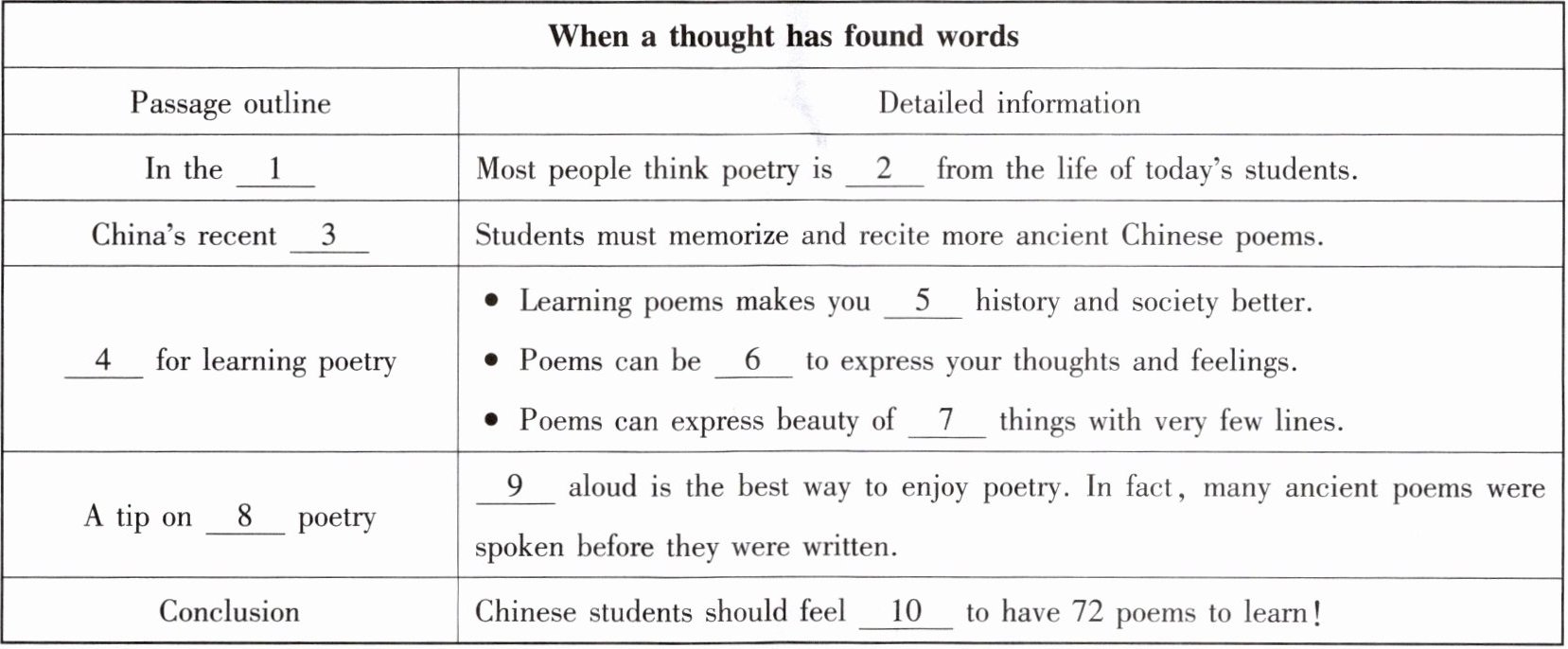
| When a thought has found words | |
| Passage outline | Detailed information |
| In the 1 | Most people think poetry is 2 from the life of today's students. |
| China's recent 3 | Students must memorize and recite more ancient Chinese poems. |
| 4 for learning poetry | • Learning poems makes you 5 history and society better. • Poems can be 6 to express your thoughts and feelings. • Poems can express beauty of 7 things with very few lines. |
| A tip on 8 poetry | 9 aloud is the best way to enjoy poetry. In fact, many ancient poems were spoken before they were written. |
| Conclusion | Chinese students should feel 10 to have 72 poems to learn! |
1.
2.
3.
4.
5.
6.
7.
8.
9.
10.
Poetry is the forgotten child of literature. Few people read it for pleasure. In Western high schools, poetry is seldom taught because it is considered to be out of date and have little to do with the life of today's students.
In China, however, poetry is still an important part of the curriculum (课程). Recently, the Ministry of Education has increased the number of ancient Chinese poems for students to memorize and recite, from 14 to 72. Why is it important to learn poems?
First of all, poetry is a necessary part of learning traditional Chinese culture. It is a path to understanding your history and your society. It is also the key to understanding the thoughts and feelings that are common to everyone but we may be unable to express—the joy of Li Bai dancing with the moon, for example. Everyone has feelings of joy, love, loneliness, sadness and even anger, and a good poem can help us put those feelings into words and bring us self-understanding.
Poems can also express beauty in a few short lines. Even something common can become beautiful. Here is a poem called Fog: The fog comes / on silent haunches (腰腿) / and then moves on. Yes, fog does move smoothly, silently like a cat, and the poet catches that feeling and image, and makes it beautiful.
Of course, to really enjoy poetry, it has to be read aloud. After all, a poem is really just a song without music. Most ancient poetry, like Homeric Epics and China's Book of Songs, was spoken for hundreds of years before it was written.
A poet once said, "Poetry is when an emotion has found its thought and the thought has found words." You are lucky that you now have seventy-two poems to learn!
| When a thought has found words | |
| Passage outline | Detailed information |
| In the 1 | Most people think poetry is 2 from the life of today's students. |
| China's recent 3 | Students must memorize and recite more ancient Chinese poems. |
| 4 for learning poetry | • Learning poems makes you 5 history and society better. • Poems can be 6 to express your thoughts and feelings. • Poems can express beauty of 7 things with very few lines. |
| A tip on 8 poetry | 9 aloud is the best way to enjoy poetry. In fact, many ancient poems were spoken before they were written. |
| Conclusion | Chinese students should feel 10 to have 72 poems to learn! |
1.
West
2.
far
3.
policy
4.
Reasons
5.
understand
6.
used
7.
common
8.
enjoying
9.
Reading
10.
lucky
答案:
1. West
2. far
3. policy
4. Reasons
5. understand
6. used
7. common
8. enjoying
9. Reading
10. lucky
2. far
3. policy
4. Reasons
5. understand
6. used
7. common
8. enjoying
9. Reading
10. lucky
查看更多完整答案,请扫码查看

