

 搜索
搜索
第82页
- 第1页
- 第2页
- 第3页
- 第4页
- 第5页
- 第6页
- 第7页
- 第8页
- 第9页
- 第10页
- 第11页
- 第12页
- 第13页
- 第14页
- 第15页
- 第16页
- 第17页
- 第18页
- 第19页
- 第20页
- 第21页
- 第22页
- 第23页
- 第24页
- 第25页
- 第26页
- 第27页
- 第28页
- 第29页
- 第30页
- 第31页
- 第32页
- 第33页
- 第34页
- 第35页
- 第36页
- 第37页
- 第38页
- 第39页
- 第40页
- 第41页
- 第42页
- 第43页
- 第44页
- 第45页
- 第46页
- 第47页
- 第48页
- 第49页
- 第50页
- 第51页
- 第52页
- 第53页
- 第54页
- 第55页
- 第56页
- 第57页
- 第58页
- 第59页
- 第60页
- 第61页
- 第62页
- 第63页
- 第64页
- 第65页
- 第66页
- 第67页
- 第68页
- 第69页
- 第70页
- 第71页
- 第72页
- 第73页
- 第74页
- 第75页
- 第76页
- 第77页
- 第78页
- 第79页
- 第80页
- 第81页
- 第82页
- 第83页
- 第84页
- 第85页
- 第86页
- 第87页
- 第88页
- 第89页
- 第90页
- 第91页
- 第92页
- 第93页
- 第94页
- 第95页
- 第96页
- 第97页
- 第98页
- 第99页
- 第100页
- 第101页
- 第102页
- 第103页
- 第104页
- 第105页
- 第106页
- 第107页
- 第108页
- 第109页
- 第110页
- 第111页
- 第112页
- 第113页
- 第114页
- 第115页
- 第116页
- 第117页
- 第118页
- 第119页
- 第120页
- 第121页
- 第122页
- 第123页
- 第124页
- 第125页
- 第126页
- 第127页
- 第128页
- 第129页
- 第130页
- 第131页
- 第132页
- 第133页
- 第134页
- 第135页
- 第136页
- 第137页
- 第138页
- 第139页
- 第140页
- 第141页
- 第142页
- 第143页
三、任务型阅读
The ancient art of the brush
Throughout its long history, writing has been a big deal in China. Since the earliest dynasties the skills of reading and writing have been highly respected. In fact, they form an important part of the Chinese art world. Calligraphy, the art of writing with a brush is almost as old as writing itself. And though this art form dates back thousands of years, it is still extremely popular today.
How did writing become so important in Chinese culture? The answer most likely lies way back in the Shang Dynasty. That's when characters were first carved in bronze and used in religious events. This practice conveyed a spiritual aspect which gave writing authority in the eyes of ordinary people.
Calligraphy spread during the Han Dynasty when the necessary tools and materials became more widely available. First, there was the brush, made from bamboo and animal hair. Early ink, or lampblack, was made by burning pinewood and mixing it with water. Early forms of paper were invented around AD 105. Finally, there was inkstone, a smooth piece of stone used for mixing ink. Together, these tools were known as the "four treasures of study" in ancient China.
Calligraphy has been popular in China for thousands of years. Some say that it's an even higher art form than painting. Though foreigners may not always get it, there's something truly special about calligraphy. Every written character has a strict stroke order. When viewing the results, you can trace the artist's process, reliving every stroke of his or her brush. This allows for an intimate connection between the artist and the audience.
Calligraphy is something that's best experienced by doing. Luckily, this ancient art is still widely practised today. So, what are you waiting for? Get out there and find yourself a teacher!
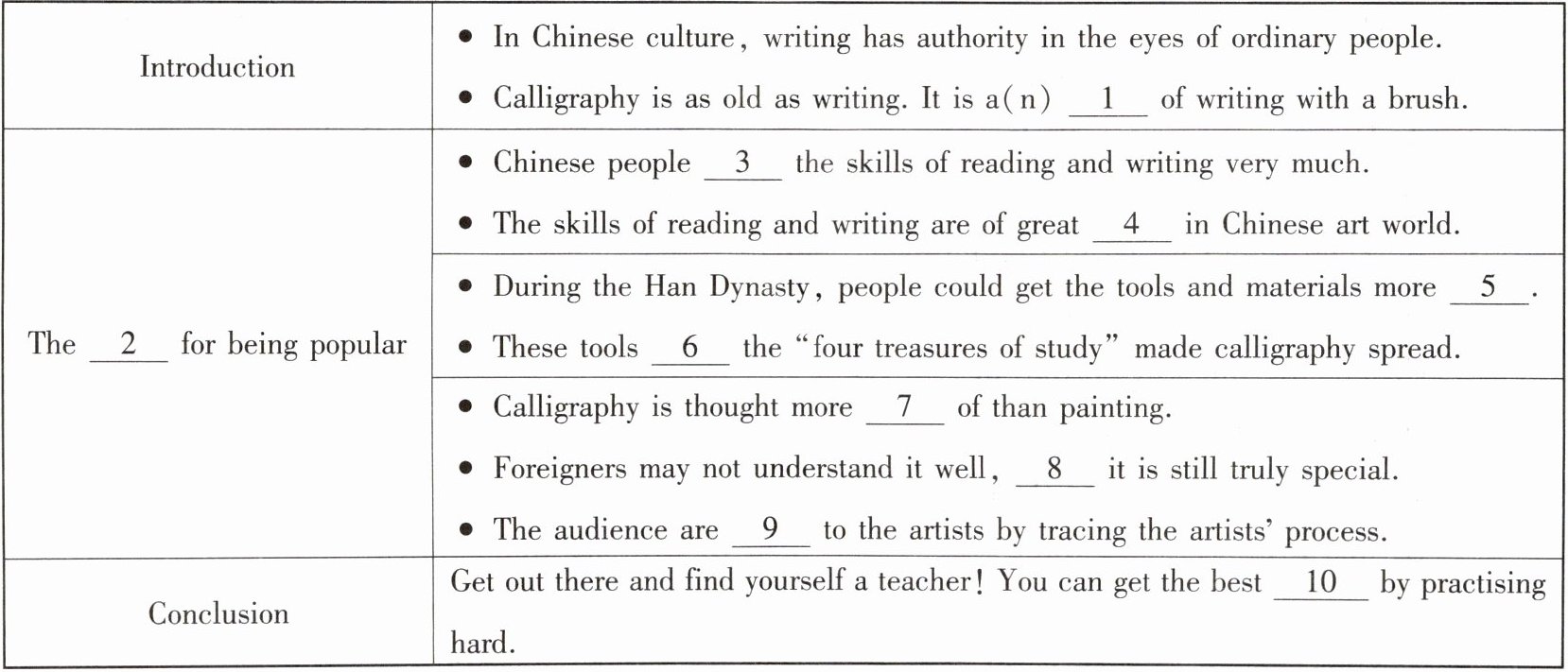
| Introduction | ● In Chinese culture, writing has authority in the eyes of ordinary people. ● Calligraphy is as old as writing. It is a(n) 1 of writing with a brush. |
| The 2 for being popular | ● Chinese people 3 the skills of reading and writing very much. ● The skills of reading and writing are of great 4 in Chinese art world. ● During the Han Dynasty, people could get the tools and materials more 5. ● These tools 6 the "four treasures of study" made calligraphy spread. ● Calligraphy is thought more 7 of than painting. ● Foreigners may not understand it well, 8 it is still truly special. ● The audience are 9 to the artists by tracing the artists' process. |
| Conclusion | Get out there and find yourself a teacher! You can get the best 10 by practising hard. |
1.
2.
3.
4.
5.
6.
7.
8.
9.
10.
The ancient art of the brush
Throughout its long history, writing has been a big deal in China. Since the earliest dynasties the skills of reading and writing have been highly respected. In fact, they form an important part of the Chinese art world. Calligraphy, the art of writing with a brush is almost as old as writing itself. And though this art form dates back thousands of years, it is still extremely popular today.
How did writing become so important in Chinese culture? The answer most likely lies way back in the Shang Dynasty. That's when characters were first carved in bronze and used in religious events. This practice conveyed a spiritual aspect which gave writing authority in the eyes of ordinary people.
Calligraphy spread during the Han Dynasty when the necessary tools and materials became more widely available. First, there was the brush, made from bamboo and animal hair. Early ink, or lampblack, was made by burning pinewood and mixing it with water. Early forms of paper were invented around AD 105. Finally, there was inkstone, a smooth piece of stone used for mixing ink. Together, these tools were known as the "four treasures of study" in ancient China.
Calligraphy has been popular in China for thousands of years. Some say that it's an even higher art form than painting. Though foreigners may not always get it, there's something truly special about calligraphy. Every written character has a strict stroke order. When viewing the results, you can trace the artist's process, reliving every stroke of his or her brush. This allows for an intimate connection between the artist and the audience.
Calligraphy is something that's best experienced by doing. Luckily, this ancient art is still widely practised today. So, what are you waiting for? Get out there and find yourself a teacher!
| Introduction | ● In Chinese culture, writing has authority in the eyes of ordinary people. ● Calligraphy is as old as writing. It is a(n) 1 of writing with a brush. |
| The 2 for being popular | ● Chinese people 3 the skills of reading and writing very much. ● The skills of reading and writing are of great 4 in Chinese art world. ● During the Han Dynasty, people could get the tools and materials more 5. ● These tools 6 the "four treasures of study" made calligraphy spread. ● Calligraphy is thought more 7 of than painting. ● Foreigners may not understand it well, 8 it is still truly special. ● The audience are 9 to the artists by tracing the artists' process. |
| Conclusion | Get out there and find yourself a teacher! You can get the best 10 by practising hard. |
1.
art
2.
reasons
3.
respect
4.
importance
5.
widely
6.
known as
7.
highly
8.
but
9.
connected
10.
experience
答案:
1. art
2. reasons
3. respect
4. importance
5. widely
6. known as
7. highly
8. but
9. connected
10. experience
2. reasons
3. respect
4. importance
5. widely
6. known as
7. highly
8. but
9. connected
10. experience
查看更多完整答案,请扫码查看

