

 搜索
搜索
第119页
- 第1页
- 第2页
- 第3页
- 第4页
- 第5页
- 第6页
- 第7页
- 第8页
- 第9页
- 第10页
- 第11页
- 第12页
- 第13页
- 第14页
- 第15页
- 第16页
- 第17页
- 第18页
- 第19页
- 第20页
- 第21页
- 第22页
- 第23页
- 第24页
- 第25页
- 第26页
- 第27页
- 第28页
- 第29页
- 第30页
- 第31页
- 第32页
- 第33页
- 第34页
- 第35页
- 第36页
- 第37页
- 第38页
- 第39页
- 第40页
- 第41页
- 第42页
- 第43页
- 第44页
- 第45页
- 第46页
- 第47页
- 第48页
- 第49页
- 第50页
- 第51页
- 第52页
- 第53页
- 第54页
- 第55页
- 第56页
- 第57页
- 第58页
- 第59页
- 第60页
- 第61页
- 第62页
- 第63页
- 第64页
- 第65页
- 第66页
- 第67页
- 第68页
- 第69页
- 第70页
- 第71页
- 第72页
- 第73页
- 第74页
- 第75页
- 第76页
- 第77页
- 第78页
- 第79页
- 第80页
- 第81页
- 第82页
- 第83页
- 第84页
- 第85页
- 第86页
- 第87页
- 第88页
- 第89页
- 第90页
- 第91页
- 第92页
- 第93页
- 第94页
- 第95页
- 第96页
- 第97页
- 第98页
- 第99页
- 第100页
- 第101页
- 第102页
- 第103页
- 第104页
- 第105页
- 第106页
- 第107页
- 第108页
- 第109页
- 第110页
- 第111页
- 第112页
- 第113页
- 第114页
- 第115页
- 第116页
- 第117页
- 第118页
- 第119页
- 第120页
- 第121页
- 第122页
- 第123页
- 第124页
- 第125页
- 第126页
- 第127页
- 第128页
- 第129页
- 第130页
- 第131页
- 第132页
- 第133页
- 第134页
- 第135页
- 第136页
- 第137页
- 第138页
- 第139页
- 第140页
- 第141页
- 第142页
- 第143页
(
—But I don't think she looks good ______ red.
A.dressed; in
B.put on; wear
C.wearing; in
D.wear; put on
C
) 4.—I saw Ann ______ a green dress at the meeting.—But I don't think she looks good ______ red.
A.dressed; in
B.put on; wear
C.wearing; in
D.wear; put on
答案:
C
(
—They are ______ than romantic stories.
A.much more exciting
B.so more exciting
C.much more excited
D.so more excited
A
) 5.—What do you think of detective stories?—They are ______ than romantic stories.
A.much more exciting
B.so more exciting
C.much more excited
D.so more excited
答案:
A
(
A.found
B.was found
C.were found
D.was founded
B
) 6.Early this morning, the body of a young man ______ in the middle of a street.A.found
B.was found
C.were found
D.was founded
答案:
B
三、阅读填空
Mr Dawson was an old grouch(好抱怨的人). Kids knew not to go into his yard to pick a delicious a 1 , even off the ground because old Dawson, they said, would come after you a 2 .
One Friday, Janet went to town with her friend Amy. They had to walk by Dawson's house, but as they got close Janet saw him sitting on his front porch. She s 3 they cross over to the other side of the street. Like most of the children, she was scared of the old man.
Amy said not to w 4 , and they went on. When they got close enough, Dawson looked up with his usual frown(皱眉), but when he saw it was Amy, a big s 5 changed his face. "Hello, Amy. I see you've got a friend with you today."
Amy smiled back and told him where they would go. Dawson seemed very i 6 and asked more questions. He even offered them each a fresh-picked apple off his tree.
When they left his house, Janet asked Amy, "Everyone says he's an old grouch. Why was he so n 7 to us?"
Amy explained that when she first walked past his house he wasn't very friendly, but she always smiled at h 8 . It took a while, and one day he smiled b 9 at her.
Smiles are contagious(传染的) and s 10 are angry looks. Giving a smile away takes so little effort and time. We should try to be the ones that smile to others instead of showing the anger.
1.
6.
Mr Dawson was an old grouch(好抱怨的人). Kids knew not to go into his yard to pick a delicious a 1 , even off the ground because old Dawson, they said, would come after you a 2 .
One Friday, Janet went to town with her friend Amy. They had to walk by Dawson's house, but as they got close Janet saw him sitting on his front porch. She s 3 they cross over to the other side of the street. Like most of the children, she was scared of the old man.
Amy said not to w 4 , and they went on. When they got close enough, Dawson looked up with his usual frown(皱眉), but when he saw it was Amy, a big s 5 changed his face. "Hello, Amy. I see you've got a friend with you today."
Amy smiled back and told him where they would go. Dawson seemed very i 6 and asked more questions. He even offered them each a fresh-picked apple off his tree.
When they left his house, Janet asked Amy, "Everyone says he's an old grouch. Why was he so n 7 to us?"
Amy explained that when she first walked past his house he wasn't very friendly, but she always smiled at h 8 . It took a while, and one day he smiled b 9 at her.
Smiles are contagious(传染的) and s 10 are angry looks. Giving a smile away takes so little effort and time. We should try to be the ones that smile to others instead of showing the anger.
1.
apple
2. angrily
3. suggested
4. worry
5. smile
6.
interested
7. nice
8. him
9. back
10. so
答案:
1. apple 2. angrily 3. suggested 4. worry 5. smile 6. interested 7. nice 8. him 9. back 10. so
四、任务型阅读
Rivers are the lifeblood of human civilizations. As one of the longest-lasting civilizations, China has a large number of rivers. A total of 45,203 rivers with a drainage area(流域面积) of more than 50 square kilometres run across the country, according to the National Bureau of Statistics.
The most famous ones are the Yangtze and Yellow Rivers. As the longest river in Asia and third longest in the world, the Yangtze River has a length of 6,300 kilometres. It originates from the Qinghai-Xizang Plateau(高原) and flows through 11 provincial-level administrative regions(省级行政区) before ending in the East China Sea. Second to the Yangtze River is the Yellow River, with a length of 5,464 kilometres as it flows from the west to the east of China.
Apart from its big number of natural rivers, China also has a lot of beautiful man-made rivers. The Grand Canal is one example. With a history of more than 2,500 years, the Grand Canal stretches(延伸) nearly 3,200 kilometres and connects the north and south of China.
Despite their different features, these rivers and canals continue to nourish(滋养) the Chinese people physically and culturally. They bring fertile(肥沃的) soil and enough irrigation(灌溉) water, which makes many areas "a land of fish and rice". Connecting China as a whole, the water network runs through geographical boundaries and provides people with convenient transportation, expanding trade and promoting economic growth. These rivers are immortalized(使名垂千古) in Chinese culture, as can be found in Chinese poetry, art, literature and folklore.
To protect these bodies of water, many measures have been taken in recent years. For example, in August the Ministry of Water Resources announced plans to bring back 700,000 hectares(公顷) of degraded natural forest and treat almost 1.4 million hectares of land suffering from desertification(沙漠化) by 2025.
Through these government measures, our rivers have seen many positive changes—birds flying above the wetlands and farmers happily harvesting on irrigated lands.
| Life flows through 1 | |
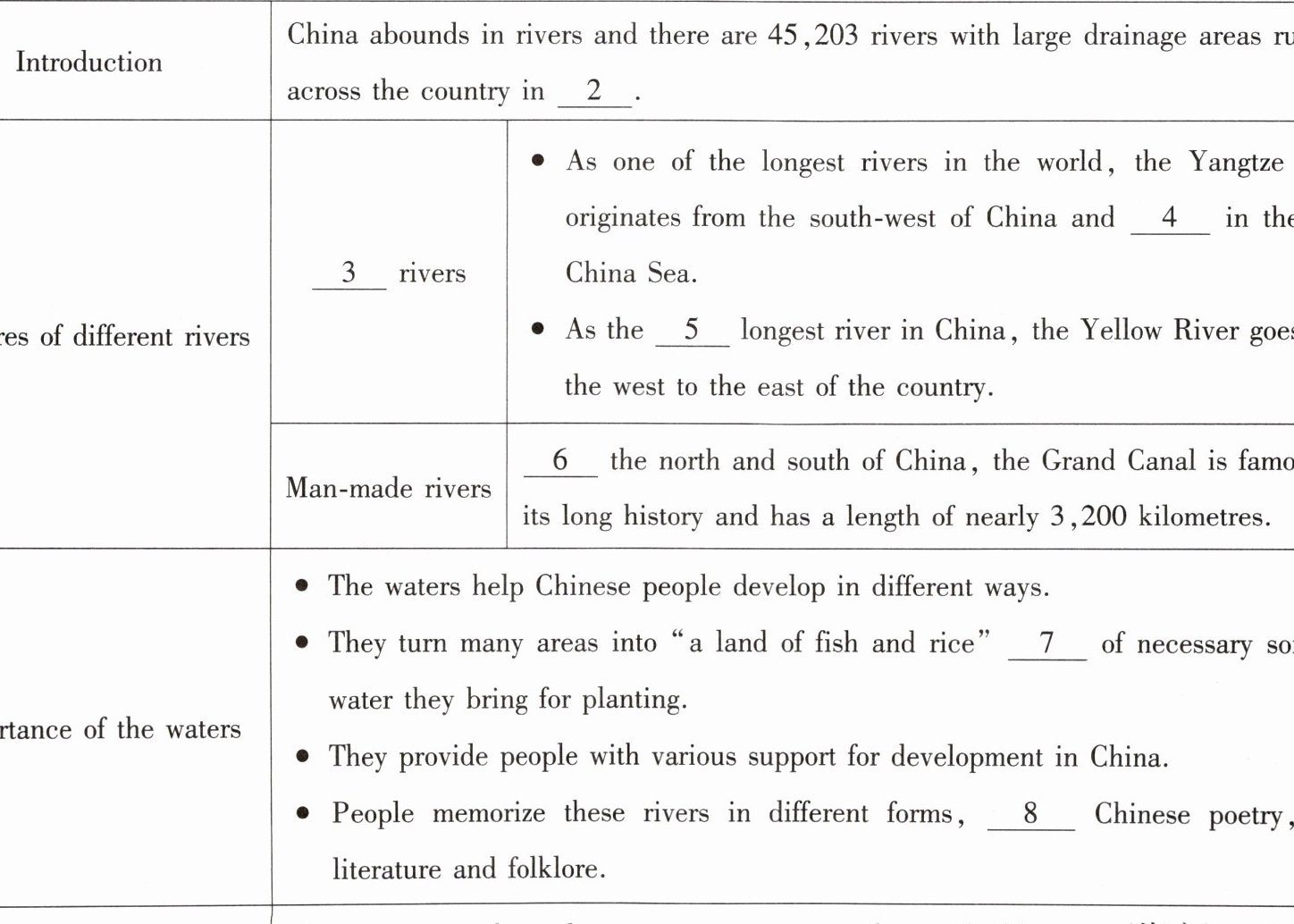
| Introduction | China abounds in rivers and there are 45,203 rivers with large drainage areas running across the country in 2. |
| Features of different rivers | 3 rivers | • As one of the longest rivers in the world, the Yangtze River originates from the south-west of China and 4 in the East China Sea. |
| | | • As the 5 longest river in China, the Yellow River goes from the west to the east of the country. |
| | Man-made rivers | 6 the north and south of China, the Grand Canal is famous for its long history and has a length of nearly 3,200 kilometres. |
| Importance of the waters | • The waters help Chinese people develop in different ways. | |
| | • They turn many areas into "a land of fish and rice" 7 of necessary soil and water they bring for planting. | |
| | • They provide people with various support for development in China. | |
| | • People memorize these rivers in different forms, 8 Chinese poetry, art, literature and folklore. | |
| | 9 of the waters | The government has taken measures to protect the invaluable assets(资产) in different ways. To our relief, our life is getting 10. | |
| 1. ______ 2. ______ 3. ______ 4. ______ 5. ______
| 6. ______ 7. ______ 8. ______ 9. ______ 10. ______
1.
6.
Rivers are the lifeblood of human civilizations. As one of the longest-lasting civilizations, China has a large number of rivers. A total of 45,203 rivers with a drainage area(流域面积) of more than 50 square kilometres run across the country, according to the National Bureau of Statistics.
The most famous ones are the Yangtze and Yellow Rivers. As the longest river in Asia and third longest in the world, the Yangtze River has a length of 6,300 kilometres. It originates from the Qinghai-Xizang Plateau(高原) and flows through 11 provincial-level administrative regions(省级行政区) before ending in the East China Sea. Second to the Yangtze River is the Yellow River, with a length of 5,464 kilometres as it flows from the west to the east of China.
Apart from its big number of natural rivers, China also has a lot of beautiful man-made rivers. The Grand Canal is one example. With a history of more than 2,500 years, the Grand Canal stretches(延伸) nearly 3,200 kilometres and connects the north and south of China.
Despite their different features, these rivers and canals continue to nourish(滋养) the Chinese people physically and culturally. They bring fertile(肥沃的) soil and enough irrigation(灌溉) water, which makes many areas "a land of fish and rice". Connecting China as a whole, the water network runs through geographical boundaries and provides people with convenient transportation, expanding trade and promoting economic growth. These rivers are immortalized(使名垂千古) in Chinese culture, as can be found in Chinese poetry, art, literature and folklore.
To protect these bodies of water, many measures have been taken in recent years. For example, in August the Ministry of Water Resources announced plans to bring back 700,000 hectares(公顷) of degraded natural forest and treat almost 1.4 million hectares of land suffering from desertification(沙漠化) by 2025.
Through these government measures, our rivers have seen many positive changes—birds flying above the wetlands and farmers happily harvesting on irrigated lands.
| Life flows through 1 | |
| Introduction | China abounds in rivers and there are 45,203 rivers with large drainage areas running across the country in 2. |
| Features of different rivers | 3 rivers | • As one of the longest rivers in the world, the Yangtze River originates from the south-west of China and 4 in the East China Sea. |
| | | • As the 5 longest river in China, the Yellow River goes from the west to the east of the country. |
| | Man-made rivers | 6 the north and south of China, the Grand Canal is famous for its long history and has a length of nearly 3,200 kilometres. |
| Importance of the waters | • The waters help Chinese people develop in different ways. | |
| | • They turn many areas into "a land of fish and rice" 7 of necessary soil and water they bring for planting. | |
| | • They provide people with various support for development in China. | |
| | • People memorize these rivers in different forms, 8 Chinese poetry, art, literature and folklore. | |
|
| 9 of the waters | The government has taken measures to protect the invaluable assets(资产) in different ways. To our relief, our life is getting 10. | || 1. ______ 2. ______ 3. ______ 4. ______ 5. ______
| 6. ______ 7. ______ 8. ______ 9. ______ 10. ______
1.
China's rivers
2. total
3. Natural
4. ends
5. second
6.
Connecting
7. because
8. like
9. Protection
10. better
答案:
1. China's rivers 2. total 3. Natural 4. ends 5. second 6. Connecting 7. because 8. like 9. Protection 10. better
查看更多完整答案,请扫码查看

