

 搜索
搜索
第77页
- 第1页
- 第2页
- 第3页
- 第4页
- 第5页
- 第6页
- 第7页
- 第8页
- 第9页
- 第10页
- 第11页
- 第12页
- 第13页
- 第14页
- 第15页
- 第16页
- 第17页
- 第18页
- 第19页
- 第20页
- 第21页
- 第22页
- 第23页
- 第24页
- 第25页
- 第26页
- 第27页
- 第28页
- 第29页
- 第30页
- 第31页
- 第32页
- 第33页
- 第34页
- 第35页
- 第36页
- 第37页
- 第38页
- 第39页
- 第40页
- 第41页
- 第42页
- 第43页
- 第44页
- 第45页
- 第46页
- 第47页
- 第48页
- 第49页
- 第50页
- 第51页
- 第52页
- 第53页
- 第54页
- 第55页
- 第56页
- 第57页
- 第58页
- 第59页
- 第60页
- 第61页
- 第62页
- 第63页
- 第64页
- 第65页
- 第66页
- 第67页
- 第68页
- 第69页
- 第70页
- 第71页
- 第72页
- 第73页
- 第74页
- 第75页
- 第76页
- 第77页
- 第78页
- 第79页
- 第80页
- 第81页
- 第82页
- 第83页
- 第84页
- 第85页
- 第86页
- 第87页
- 第88页
- 第89页
- 第90页
- 第91页
- 第92页
- 第93页
- 第94页
- 第95页
- 第96页
- 第97页
- 第98页
- 第99页
- 第100页
- 第101页
- 第102页
- 第103页
- 第104页
- 第105页
- 第106页
- 第107页
- 第108页
- 第109页
- 第110页
- 第111页
- 第112页
- 第113页
- 第114页
- 第115页
- 第116页
- 第117页
- 第118页
- 第119页
- 第120页
- 第121页
- 第122页
- 第123页
- 第124页
- 第125页
- 第126页
- 第127页
- 第128页
- 第129页
- 第130页
- 第131页
- 第132页
- 第133页
- 第134页
- 第135页
- 第136页
- 第137页
- 第138页
- 第139页
- 第140页
- 第141页
- 第142页
- 第143页
四、任务型阅读
"What a pretty jasmine flower! What a pretty jasmine flower! Nice to see and nice to smell! Praiseworthy scent, and white as well!"
Have you ever heard of this famous song, Molihua (Jasmine Flower)? Molihua is a Chinese folk song from Jiangsu Province. The song was so well-known that the jasmine flower became the Province Flower of Jiangsu in 2007. It was one of the first Chinese folk songs to be liked by people outside China. The song describes a custom of giving jasmine flowers, popular in the south of Yangtze River Delta region.
As time goes by, Molihua is popular both in China and abroad. The song made its first appearance in the 18th century. It was created during the Qianlong period of the Qing Dynasty. In 1896, the song was used as a national anthem by the Qing Chinese officials in Europe. In 1982, the song found a place on a UNESCO list of recommended songs and was put into the musical textbooks in Asia. When Hong Kong and Macau came back to China in 1997 and 1999, this music was played in the ceremonies (典礼). In 2008, an adaptation(改编) by Tan Dun and Wang Hesheng was played during the medal ceremonies at the Beijing Olympic Games. In 2018, with Second Farewell to Cambridge by the famous Chinese poet Xu Zhimo, Molihua was sung in Chinese by the Choir(合唱团) of King's College in Cambridge University. In its 500-year history, no other Chinese songs have ever been recorded. On the evening of February 15, 2022, Wang Yaping played part of the popular music Molihua on Shenzhou-13 to celebrate the Lantern Festival.
The song expresses sincere and simple feelings of Chinese people. People describe the music as heart-touching. It is such a beautiful song that it almost stands for China abroad. This melody is a cultural gift from the Chinese people to the world. With music, friendship is our message around the world.
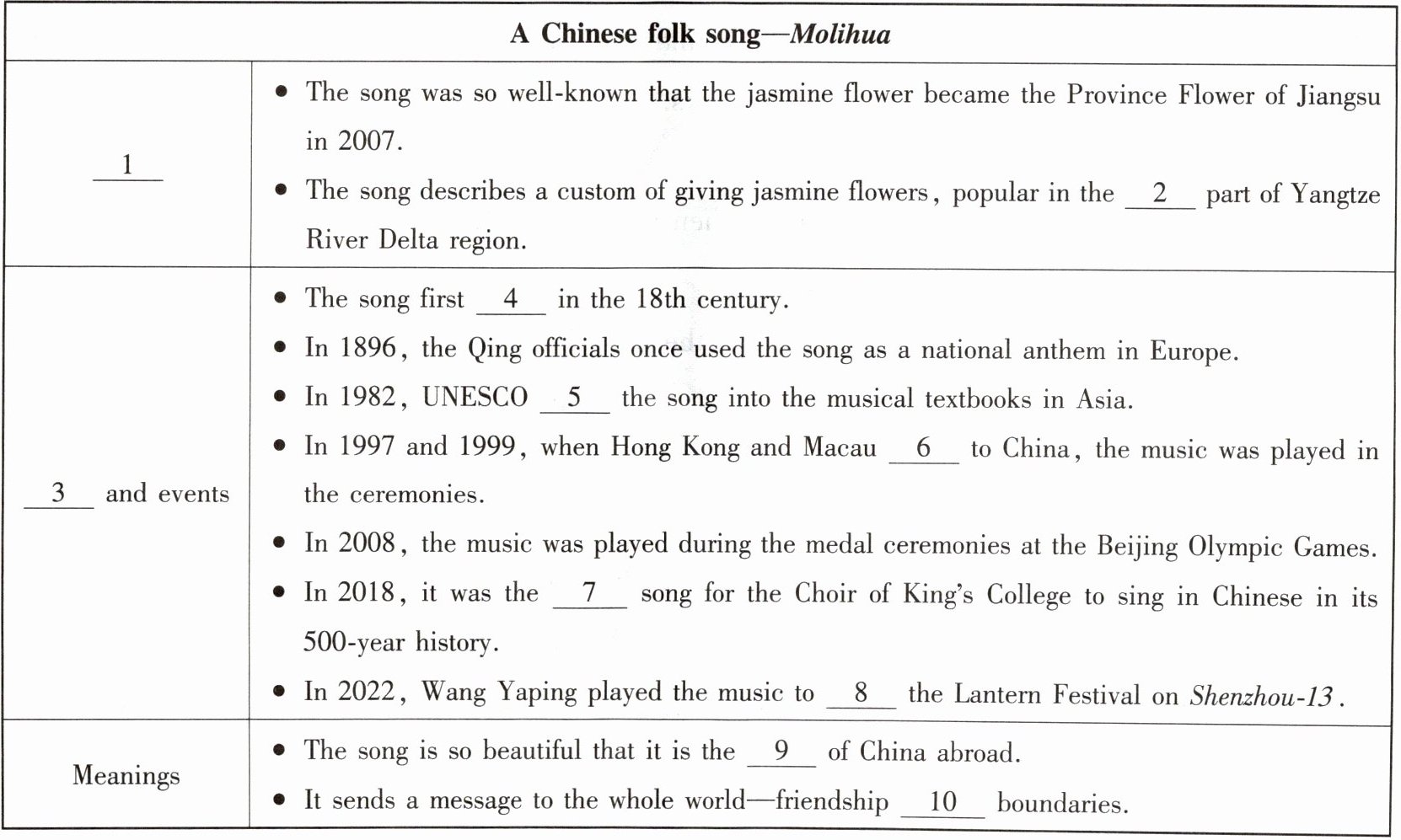
A Chinese folk song—Molihua
| | • The song was so well-known that the jasmine flower became the Province Flower of Jiangsu in 2007. • The song describes a custom of giving jasmine flowers, popular in the 2 part of Yangtze River Delta region. |
| :---: | :---: |
| 3 and events | • The song first 4 in the 18th century. • In 1896, the Qing officials once used the song as a national anthem in Europe. • In 1982, UNESCO 5 the song into the musical textbooks in Asia. • In 1997 and 1999, when Hong Kong and Macau 6 to China, the music was played in the ceremonies. • In 2008, the music was played during the medal ceremonies at the Beijing Olympic Games. • In 2018, it was the 7 song for the Choir of King's College to sing in Chinese in its 500-year history. • In 2022, Wang Yaping played the music to 8 the Lantern Festival on Shenzhou-13. |
| Meanings | • The song is so beautiful that it is the 9 of China abroad. • It sends a message to the whole world—friendship 10 boundaries. |
1.
6.
"What a pretty jasmine flower! What a pretty jasmine flower! Nice to see and nice to smell! Praiseworthy scent, and white as well!"
Have you ever heard of this famous song, Molihua (Jasmine Flower)? Molihua is a Chinese folk song from Jiangsu Province. The song was so well-known that the jasmine flower became the Province Flower of Jiangsu in 2007. It was one of the first Chinese folk songs to be liked by people outside China. The song describes a custom of giving jasmine flowers, popular in the south of Yangtze River Delta region.
As time goes by, Molihua is popular both in China and abroad. The song made its first appearance in the 18th century. It was created during the Qianlong period of the Qing Dynasty. In 1896, the song was used as a national anthem by the Qing Chinese officials in Europe. In 1982, the song found a place on a UNESCO list of recommended songs and was put into the musical textbooks in Asia. When Hong Kong and Macau came back to China in 1997 and 1999, this music was played in the ceremonies (典礼). In 2008, an adaptation(改编) by Tan Dun and Wang Hesheng was played during the medal ceremonies at the Beijing Olympic Games. In 2018, with Second Farewell to Cambridge by the famous Chinese poet Xu Zhimo, Molihua was sung in Chinese by the Choir(合唱团) of King's College in Cambridge University. In its 500-year history, no other Chinese songs have ever been recorded. On the evening of February 15, 2022, Wang Yaping played part of the popular music Molihua on Shenzhou-13 to celebrate the Lantern Festival.
The song expresses sincere and simple feelings of Chinese people. People describe the music as heart-touching. It is such a beautiful song that it almost stands for China abroad. This melody is a cultural gift from the Chinese people to the world. With music, friendship is our message around the world.
A Chinese folk song—Molihua
| | • The song was so well-known that the jasmine flower became the Province Flower of Jiangsu in 2007. • The song describes a custom of giving jasmine flowers, popular in the 2 part of Yangtze River Delta region. |
| :---: | :---: |
| 3 and events | • The song first 4 in the 18th century. • In 1896, the Qing officials once used the song as a national anthem in Europe. • In 1982, UNESCO 5 the song into the musical textbooks in Asia. • In 1997 and 1999, when Hong Kong and Macau 6 to China, the music was played in the ceremonies. • In 2008, the music was played during the medal ceremonies at the Beijing Olympic Games. • In 2018, it was the 7 song for the Choir of King's College to sing in Chinese in its 500-year history. • In 2022, Wang Yaping played the music to 8 the Lantern Festival on Shenzhou-13. |
| Meanings | • The song is so beautiful that it is the 9 of China abroad. • It sends a message to the whole world—friendship 10 boundaries. |
1.
Facts
2. southern
3. Time
4. appeared
5. put
6.
returned
7. first
8. celebrate
9. symbol
10. crosses
答案:
1. Facts
2. southern
3. Time
4. appeared
5. put
6. returned
7. first
8. celebrate
9. symbol
10. crosses
2. southern
3. Time
4. appeared
5. put
6. returned
7. first
8. celebrate
9. symbol
10. crosses
查看更多完整答案,请扫码查看

