

 搜索
搜索
第64页
- 第2页
- 第3页
- 第4页
- 第5页
- 第6页
- 第7页
- 第8页
- 第9页
- 第10页
- 第11页
- 第12页
- 第13页
- 第14页
- 第15页
- 第16页
- 第17页
- 第18页
- 第19页
- 第20页
- 第21页
- 第22页
- 第23页
- 第24页
- 第25页
- 第26页
- 第27页
- 第28页
- 第29页
- 第30页
- 第31页
- 第32页
- 第33页
- 第34页
- 第35页
- 第36页
- 第37页
- 第38页
- 第39页
- 第40页
- 第41页
- 第42页
- 第43页
- 第44页
- 第45页
- 第46页
- 第47页
- 第48页
- 第49页
- 第50页
- 第51页
- 第52页
- 第53页
- 第54页
- 第55页
- 第56页
- 第57页
- 第58页
- 第59页
- 第60页
- 第61页
- 第62页
- 第63页
- 第64页
- 第65页
- 第66页
- 第67页
- 第68页
- 第69页
- 第70页
- 第71页
- 第72页
- 第73页
- 第74页
- 第75页
- 第76页
- 第77页
- 第78页
- 第79页
- 第80页
- 第81页
- 第82页
- 第83页
- 第84页
- 第85页
- 第86页
- 第87页
- 第88页
- 第89页
- 第90页
- 第91页
- 第92页
- 第93页
- 第94页
- 第95页
- 第96页
- 第97页
- 第98页
- 第99页
- 第100页
- 第101页
- 第102页
- 第103页
- 第104页
五、阅读理解
Still remember the following poems? Memories return every time I read or hear them.
| | Hush now, my little one. Hush now, my sunshine. Hush now, piece of my heart. Go to sleep, my little one. Go to sleep, my love. Go to sleep, piece of my heart. Sleep, my little one, When I sing to you. Sleep, my little one, Who is already asleep. |
| ① | |
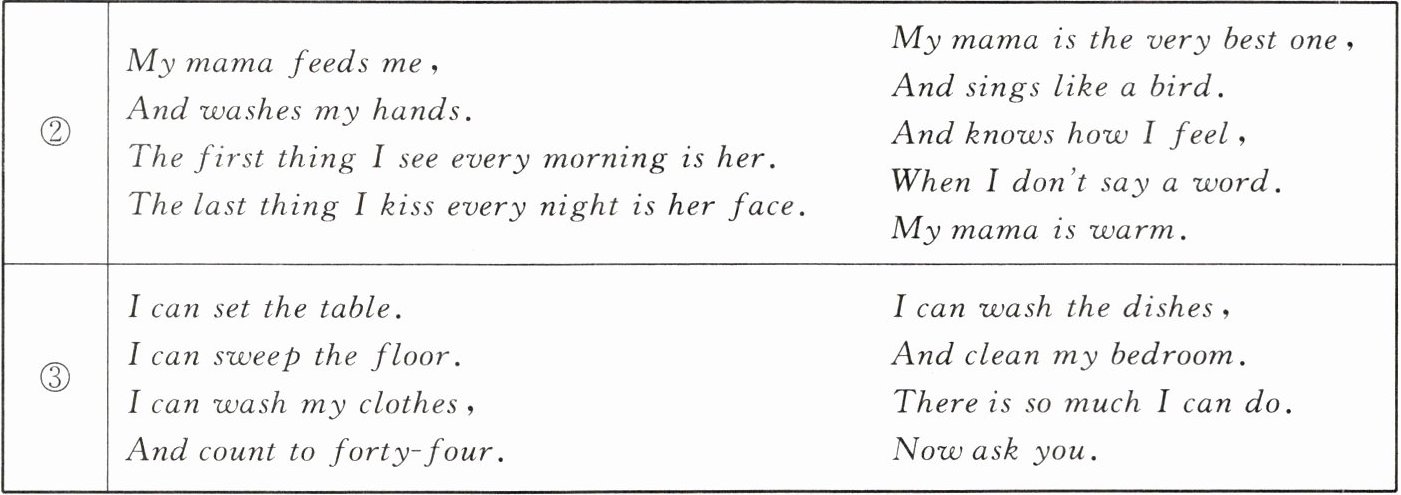
| ② | My mama feeds me, And washes my hands. The first thing I see every morning is her. The last thing I kiss every night is her face. My mama is the very best one, And sings like a bird. And knows how I feel, When I don’t say a word. My mama is warm. |
| ③ | I can set the table. I can sweep the floor. I can wash my clothes, And count to forty - four. I can wash the dishes, And clean my bedroom. There is so much I can do. Now ask you. |
(
A. Babies. B. Mothers. C. Relatives. D. Friends.
(
A. Talk back. B. Be happy. C. Grow up. D. Be quiet.
(
A. The fur. B. Mom’s face. C. A bird. D. Mom’s bed.
(
A. Helpful. B. Lucky. C. Crazy. D. Shy.
(
A. Food and health. B. Hobbies and sports.
C. Family and love. D. Animals and humans.
Still remember the following poems? Memories return every time I read or hear them.
| | Hush now, my little one. Hush now, my sunshine. Hush now, piece of my heart. Go to sleep, my little one. Go to sleep, my love. Go to sleep, piece of my heart. Sleep, my little one, When I sing to you. Sleep, my little one, Who is already asleep. |
| ① | |
| ② | My mama feeds me, And washes my hands. The first thing I see every morning is her. The last thing I kiss every night is her face. My mama is the very best one, And sings like a bird. And knows how I feel, When I don’t say a word. My mama is warm. |
| ③ | I can set the table. I can sweep the floor. I can wash my clothes, And count to forty - four. I can wash the dishes, And clean my bedroom. There is so much I can do. Now ask you. |
(
A
)1. Who is the first poem sung to?A. Babies. B. Mothers. C. Relatives. D. Friends.
(
D
)2. What does the underlined word “Hush” in the first poem mean?A. Talk back. B. Be happy. C. Grow up. D. Be quiet.
(
B
)3. In the second poem, what will “I” kiss at night?A. The fur. B. Mom’s face. C. A bird. D. Mom’s bed.
(
A
)4. What do you think of “I” in the third poem?A. Helpful. B. Lucky. C. Crazy. D. Shy.
(
C
)5. What are the three poems mainly about?A. Food and health. B. Hobbies and sports.
C. Family and love. D. Animals and humans.
答案:
1.A 2.D 3.B 4.A 5.C
译文:
诗歌①:
安静点,我的小家伙。
安静点,我的阳光。
安静点,我的心头肉。
去睡觉吧,我的小家伙。
去睡觉吧,我的爱人。
去睡觉吧,我的心头肉。
睡吧,我的小家伙,
当我为你歌唱时。
睡吧,我的小家伙,
那个已经睡着的人。
诗歌②:
我妈妈喂我吃饭,
给我洗手。
我每天早上第一眼看到的是她。
我每晚最后亲吻的是她的脸。
我妈妈是最棒的,
唱歌像小鸟一样。
知道我的感受,
即使我一言不发。
我妈妈很温暖。
诗歌③:
我会摆餐桌。
我会扫地。
我会洗衣服,
还能数到四十四。
我会洗碗,
打扫我的卧室。
我能做的事情太多了。
现在问问你。
1. 答案:A
句意:第一首诗是唱给谁的?
选项含义:A. 婴儿;B. 母亲;C. 亲戚;D. 朋友。
解析:诗歌①第一行提到“Hush now, my little one.(安静点,我的小家伙。)”第四行提到“Go to sleep, my little one.(去睡觉吧,我的小家伙。)”,是哄婴儿睡觉的内容,故选A。
2. 答案:D
句意:第一首诗中划线的“Hush”是什么意思?
选项含义:A. 顶嘴;B. 开心;C. 长大;D. 安静。
解析:诗歌①是哄婴儿睡觉的场景,“Hush”在此处是让婴儿安静下来,意为“安静”,故选D。
3. 答案:B
句意:在第二首诗中,“我”晚上会亲吻什么?
选项含义:A. 皮毛;B. 妈妈的脸;C. 鸟;D. 妈妈的床。
解析:诗歌②第四行提到“The last thing I kiss every night is her face.(我每晚最后亲吻的是她的脸。)”,故选B。
4. 答案:A
句意:你觉得第三首诗里的“我”怎么样?
选项含义:A. 乐于助人的;B. 幸运的;C. 疯狂的;D. 害羞的。
解析:诗歌③提到“I can set the table... wash the dishes... clean my bedroom(我会摆餐桌、洗碗、打扫卧室等)”,说明“我”会做很多家务,是乐于助人的,故选A。
5. 答案:C
句意:这三首诗主要关于什么?
选项含义:A. 食物和健康;B. 爱好和运动;C. 家庭和爱;D. 动物和人类。
解析:诗歌①是母亲哄婴儿(家庭爱),诗歌②歌颂母亲(家庭爱),诗歌③讲述自己做家务(家庭中的贡献与爱),主题是家庭和爱,故选C。
六、阅读下面短文,在空白处填入一个适当的词,或填入括号中所给单词的正确形式
Vincent got up at half past six in the morning. He hurriedly finished the breakfast that 1. (
Dad’s car was already there. “You are 3. (
“I’ve told you hundreds of times. Mom will be back in two 5. (
“Not at all. Is work 8. (
读后词汇拓展
猜出画波浪线单词的词性和中文意思,并收入自己的小词典。
nod
Vincent got up at half past six in the morning. He hurriedly finished the breakfast that 1. (
was prepared
) by Grandma. His grandparents were the only two people living with him. As soon as he said goodbye to them, Vincent rushed out to the small car park 2. (happily
).Dad’s car was already there. “You are 3. (
earlier
) than I expected, Dad,” said Vincent, and he got into the car. “I miss you,” Dad said and drove off. “Me too. 4. When
can I live with Mom and you again?” asked Vincent.“I’ve told you hundreds of times. Mom will be back in two 5. (
months
). We will live together again then. Mom loves her job and she wants to take the chance 6. (to meet
) more clients(客户),” Dad explained. “And her boss told her that she might become the manager from 7. a
usual clerk. Are you happy?”“Not at all. Is work 8. (
more important
) than me?” asked Vincent. “No, of course not. You are the most important to us, 9. but
we have to work. You will understand us when you grow up,” said Dad as he stopped at the school gate. Vincent got out 10. of
the car. Dad drove away, going to his office.读后词汇拓展
猜出画波浪线单词的词性和中文意思,并收入自己的小词典。
nod
v. 点头
答案:
1. was prepared 2. happily 3. earlier 4. When 5. months 6. to meet 7. a 8. more important 9. but 10. of
读后词汇拓展 v. 点头
读后词汇拓展 v. 点头
译文:
文森特早上六点半起床。他匆匆吃完奶奶准备的早餐。只有他的爷爷奶奶和他一起住。他一和他们道别,就开心地冲向小型停车场。
爸爸的车已经在那儿了。“爸爸,你比我预期的来得早,”文森特说着上了车。“我想你了,”爸爸说着开车离开。“我也是。我什么时候能再和你和妈妈住在一起?”文森特问。
“我已经告诉你好几百次了。妈妈两个月后回来。到时候我们又会一起住。妈妈喜欢她的工作,她想抓住机会结识更多客户,”爸爸解释道。“而且她的老板告诉她,她可能会从普通职员变成经理。你开心吗?”
“一点也不。工作比我还重要吗?”文森特问。“不,当然不是。你对我们来说是最重要的,但我们必须工作。等你长大了就会理解我们了,”爸爸在学校门口停车时说道。
文森特下了车。爸爸开车离开,去他的办公室了。
1. 答案:was prepared
句意:他匆匆吃完奶奶准备的早餐。
解析:“breakfast”和“prepare”是被动关系,且动作发生在过去,用一般过去时的被动语态,结构为“was/were + 过去分词”,“breakfast”是单数,故填was prepared。
2. 答案:happily
句意:他一和他们道别,就开心地冲向小型停车场。
解析:此处需要副词修饰动词“rushed”,“happy”的副词形式是“happily”,故填happily。
3. 答案:earlier
句意:“爸爸,你比我预期的来得早,”文森特说着上了车。
解析:“than”是比较级的标志,“early”的比较级是“earlier”,故填earlier。
4. 答案:When
句意:“我也是。我什么时候能再和你和妈妈住在一起?”文森特问。
解析:根据语境,此处询问时间,用特殊疑问词“When”,句首首字母大写,故填When。
5. 答案:months
句意:“我已经告诉你好几百次了。妈妈两个月后回来。”
解析:“two”后接可数名词复数,“month”的复数是“months”,故填months。
6. 答案:to meet
句意:妈妈喜欢她的工作,她想抓住机会结识更多客户。
解析:“take the chance to do sth.”是固定搭配,意为“抓住机会做某事”,故填to meet。
7. 答案:a
句意:而且她的老板告诉她,她可能会从普通职员变成经理。
解析:“usual clerk”是单数可数名词,且“usual”以辅音音素开头,用不定冠词“a”修饰,故填a。
8. 答案:more important
句意:“一点也不。工作比我还重要吗?”文森特问。
解析:“than”是比较级的标志,“important”是多音节形容词,比较级为“more important”,故填more important。
9. 答案:but
句意:“不,当然不是。你对我们来说是最重要的,但我们必须工作。”
解析:前后句是转折关系,用连词“but”,故填but。
10. 答案:of
句意:文森特下了车。
解析:“get out of”是固定短语,意为“从……出来”,故填of。
查看更多完整答案,请扫码查看

