

 搜索
搜索
第19页
- 第1页
- 第2页
- 第3页
- 第4页
- 第5页
- 第6页
- 第7页
- 第8页
- 第9页
- 第10页
- 第11页
- 第12页
- 第13页
- 第14页
- 第15页
- 第16页
- 第17页
- 第18页
- 第19页
- 第20页
- 第21页
- 第22页
- 第23页
- 第24页
- 第25页
- 第26页
- 第27页
- 第28页
- 第29页
- 第30页
- 第31页
- 第32页
- 第33页
- 第34页
- 第35页
- 第36页
- 第37页
- 第38页
- 第39页
- 第40页
- 第41页
- 第42页
- 第43页
- 第44页
- 第45页
- 第46页
- 第47页
- 第48页
- 第49页
- 第50页
- 第51页
- 第52页
- 第53页
- 第54页
- 第55页
- 第56页
- 第57页
- 第58页
- 第59页
- 第60页
- 第61页
- 第62页
- 第63页
- 第64页
- 第65页
- 第66页
- 第67页
- 第68页
- 第69页
- 第70页
- 第71页
- 第72页
- 第73页
- 第74页
- 第75页
- 第76页
- 第77页
- 第78页
- 第79页
- 第80页
- 第81页
- 第82页
(2024江西修水期末改编)
A
Wait to be seated by the host. The host will say “Buen provecho” (meaning “enjoy” or “have a good meal”) as an invitation to start eating.
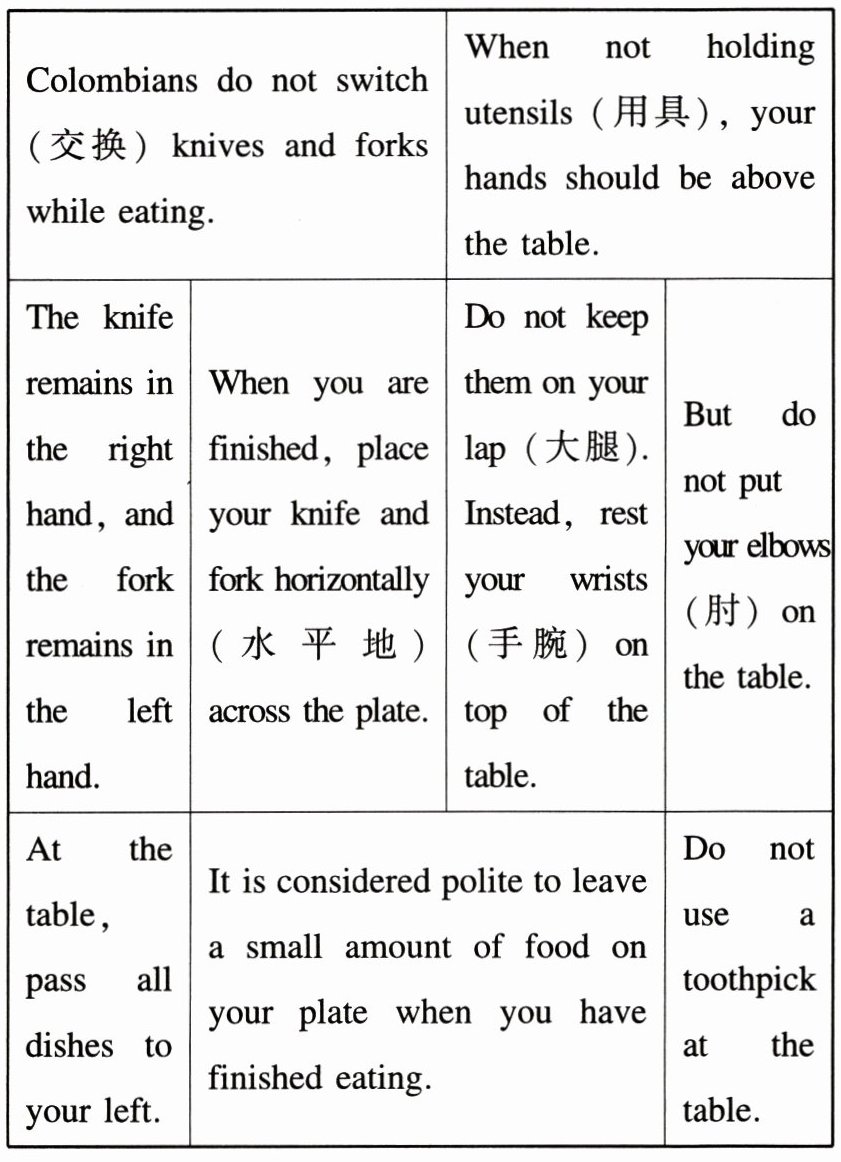
16.Where should the knife be while you are eating in Colombia?
A.On the table.
B.On the plate.
C.In your right hand.
D.In your left hand.
17.What is considered polite in Colombia?
A.Putting your elbows on the table.
B.Using a toothpick at the table.
C.Passing all the dishes to your right.
D.Leaving a little food on the plate after finishing eating.
18.What is the passage mainly about?
A.Table manners in Colombia.
B.Travel tips in Colombia.
C.Special food in Colombia.
D.Things used at Colombian dinner.
A
Wait to be seated by the host. The host will say “Buen provecho” (meaning “enjoy” or “have a good meal”) as an invitation to start eating.
16.Where should the knife be while you are eating in Colombia?
A.On the table.
B.On the plate.
C.In your right hand.
D.In your left hand.
17.What is considered polite in Colombia?
A.Putting your elbows on the table.
B.Using a toothpick at the table.
C.Passing all the dishes to your right.
D.Leaving a little food on the plate after finishing eating.
18.What is the passage mainly about?
A.Table manners in Colombia.
B.Travel tips in Colombia.
C.Special food in Colombia.
D.Things used at Colombian dinner.
答案:
16. C 细节理解题。根据表格中“The knife remains in the right hand, and the fork remains in the left hand.”可知,当你在哥伦比亚吃饭时,右手拿刀,左手拿叉。故选C。
17. D 细节理解题。根据表格中“It is considered polite to leave a small amount of food on your plate when you have finished eating.”可知,吃完饭后在盘子里留下一点食物被认为是有礼貌的。故选D。
18. A 主旨大意题。通读全文可知,文章主要介绍了哥伦比亚的餐桌礼仪。故选A。
B
Good gift - giving is welcome all over the world but it is not the same in different countries. Here are some examples.
China has a long history of gift - giving culture. If you want to send others gifts there, you had better give them the gifts yourself and give your wishes face to face. In China, even if a gift is precious, the giver always has to tell the receiver that this expensive gift is just “a little gift”. And if you receive gifts from a Chinese friend, it is not polite to open them in front of the giver.
Unlike in China, when you receive a gift in Japan, you must open it in front of the giver. Whether you like it or not, you must praise the gift to show you like it very much. In this way, both the receiver and the giver will be happy. No other countries could take gift - giving seriously like Japan. Gift - givers often pack gifts in white paper. They use white paper to keep dirty things out so that the gift is clean.
Italians usually do not bring gifts when they visit others. They send gifts the next day or even later. It is to show respect (尊敬) and can help the givers choose right gifts. Usually wine (葡萄酒) is a popular gift. Chocolate is also a good choice. In Italy, a handkerchief (手帕) is not welcome as a gift. A handkerchief is the symbol of saying goodbye.
19.What does the underlined word “precious” mean?
A.excellent B.valuable
C.magical D.special
20.Which paragraph is about Japanese gift - giving?
A.Paragraph 1. B.Paragraph 2.
C.Paragraph 3. D.Paragraph 4.
21.If you want to send your Italian friend a gift, you can send all the following things EXCEPT ______.
A.a handkerchief B.chocolate
C.white wine D.red wine
22.What can we learn from the passage?
A.Japanese people like opening a gift after the giver leaves.
B.Chinese people always like giving a little gift to each other.
C.In Italy, people send gifts to their friends the day before the party.
D.To keep dirty things away, Japanese people use white paper to pack gifts.
23.What is the best title for the passage?
A.Experiences of Gift - giving
B.Gifts in Different Countries
C.Experiences of Gift - receiving
D.Gift - giving Traditions in Different Countries
Good gift - giving is welcome all over the world but it is not the same in different countries. Here are some examples.
China has a long history of gift - giving culture. If you want to send others gifts there, you had better give them the gifts yourself and give your wishes face to face. In China, even if a gift is precious, the giver always has to tell the receiver that this expensive gift is just “a little gift”. And if you receive gifts from a Chinese friend, it is not polite to open them in front of the giver.
Unlike in China, when you receive a gift in Japan, you must open it in front of the giver. Whether you like it or not, you must praise the gift to show you like it very much. In this way, both the receiver and the giver will be happy. No other countries could take gift - giving seriously like Japan. Gift - givers often pack gifts in white paper. They use white paper to keep dirty things out so that the gift is clean.
Italians usually do not bring gifts when they visit others. They send gifts the next day or even later. It is to show respect (尊敬) and can help the givers choose right gifts. Usually wine (葡萄酒) is a popular gift. Chocolate is also a good choice. In Italy, a handkerchief (手帕) is not welcome as a gift. A handkerchief is the symbol of saying goodbye.
19.What does the underlined word “precious” mean?
A.excellent B.valuable
C.magical D.special
20.Which paragraph is about Japanese gift - giving?
A.Paragraph 1. B.Paragraph 2.
C.Paragraph 3. D.Paragraph 4.
21.If you want to send your Italian friend a gift, you can send all the following things EXCEPT ______.
A.a handkerchief B.chocolate
C.white wine D.red wine
22.What can we learn from the passage?
A.Japanese people like opening a gift after the giver leaves.
B.Chinese people always like giving a little gift to each other.
C.In Italy, people send gifts to their friends the day before the party.
D.To keep dirty things away, Japanese people use white paper to pack gifts.
23.What is the best title for the passage?
A.Experiences of Gift - giving
B.Gifts in Different Countries
C.Experiences of Gift - receiving
D.Gift - giving Traditions in Different Countries
答案:
19. B 词义猜测题。even if即使,引导让步状语从句。结合后面的this expensive gift可知,画线词与expensive是同义词。由此推知,这里的precious与valuable同义,意为“贵重的”。故选B。 20. C 段落大意题。从第三段开头的“Unlike in China, when you receive a gift in Japan, you must open it in front of the giver.”可知,第三段是关于日本的送礼习俗的。故选C。 21. A 细节理解题。从最后一段中“Usually wine is a popular gift. Chocolate is also a good choice. In Italy, a handkerchief is not welcome as a gift.”可知,在意大利,酒和巧克力都是受人欢迎的礼物,然而手帕作为礼物却不受欢迎。由此可知,如果你想给意大利朋友送礼物,千万不要送手帕。故选A。 22. D 细节理解题。从第三段中“Gift - givers often pack gifts in white paper. They use white paper to keep dirty things out so that the gift is clean.”可知,在日本,送礼的人常用白纸包装礼物,其目的是让礼物保持干净。故选D。 23. D 标题归纳题。本文主要告诉我们,不同的国家有不同的送礼习俗。故选D。
C
(2024河北顺平二模)
What do you think is an important social skill? I think it’s being polite. It can help you make friends, show respect and achieve success. Here are some tips to help you be polite.
Greet people politely. You can be polite by offering a proper greeting. When first meeting or greeting someone, give him or her a warm smile. It shows that you are in good spirits and are happy to see him. Also, shake hands to show respect.
Make small talk. Instead of jumping right into business, you can make small talk first. Talk about their lunch or their day. Listen carefully and pay attention to what they are saying to you. Show them you’re interested by asking questions.
Congratulate other people on their success. When others do well, offer them your praise. If you meet a friend who has recently graduated, won a match, or got a new job, congratulate him.
Avoid uncomfortable topics. Some topics can make people uncomfortable. You might hurt other people’s feelings if you talk about them. Try to keep your conversation in the pleasant areas.
Make eye contact (接触). When in conversation with someone, look them in the eye when you’re speaking. Keeping eye contact shows that you are paying attention. However, don’t stare at people all the time.
24.新考法·开篇方式题 How does the writer begin the text?
A.By giving examples.
B.By telling a piece of news.
C.By asking a question.
D.By showing a saying.
25.What can we do to show our interest when talking?
A.Smile. B.Ask questions.
C.Offer praise. D.Shake hands.
26.What can’t we get from the text?
A.Congratulating others is helpful.
B.Finding comfortable topics can be pleasant.
C.Keeping eye contact is necessary.
D.Staring at people all the time can show respect.
27.新考法·写作目的题 What is the writer trying to do in the text?
A.Introduce some tips to be polite.
B.Explain the ways of greeting others.
C.Teach us how to make small talk.
D.Discuss some hot topics.
(2024河北顺平二模)
What do you think is an important social skill? I think it’s being polite. It can help you make friends, show respect and achieve success. Here are some tips to help you be polite.
Greet people politely. You can be polite by offering a proper greeting. When first meeting or greeting someone, give him or her a warm smile. It shows that you are in good spirits and are happy to see him. Also, shake hands to show respect.
Make small talk. Instead of jumping right into business, you can make small talk first. Talk about their lunch or their day. Listen carefully and pay attention to what they are saying to you. Show them you’re interested by asking questions.
Congratulate other people on their success. When others do well, offer them your praise. If you meet a friend who has recently graduated, won a match, or got a new job, congratulate him.
Avoid uncomfortable topics. Some topics can make people uncomfortable. You might hurt other people’s feelings if you talk about them. Try to keep your conversation in the pleasant areas.
Make eye contact (接触). When in conversation with someone, look them in the eye when you’re speaking. Keeping eye contact shows that you are paying attention. However, don’t stare at people all the time.
24.新考法·开篇方式题 How does the writer begin the text?
A.By giving examples.
B.By telling a piece of news.
C.By asking a question.
D.By showing a saying.
25.What can we do to show our interest when talking?
A.Smile. B.Ask questions.
C.Offer praise. D.Shake hands.
26.What can’t we get from the text?
A.Congratulating others is helpful.
B.Finding comfortable topics can be pleasant.
C.Keeping eye contact is necessary.
D.Staring at people all the time can show respect.
27.新考法·写作目的题 What is the writer trying to do in the text?
A.Introduce some tips to be polite.
B.Explain the ways of greeting others.
C.Teach us how to make small talk.
D.Discuss some hot topics.
答案:
24. C 开篇方式题。根据第一段中“What do you think is an important social skill?”可知,作者是以一个问题开始这篇文章的。故选C。 25. B 细节理解题。根据第三段中“Show them you're interested by asking questions.”可知,通过问问题来表示你对他们感兴趣。故选B。 26. D 细节理解题。根据本文最后一句“However, don't stare at people all the time.”可知,不要一直盯着别人看。故选D。 27. A 写作目的题。本文从五个方面介绍了在社交中怎样做到有礼貌。故选A。
查看更多完整答案,请扫码查看

