

 搜索
搜索
第123页
- 第1页
- 第2页
- 第3页
- 第4页
- 第5页
- 第6页
- 第7页
- 第8页
- 第9页
- 第10页
- 第11页
- 第12页
- 第13页
- 第14页
- 第15页
- 第16页
- 第17页
- 第18页
- 第19页
- 第20页
- 第21页
- 第22页
- 第23页
- 第24页
- 第25页
- 第26页
- 第27页
- 第28页
- 第29页
- 第30页
- 第31页
- 第32页
- 第33页
- 第34页
- 第35页
- 第36页
- 第37页
- 第38页
- 第39页
- 第40页
- 第41页
- 第42页
- 第43页
- 第44页
- 第45页
- 第46页
- 第47页
- 第48页
- 第49页
- 第50页
- 第51页
- 第52页
- 第53页
- 第54页
- 第55页
- 第56页
- 第57页
- 第58页
- 第59页
- 第60页
- 第61页
- 第62页
- 第63页
- 第64页
- 第65页
- 第66页
- 第67页
- 第68页
- 第69页
- 第70页
- 第71页
- 第72页
- 第73页
- 第74页
- 第75页
- 第76页
- 第77页
- 第78页
- 第79页
- 第80页
- 第81页
- 第82页
- 第83页
- 第84页
- 第85页
- 第86页
- 第87页
- 第88页
- 第89页
- 第90页
- 第91页
- 第92页
- 第93页
- 第94页
- 第95页
- 第96页
- 第97页
- 第98页
- 第99页
- 第100页
- 第101页
- 第102页
- 第103页
- 第104页
- 第105页
- 第106页
- 第107页
- 第108页
- 第109页
- 第110页
- 第111页
- 第112页
- 第113页
- 第114页
- 第115页
- 第116页
- 第117页
- 第118页
- 第119页
- 第120页
- 第121页
- 第122页
- 第123页
- 第124页
- 第125页
一、请为与后缀 -ly 相关的三类变化各举三个例子
(例:bad→badly)
| 1. 形容词变副词 | 2. 名词变形容词 | 3. 形容词变形容词 |
| | | |

(例:bad→badly)
| 1. 形容词变副词 | 2. 名词变形容词 | 3. 形容词变形容词 |
| | | |
答案:
| 1. 形容词变副词 | 2. 名词变形容词 | 3. 形容词变形容词 |
| --- | --- | --- |
| quick→quickly
slow→slowly
careful→carefully | friend→friendly
love→lovely
day→daily | good→goodly
ill→illy
low→lowly |
| --- | --- | --- |
| quick→quickly
slow→slowly
careful→carefully | friend→friendly
love→lovely
day→daily | good→goodly
ill→illy
low→lowly |
二、请为加后缀 -ly 的三种情况各举三个例子
| 1. 直接加 -ly | 2. 词尾为 le,变 e 为 y | 3. 词尾为 y,先变 y 为 i,再加 -ly |
| | | |
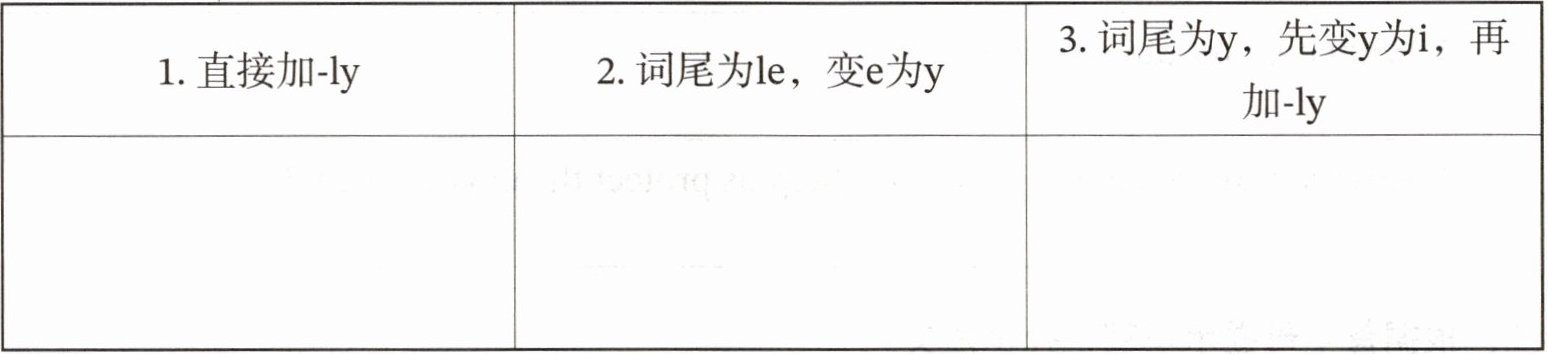
| 1. 直接加 -ly | 2. 词尾为 le,变 e 为 y | 3. 词尾为 y,先变 y 为 i,再加 -ly |
| | | |
答案:
| 1. 直接加 -ly | 2. 词尾为 le,变 e 为 y | 3. 词尾为 y,先变 y 为 i,再加 -ly |
| --- | --- | --- |
| quick - quickly
slow - slowly
clear - clearly | gentle - gently
simple - simply
possible - possibly | happy - happily
heavy - heavily
angry - angrily |
| --- | --- | --- |
| quick - quickly
slow - slowly
clear - clearly | gentle - gently
simple - simply
possible - possibly | happy - happily
heavy - heavily
angry - angrily |
三、用括号中所给单词的正确形式填空
Protect the coral reef
A coral reef is like a magical underwater city. It is full of colourful fish, strange sea plants and amazing coral.
In this beautiful place, small fish swim $^{(1)}$ ____ (quick) among the coral, looking for food. Big sea turtles move $^{(2)}$ ____ (slow), as if they were taking a peaceful walk. Crabs crawl (爬行) $^{(3)}$ ____ (careful) in the sand, trying not to be noticed. Some small shrimps (虾) work $^{(4)}$ ____ (real) hard to clean the coral reef.
However, humans are making trouble. Some boats make loud noises when passing by coral reefs. That is not $^{(5)}$ ____ (friend) to the sea animals. We also fish too much and pollute the sea. These human activities are hurting coral reefs, and many sea animals are losing their homes.
We need to act now. Let's stop polluting and protect coral reefs. Only in this way can we keep this type of amazing ecosystem alive.
Protect the coral reef
A coral reef is like a magical underwater city. It is full of colourful fish, strange sea plants and amazing coral.
In this beautiful place, small fish swim $^{(1)}$ ____ (quick) among the coral, looking for food. Big sea turtles move $^{(2)}$ ____ (slow), as if they were taking a peaceful walk. Crabs crawl (爬行) $^{(3)}$ ____ (careful) in the sand, trying not to be noticed. Some small shrimps (虾) work $^{(4)}$ ____ (real) hard to clean the coral reef.
However, humans are making trouble. Some boats make loud noises when passing by coral reefs. That is not $^{(5)}$ ____ (friend) to the sea animals. We also fish too much and pollute the sea. These human activities are hurting coral reefs, and many sea animals are losing their homes.
We need to act now. Let's stop polluting and protect coral reefs. Only in this way can we keep this type of amazing ecosystem alive.
答案:
(1) quickly
(2) slowly
(3) carefully
(4) really
(5) friendly
(1) quickly
(2) slowly
(3) carefully
(4) really
(5) friendly
一、阅读短文,回答问题
The sea water has turned red by the beaches of Sydney. The beaches are closed and swimmers are afraid to go swimming in the sea. Moreover, the water looks bright in the dark. This is called a "red tide (赤潮)". It is only a natural phenomenon (现象) and has nothing to do with the end of the world. The red colour comes from a kind of bacteria (细菌) that grows in the water. The reason why the water has turned red is that the temperature in the water is just right to make these bacteria grow.
Some of the red tides can smell bad and let off gases (气体) that can hurt the skin. That makes people uncomfortable. Some can even be harmful to fish because there will be little oxygen in the water.
Are these tides always red? No. There are tides that have no colour or a colour of pink or green. Different colours depend on different kinds of bacteria causing the tides.
1. What causes the sea water to turn red?____
2. Why can red tides be harmful to fish?____
3. What colours can red tides be?____
4. How can understanding red tides help us protect the environment?____
The sea water has turned red by the beaches of Sydney. The beaches are closed and swimmers are afraid to go swimming in the sea. Moreover, the water looks bright in the dark. This is called a "red tide (赤潮)". It is only a natural phenomenon (现象) and has nothing to do with the end of the world. The red colour comes from a kind of bacteria (细菌) that grows in the water. The reason why the water has turned red is that the temperature in the water is just right to make these bacteria grow.
Some of the red tides can smell bad and let off gases (气体) that can hurt the skin. That makes people uncomfortable. Some can even be harmful to fish because there will be little oxygen in the water.
Are these tides always red? No. There are tides that have no colour or a colour of pink or green. Different colours depend on different kinds of bacteria causing the tides.
1. What causes the sea water to turn red?____
2. Why can red tides be harmful to fish?____
3. What colours can red tides be?____
4. How can understanding red tides help us protect the environment?____
答案:
1. A kind of bacteria that grows in the water.
2. Because there will be little oxygen in the water.
3. Red, no colour, pink or green.
4. By knowing the causes and effects of red tides, we can take measures to reduce water pollution and control the conditions that promote bacterial growth.
2. Because there will be little oxygen in the water.
3. Red, no colour, pink or green.
4. By knowing the causes and effects of red tides, we can take measures to reduce water pollution and control the conditions that promote bacterial growth.
查看更多完整答案,请扫码查看

