

 搜索
搜索
第60页
- 第2页
- 第3页
- 第4页
- 第5页
- 第6页
- 第7页
- 第8页
- 第9页
- 第10页
- 第11页
- 第12页
- 第13页
- 第14页
- 第15页
- 第16页
- 第17页
- 第18页
- 第19页
- 第20页
- 第21页
- 第22页
- 第23页
- 第24页
- 第25页
- 第26页
- 第27页
- 第28页
- 第29页
- 第30页
- 第31页
- 第32页
- 第33页
- 第34页
- 第35页
- 第36页
- 第37页
- 第38页
- 第39页
- 第40页
- 第41页
- 第42页
- 第43页
- 第44页
- 第45页
- 第46页
- 第47页
- 第48页
- 第49页
- 第50页
- 第51页
- 第52页
- 第53页
- 第54页
- 第55页
- 第56页
- 第57页
- 第58页
- 第59页
- 第60页
- 第61页
- 第62页
- 第63页
- 第64页
- 第65页
- 第66页
- 第67页
- 第68页
- 第69页
- 第70页
- 第71页
- 第72页
- 第73页
- 第74页
- 第75页
- 第76页
- 第77页
- 第78页
- 第79页
- 第80页
- 第81页
- 第82页
- 第83页
- 第84页
- 第85页
- 第86页
- 第87页
- 第88页
- 第89页
- 第90页
- 第91页
- 第92页
- 第93页
- 第94页
- 第95页
- 第96页
- 第97页
- 第98页
Ⅰ. 图表阅读
Robots can help people in different ways. Here are some of the robots that interested people the most on a robot exhibition.
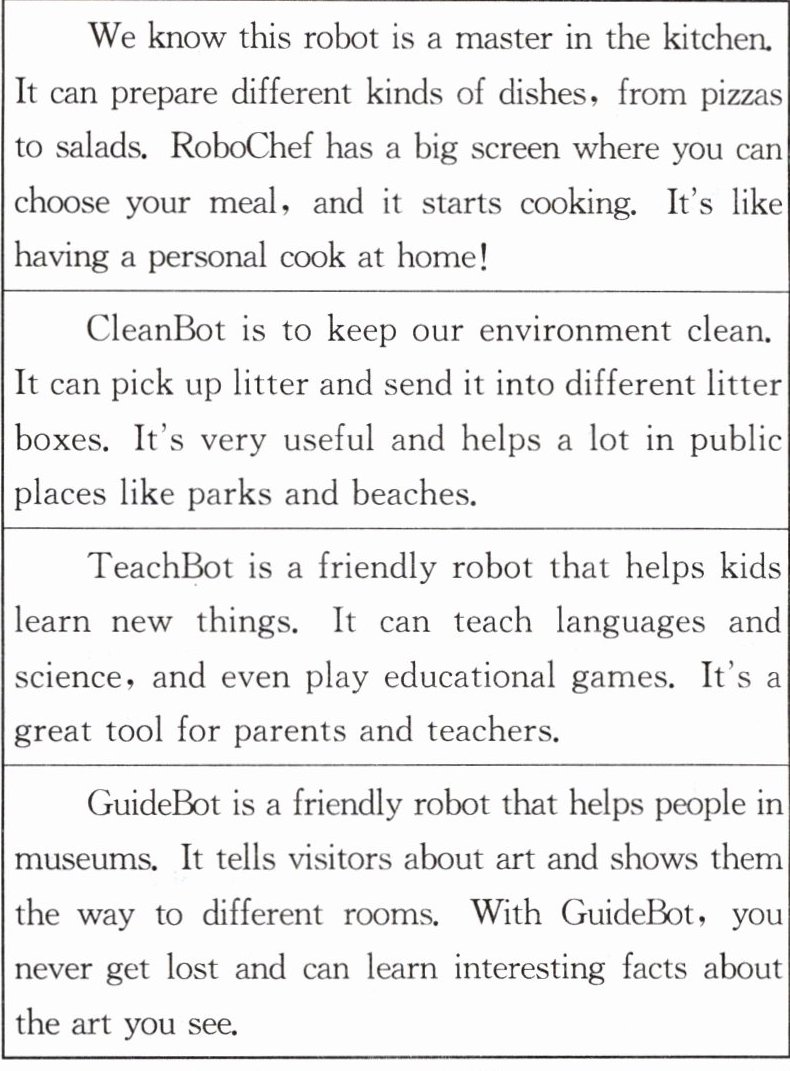
Word bank: master(大师); environment(环境); litter(垃圾); public(公共的)
(
A. In a park.
B. In a kitchen.
C. In a factory.
D. In a classroom.
(
A. Doctors.
B. Kids.
C. Cooks.
D. Cleaners.
(
A. In a storybook.
B. In a guide book.
C. On a travel website.
D. In a science magazine.
Robots can help people in different ways. Here are some of the robots that interested people the most on a robot exhibition.
Word bank: master(大师); environment(环境); litter(垃圾); public(公共的)
(
A
)1. Where does CleanBot mainly work?A. In a park.
B. In a kitchen.
C. In a factory.
D. In a classroom.
(
B
)2. Who can get help from TeachBot?A. Doctors.
B. Kids.
C. Cooks.
D. Cleaners.
(
D
)3. Where can we find the text?A. In a storybook.
B. In a guide book.
C. On a travel website.
D. In a science magazine.
答案:
Ⅰ.1.A 2.B 3.D
Ⅱ. 短文阅读
Sirish Subash, a 14-year-old student from Snellville, Georgia, USA, won the 3M Young Scientist Challenge. He made a tool that can find pesticides(杀虫剂) on fruits and vegetables. This won him 25,000 and he was named as “Best Young Scientist in America”.
Subash's idea for the tool came from his daily life. His mother always told him to wash fruit before eating it. The boy wondered, “Did the action do any good?” Then he learned that 70% of fruits and vegetables have pesticides. They can bring possible health problems. Washing only removes some of the pesticides. “If we could find them, we could avoid(避免) eating them and lower the risk of those health problems,” Subash said.
This led Subash to invent PestiSCAND. It is a small tool that people can take with them. It uses light reflection(反射) to check if there are pesticides around. To use it, users must point PestiSCAND at the fruit or vegetable to see if they need to wash it again. They can check the results in an app on their phones. During testing, PestiSCAND found pesticides correctly more than 85% of the time. Subash plans to improve his tool and hopes to get it to market by the time he starts college(大学).
(
A. Discovering pesticides.
B. Washing fruits quickly.
C. Solving health problems.
D. Making fruits taste better.
(
A. From his mother's job.
B. From an app on his phone.
C. From a question in daily life.
D. From his own health problems.
(
A. The ways to use it.
B. The influence it has on our lives.
C. The apps it needs on the phone.
D. The problems it needs to work out.
Sirish Subash, a 14-year-old student from Snellville, Georgia, USA, won the 3M Young Scientist Challenge. He made a tool that can find pesticides(杀虫剂) on fruits and vegetables. This won him 25,000 and he was named as “Best Young Scientist in America”.
Subash's idea for the tool came from his daily life. His mother always told him to wash fruit before eating it. The boy wondered, “Did the action do any good?” Then he learned that 70% of fruits and vegetables have pesticides. They can bring possible health problems. Washing only removes some of the pesticides. “If we could find them, we could avoid(避免) eating them and lower the risk of those health problems,” Subash said.
This led Subash to invent PestiSCAND. It is a small tool that people can take with them. It uses light reflection(反射) to check if there are pesticides around. To use it, users must point PestiSCAND at the fruit or vegetable to see if they need to wash it again. They can check the results in an app on their phones. During testing, PestiSCAND found pesticides correctly more than 85% of the time. Subash plans to improve his tool and hopes to get it to market by the time he starts college(大学).
(
A
)1. What is Subash's invention used for?A. Discovering pesticides.
B. Washing fruits quickly.
C. Solving health problems.
D. Making fruits taste better.
(
C
)2. Where did Subash get the idea for his invention?A. From his mother's job.
B. From an app on his phone.
C. From a question in daily life.
D. From his own health problems.
(
A
)3. What did the last paragraph introduce about Subash's invention?A. The ways to use it.
B. The influence it has on our lives.
C. The apps it needs on the phone.
D. The problems it needs to work out.
答案:
Ⅱ.1.A 2.C 3.A
查看更多完整答案,请扫码查看

