

 搜索
搜索
第21页
- 第1页
- 第2页
- 第3页
- 第4页
- 第5页
- 第6页
- 第7页
- 第8页
- 第9页
- 第10页
- 第11页
- 第12页
- 第13页
- 第14页
- 第15页
- 第16页
- 第17页
- 第18页
- 第19页
- 第20页
- 第21页
- 第22页
- 第23页
- 第24页
- 第25页
- 第26页
- 第27页
- 第28页
- 第29页
- 第30页
- 第31页
- 第32页
- 第33页
- 第34页
- 第35页
- 第36页
- 第37页
- 第38页
- 第39页
- 第40页
- 第41页
- 第42页
- 第43页
- 第44页
- 第45页
- 第46页
- 第47页
- 第48页
- 第49页
- 第50页
- 第51页
- 第52页
- 第53页
- 第54页
- 第55页
- 第56页
- 第57页
- 第58页
- 第59页
- 第60页
- 第61页
- 第62页
- 第63页
- 第64页
- 第65页
- 第66页
- 第67页
- 第68页
一 新形式·日历 将下列时间状语的序号填到日历相应的位置。
A. yesterday B. last Friday C. last weekend
D. this weekend E. next weekend
F. the day before yesterday
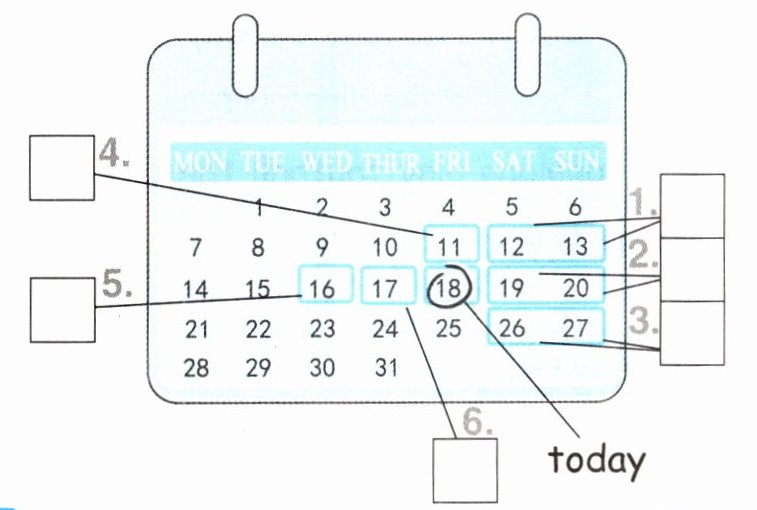
A. yesterday B. last Friday C. last weekend
D. this weekend E. next weekend
F. the day before yesterday
答案:
1. C 2. D 3. E 4. B 5. F 6. A
【点拨】今天是18号,星期五。
所以17号是昨天,yesterday。
16号是前天,the day before yesterday。
11号是上周五,last Friday。
19~20号是这周末,this weekend。
12~13号是上周末,last weekend。
26~27号是下周末,next weekend。
二 根据图片提示写单词或短语,补全短文。

Hello, I'm Huahua. I had a good time last weekend. On Saturday, I 1. __________. On Sunday, I 2. __________ with my parents. It was interesting. But it was cold and windy that day. I 3. __________. It was too bad. So I didn't go to school on Monday. I stayed at home and 4. __________ all day. Today, I'm better. I can go to school now!
Hello, I'm Huahua. I had a good time last weekend. On Saturday, I 1. __________. On Sunday, I 2. __________ with my parents. It was interesting. But it was cold and windy that day. I 3. __________. It was too bad. So I didn't go to school on Monday. I stayed at home and 4. __________ all day. Today, I'm better. I can go to school now!
答案:
read a book@@saw a film@@had a cold@@slept
三 给下列问句选择合适的答语。
( ) 1. What does Tom usually do on Sundays?
( ) 2. How was your weekend?
( ) 3. What did Amy do the day before yesterday?
( ) 4. Was the new film magazine interesting?
( ) 5. Did he go fishing last Monday?
A. Yes, he did. B. No, it wasn't.
C. She saw a film. D. He reads a book.
E. It was good.
( ) 1. What does Tom usually do on Sundays?
( ) 2. How was your weekend?
( ) 3. What did Amy do the day before yesterday?
( ) 4. Was the new film magazine interesting?
( ) 5. Did he go fishing last Monday?
A. Yes, he did. B. No, it wasn't.
C. She saw a film. D. He reads a book.
E. It was good.
答案:
1. D 2. E 3. C 4. B 5. A
四 新情境·成语故事 主题情境:凿壁偷光刻苦读书 阅读故事,完成下列任务。
When Kuang Heng was little, his family was very poor (贫穷的). So he couldn't go to school. He often hid (藏) outside the school and 1 quietly to the sound of reading. He had no money to buy books. So he had to borrow (借) books to read. He 2 in the fields all day and came back home in the evening. It was always very dark (黑的). He wanted to 3 after dinner. But he had no money to buy a candle (蜡烛).
One night, when he came home from the outside, he 4 light (灯光) coming in from a neighbour's (邻居家的) window. He had an idea. He dug a small hole in the wall, and light came to the room through (通过) the hole. Kuang Heng 5 very happy. He could read books at night!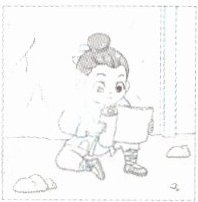
任务一:选择合适的单词补全故事。
( ) 1. A. watched B. taught C. listened
( ) 2. A. sang B. worked C. danced
( ) 3. A. read B. reads C. reading
( ) 4. A. see B. saw C. sees
( ) 5. A. is B. was C. were
任务二:判断下列句子正(T)误(F)。
( ) 1. Kuang Heng didn't want to buy books.
( ) 2. Kuang Heng often stayed in the fields all night.
( ) 3. Kuang Heng was hard - working.
When Kuang Heng was little, his family was very poor (贫穷的). So he couldn't go to school. He often hid (藏) outside the school and 1 quietly to the sound of reading. He had no money to buy books. So he had to borrow (借) books to read. He 2 in the fields all day and came back home in the evening. It was always very dark (黑的). He wanted to 3 after dinner. But he had no money to buy a candle (蜡烛).
One night, when he came home from the outside, he 4 light (灯光) coming in from a neighbour's (邻居家的) window. He had an idea. He dug a small hole in the wall, and light came to the room through (通过) the hole. Kuang Heng 5 very happy. He could read books at night!
任务一:选择合适的单词补全故事。
( ) 1. A. watched B. taught C. listened
( ) 2. A. sang B. worked C. danced
( ) 3. A. read B. reads C. reading
( ) 4. A. see B. saw C. sees
( ) 5. A. is B. was C. were
任务二:判断下列句子正(T)误(F)。
( ) 1. Kuang Heng didn't want to buy books.
( ) 2. Kuang Heng often stayed in the fields all night.
( ) 3. Kuang Heng was hard - working.
答案:
任务一:1. C 【点拨】句意为“他经常躲在学校外面安静地____读书声”。听声音用listen,过去式为listened。
2. B 【点拨】由于家里很穷不能上学,所以他要在地里劳作,选worked。
3. A 【点拨】want to do sth. 意为“想做某事”,want后接动词不定式。
4. B 【点拨】由came可知此句时态为过去时态,所以此处用see的过去式saw。
5. B 【点拨】happy是形容词,前面用be动词。时态为过去时,Kuang Heng作主语,系动词用is的过去式was。
任务二:1. F 【点拨】由第一段中“He had no money to buy books.”可知,他不是不想买书,而是没有钱买书。
2. F 【点拨】由第一段中“He...in the fields all day and came back home in the evening.”可知,匡衡在地里劳作一天,晚上回家,而不是在地里待一夜。
3. T 【点拨】通读全文可知,匡衡读书很努力。
查看更多完整答案,请扫码查看

