

 搜索
搜索
2025年天利38套对接高考单元专题测试卷高中数学选择性必修第一册人教版
注:目前有些书本章节名称可能整理的还不是很完善,但都是按照顺序排列的,请同学们按照顺序仔细查找。练习册 2025年天利38套对接高考单元专题测试卷高中数学选择性必修第一册人教版 答案主要是用来给同学们做完题方便对答案用的,请勿直接抄袭。
1. 已知向量 $ \boldsymbol{a}=(8,-2,1) $,$ \boldsymbol{b}=(-4,1,k) $,且 $ \boldsymbol{a}// \boldsymbol{b} $,那么实数 $ k $ 的值为(
A.$ \frac{1}{2} $
B.$ -\frac{1}{2} $
C.$ -2 $
D.$ 2 $
B
)A.$ \frac{1}{2} $
B.$ -\frac{1}{2} $
C.$ -2 $
D.$ 2 $
答案:
1. B 【解析】空间向量的平行
通解:$\because \boldsymbol{a}// \boldsymbol{b}$,$\therefore \boldsymbol{b}=\lambda \boldsymbol{a}$,即$\begin{cases}-4=8\lambda,\\1=-2\lambda,\\k=\lambda.\end{cases}$ $\therefore k=\lambda =-\dfrac{1}{2}$。故选 B。
快解:$\because \boldsymbol{a}// \boldsymbol{b}$,$\therefore \dfrac{8}{-4}=\dfrac{-2}{1}=\dfrac{1}{k}$。$\therefore k=-\dfrac{1}{2}$。故选 B。
通解:$\because \boldsymbol{a}// \boldsymbol{b}$,$\therefore \boldsymbol{b}=\lambda \boldsymbol{a}$,即$\begin{cases}-4=8\lambda,\\1=-2\lambda,\\k=\lambda.\end{cases}$ $\therefore k=\lambda =-\dfrac{1}{2}$。故选 B。
快解:$\because \boldsymbol{a}// \boldsymbol{b}$,$\therefore \dfrac{8}{-4}=\dfrac{-2}{1}=\dfrac{1}{k}$。$\therefore k=-\dfrac{1}{2}$。故选 B。
2. 如图,在正三棱锥 $ P - ABC $ 中,点 $ G $ 为 $ \triangle ABC $ 的重心,点 $ M $ 是线段 $ PG $ 上的一点,且 $ PM = 3MG $,记 $ \overrightarrow{PA}=\boldsymbol{a} $,$ \overrightarrow{PB}=\boldsymbol{b} $,$ \overrightarrow{PC}=\boldsymbol{c} $,则 $ \overrightarrow{AM}= $(
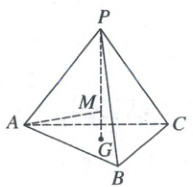
A.$ -\frac{3}{4}\boldsymbol{a}+\frac{1}{4}\boldsymbol{b}+\frac{1}{4}\boldsymbol{c} $
B.$ -\frac{3}{4}\boldsymbol{a}+\frac{1}{3}\boldsymbol{b}+\frac{1}{4}\boldsymbol{c} $
C.$ -\frac{1}{4}\boldsymbol{a}+\frac{1}{4}\boldsymbol{b}+\frac{1}{4}\boldsymbol{c} $
D.$ -\frac{1}{4}\boldsymbol{a}+\frac{1}{3}\boldsymbol{b}+\frac{1}{4}\boldsymbol{c} $
A
)A.$ -\frac{3}{4}\boldsymbol{a}+\frac{1}{4}\boldsymbol{b}+\frac{1}{4}\boldsymbol{c} $
B.$ -\frac{3}{4}\boldsymbol{a}+\frac{1}{3}\boldsymbol{b}+\frac{1}{4}\boldsymbol{c} $
C.$ -\frac{1}{4}\boldsymbol{a}+\frac{1}{4}\boldsymbol{b}+\frac{1}{4}\boldsymbol{c} $
D.$ -\frac{1}{4}\boldsymbol{a}+\frac{1}{3}\boldsymbol{b}+\frac{1}{4}\boldsymbol{c} $
答案:
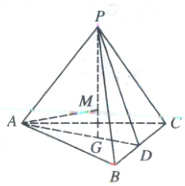
2. A 【解析】空间向量的线性运算 如图,连接$AG$并延长交$BC$于点$D$,连接$PD$。因为$G$为$\triangle ABC$的重心,$\overrightarrow{PA}=\boldsymbol{a}$,$\overrightarrow{PB}=\boldsymbol{b}$,$\overrightarrow{PC}=\boldsymbol{c}$,故$\overrightarrow{AG}=\dfrac{2}{3}\overrightarrow{AD}=\dfrac{2}{3}×\dfrac{1}{2}×(\overrightarrow{AC}+\overrightarrow{AB})=\dfrac{1}{3}(\overrightarrow{PC}-\overrightarrow{PA}+\overrightarrow{PB}-\overrightarrow{PA})=\dfrac{1}{3}(\boldsymbol{c}+\boldsymbol{b}-2\boldsymbol{a})$。又$PM = 3MG$,故$\overrightarrow{AM}=\overrightarrow{AG}+\overrightarrow{GM}=\overrightarrow{AG}+\dfrac{1}{4}×(\overrightarrow{GA}+\overrightarrow{AP})=-\dfrac{1}{4}\overrightarrow{PA}+\dfrac{3}{4}\overrightarrow{AG}=-\dfrac{1}{4}\boldsymbol{a}+\dfrac{3}{4}×\dfrac{1}{3}(\boldsymbol{c}+\boldsymbol{b}-2\boldsymbol{a})=-\dfrac{3}{4}\boldsymbol{a}+\dfrac{1}{4}\boldsymbol{b}+\dfrac{1}{4}\boldsymbol{c}$。故选 A。
2. A 【解析】空间向量的线性运算 如图,连接$AG$并延长交$BC$于点$D$,连接$PD$。因为$G$为$\triangle ABC$的重心,$\overrightarrow{PA}=\boldsymbol{a}$,$\overrightarrow{PB}=\boldsymbol{b}$,$\overrightarrow{PC}=\boldsymbol{c}$,故$\overrightarrow{AG}=\dfrac{2}{3}\overrightarrow{AD}=\dfrac{2}{3}×\dfrac{1}{2}×(\overrightarrow{AC}+\overrightarrow{AB})=\dfrac{1}{3}(\overrightarrow{PC}-\overrightarrow{PA}+\overrightarrow{PB}-\overrightarrow{PA})=\dfrac{1}{3}(\boldsymbol{c}+\boldsymbol{b}-2\boldsymbol{a})$。又$PM = 3MG$,故$\overrightarrow{AM}=\overrightarrow{AG}+\overrightarrow{GM}=\overrightarrow{AG}+\dfrac{1}{4}×(\overrightarrow{GA}+\overrightarrow{AP})=-\dfrac{1}{4}\overrightarrow{PA}+\dfrac{3}{4}\overrightarrow{AG}=-\dfrac{1}{4}\boldsymbol{a}+\dfrac{3}{4}×\dfrac{1}{3}(\boldsymbol{c}+\boldsymbol{b}-2\boldsymbol{a})=-\dfrac{3}{4}\boldsymbol{a}+\dfrac{1}{4}\boldsymbol{b}+\dfrac{1}{4}\boldsymbol{c}$。故选 A。
3. 在长方体 $ ABCD - A_{1}B_{1}C_{1}D_{1} $ 中,$ AB = 1 $,$ AA_{1} = 2 $,$ AD = 4 $,点 $ E $ 在棱 $ BC $ 上,且 $ BC = 4BE $,点 $ G $ 为 $ \triangle AB_{1}C $ 的重心,则点 $ G $ 到直线 $ AE $ 的距离为(
A.$ \frac{\sqrt{6}}{3} $
B.$ \sqrt{2} $
C.$ \frac{\sqrt{3}}{3} $
D.$ \sqrt{3} $
A
)A.$ \frac{\sqrt{6}}{3} $
B.$ \sqrt{2} $
C.$ \frac{\sqrt{3}}{3} $
D.$ \sqrt{3} $
答案:
3. A 【解析】点到直线的距离 在长方体$ABCD - A_1B_1C_1D_1$中,建立如图所示的空间直角坐标系,由$AB = 1$,$AA_1 = 2$,$AD = 4$,得$A(0,0,0)$,$C(1,4,0)$,$B_1(1,0,2)$。由点$E$在棱$BC$上,且$BC = 4BE$,得$E(1,1,0)$,则$\overrightarrow{AE} = (1,1,0)$,又$\triangle AB_1C$的重心$G\left(\dfrac{2}{3},\dfrac{4}{3},\dfrac{2}{3}\right)$,则$\overrightarrow{AG}=\left(\dfrac{2}{3},\dfrac{4}{3},\dfrac{2}{3}\right)$,则$\overrightarrow{AE}·\overrightarrow{AG}=2$,$|\overrightarrow{AG}|=\dfrac{2\sqrt{6}}{3}$。因为$|\overrightarrow{AE}|=\sqrt{2}$,所以点$G$到直线$AE$的距离$d = \sqrt{|\overrightarrow{AG}|^2 - \left(\dfrac{\overrightarrow{AG}·\overrightarrow{AE}}{|\overrightarrow{AE}|}\right)^2} = \sqrt{\dfrac{8}{3}-2}=\dfrac{\sqrt{6}}{3}$。故选 A。

3. A 【解析】点到直线的距离 在长方体$ABCD - A_1B_1C_1D_1$中,建立如图所示的空间直角坐标系,由$AB = 1$,$AA_1 = 2$,$AD = 4$,得$A(0,0,0)$,$C(1,4,0)$,$B_1(1,0,2)$。由点$E$在棱$BC$上,且$BC = 4BE$,得$E(1,1,0)$,则$\overrightarrow{AE} = (1,1,0)$,又$\triangle AB_1C$的重心$G\left(\dfrac{2}{3},\dfrac{4}{3},\dfrac{2}{3}\right)$,则$\overrightarrow{AG}=\left(\dfrac{2}{3},\dfrac{4}{3},\dfrac{2}{3}\right)$,则$\overrightarrow{AE}·\overrightarrow{AG}=2$,$|\overrightarrow{AG}|=\dfrac{2\sqrt{6}}{3}$。因为$|\overrightarrow{AE}|=\sqrt{2}$,所以点$G$到直线$AE$的距离$d = \sqrt{|\overrightarrow{AG}|^2 - \left(\dfrac{\overrightarrow{AG}·\overrightarrow{AE}}{|\overrightarrow{AE}|}\right)^2} = \sqrt{\dfrac{8}{3}-2}=\dfrac{\sqrt{6}}{3}$。故选 A。
4. 如图所示,已知正方形 $ ABCD $ 与矩形 $ ACEF $ 所在平面互相垂直,$ AB = \sqrt{2} $,$ AF = 1 $,$ M $ 在 $ EF $ 上,且 $ AM// $平面 $ BDE $,则 $ M $ 点坐标为(

A.$ (1,1,1) $
B.$ \left( \frac{\sqrt{2}}{3},\frac{\sqrt{2}}{3},1 \right) $
C.$ \left( \frac{\sqrt{2}}{2},\frac{\sqrt{2}}{2},1 \right) $
D.$ \left( \frac{\sqrt{2}}{4},\frac{\sqrt{2}}{4},1 \right) $
C
)A.$ (1,1,1) $
B.$ \left( \frac{\sqrt{2}}{3},\frac{\sqrt{2}}{3},1 \right) $
C.$ \left( \frac{\sqrt{2}}{2},\frac{\sqrt{2}}{2},1 \right) $
D.$ \left( \frac{\sqrt{2}}{4},\frac{\sqrt{2}}{4},1 \right) $
答案:
4. C 【解析】空间向量的应用+直线与平面平行的充要条件 $\because$ 点$M$在$EF$上,不妨设$ME$长度为$x$。$\therefore M\left(\dfrac{\sqrt{2}}{2}x,\dfrac{\sqrt{2}}{2}x,1\right)$。$\because A(\sqrt{2},\sqrt{2},0)$,$D(\sqrt{2},0,0)$,$E(0,0,1)$,$B(0,\sqrt{2},0)$,$\therefore \overrightarrow{ED}=(\sqrt{2},0,-1)$,$\overrightarrow{EB}=(0,\sqrt{2},-1)$,$\overrightarrow{AM}=\left(\dfrac{\sqrt{2}}{2}x - \sqrt{2},\dfrac{\sqrt{2}}{2}x - \sqrt{2},1\right)$。设平面$DEB$的法向量为$\boldsymbol{n}=(a,b,c)$,易求得其中一个法向量为$\boldsymbol{n}=(1,1,\sqrt{2})$,$\therefore$ 有$\boldsymbol{n}·\overrightarrow{AM}=0$,即$\dfrac{\sqrt{2}}{2}x - \sqrt{2}+\dfrac{\sqrt{2}}{2}x - \sqrt{2}+\sqrt{2}=0$。$\therefore \sqrt{2}x = \sqrt{2}$。$\therefore x = 1$。$\therefore M\left(\dfrac{\sqrt{2}}{2},\dfrac{\sqrt{2}}{2},1\right)$。故选 C。
5. 如图,在直三棱柱 $ ABC - A_{1}B_{1}C_{1} $ 中,$ \angle BCA = 90^{\circ} $,$ AC = CC_{1} = 2 $,$ M $ 是 $ A_{1}B_{1} $ 的中点,以 $ C $ 为坐标原点,建立如图所示的空间直角坐标系。若 $ \overrightarrow{A_{1}B}\perp \overrightarrow{C_{1}M} $,则异面直线 $ CM $ 与 $ A_{1}B $ 所成角的余弦值为(
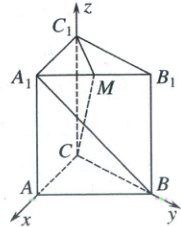
A.$ \frac{\sqrt{2}}{3} $
B.$ \frac{\sqrt{3}}{3} $
C.$ \frac{2}{3} $
D.$ \frac{\sqrt{7}}{3} $
A
)A.$ \frac{\sqrt{2}}{3} $
B.$ \frac{\sqrt{3}}{3} $
C.$ \frac{2}{3} $
D.$ \frac{\sqrt{7}}{3} $
答案:
5. A 【解析】异面直线所成角 设$CB = t(t > 0)$,则$C(0,0,0)$,$A_1(2,0,2)$,$B(0,t,0)$,$M\left(1,\dfrac{t}{2},2\right)$,$C_1(0,0,2)$(题眼),所以$\overrightarrow{A_1B}=(-2,t,-2)$,$\overrightarrow{C_1M}=\left(1,\dfrac{t}{2},0\right)$。由$\overrightarrow{A_1B}\perp\overrightarrow{C_1M}$,得$\overrightarrow{A_1B}·\overrightarrow{C_1M}=-2 + \dfrac{t^2}{2}=0$,解得$t = 2$(舍负),所以$\overrightarrow{CM}=(1,1,2)$,$\overrightarrow{A_1B}=(-2,2,-2)$。所以$\cos\langle\overrightarrow{CM},\overrightarrow{A_1B}\rangle = \dfrac{\overrightarrow{CM}·\overrightarrow{A_1B}}{|\overrightarrow{CM}||\overrightarrow{A_1B}|}=\dfrac{-4}{\sqrt{6}×\sqrt{12}}=-\dfrac{\sqrt{2}}{3}$。故异面直线$CM$与$A_1B$所成角的余弦值为$\dfrac{\sqrt{2}}{3}$(提示:异面直线所成角的取值范围为$\left(0,\dfrac{\pi}{2}\right]$),故选 A。
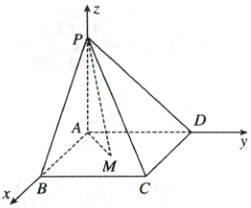
6. 【数学文化】《九章算术》中将底面为矩形且有一条侧棱与底面垂直的四棱锥称为“阳马”。现有一“阳马” $ P - ABCD $,$ PA\perp $平面 $ ABCD $,$ PA = AB = AD = 2 $,$ M $ 为底面 $ ABCD $ 及其内部的一个动点且满足 $ |PM| = \sqrt{5} $,则 $ \overrightarrow{DM}· \overrightarrow{BM} $ 的取值范围是(
A.$ [1 - 2\sqrt{2},1 + 2\sqrt{2}] $
B.$ [-1,1 + 2\sqrt{2}] $
C.$ [-1 - \sqrt{2},-1] $
D.$ [1 - 2\sqrt{2},-1] $
D
)A.$ [1 - 2\sqrt{2},1 + 2\sqrt{2}] $
B.$ [-1,1 + 2\sqrt{2}] $
C.$ [-1 - \sqrt{2},-1] $
D.$ [1 - 2\sqrt{2},-1] $
答案:
6. D 【解析】数学文化+空间向量的数量积+三角恒等变换+正弦型函数的性质
思维导图:已知条件$\xrightarrow{连接PM,AM}$建立空间直角坐标系$\to$设$M(\cos\theta,\sin\theta,0)$,$\theta\in\left[0,\dfrac{\pi}{2}\right]\to\overrightarrow{DM}·\overrightarrow{BM}\xrightarrow[正弦函数的图像]{三角恒等变换}$得解。
由题知,$PA\perp$平面$ABCD$,$PA = AB = AD = 2$,如图,连接$PM$,$AM$,因为$|PM| = \sqrt{5}$,所以$|AM| = \sqrt{|PM|^2 - |PA|^2}=1$。由于四边形$ABCD$为正方形,以$AB$,$AD$,$AP$所在的直线分别为$x$轴,$y$轴,$z$轴建立空间直角坐标系,则$B(2,0,0)$,$D(0,2,0)$,设$M(\cos\theta,\sin\theta,0)$,$\theta\in\left[0,\dfrac{\pi}{2}\right]$,则$\overrightarrow{DM}=(\cos\theta,\sin\theta - 2,0)$,$\overrightarrow{BM}=(\cos\theta - 2,\sin\theta,0)$(题眼),则$\overrightarrow{DM}·\overrightarrow{BM}=\cos\theta(\cos\theta - 2)+(\sin\theta - 2)\sin\theta=\cos^2\theta + \sin^2\theta - 2(\sin\theta + \cos\theta)=1 - 2\sqrt{2}\sin\left(\theta + \dfrac{\pi}{4}\right)$(提示:同角三角函数基本关系和辅助角公式)。因为$\theta\in\left[0,\dfrac{\pi}{2}\right]$,所以$\theta + \dfrac{\pi}{4}\in\left[\dfrac{\pi}{4},\dfrac{3\pi}{4}\right]$。所以$\sin\left(\theta + \dfrac{\pi}{4}\right)\in\left[\dfrac{\sqrt{2}}{2},1\right]$(提示:利用正弦型函数的图像求值域)。所以$\overrightarrow{DM}·\overrightarrow{BM}\in[1 - 2\sqrt{2},-1]$。故选 D。
6. D 【解析】数学文化+空间向量的数量积+三角恒等变换+正弦型函数的性质
思维导图:已知条件$\xrightarrow{连接PM,AM}$建立空间直角坐标系$\to$设$M(\cos\theta,\sin\theta,0)$,$\theta\in\left[0,\dfrac{\pi}{2}\right]\to\overrightarrow{DM}·\overrightarrow{BM}\xrightarrow[正弦函数的图像]{三角恒等变换}$得解。
由题知,$PA\perp$平面$ABCD$,$PA = AB = AD = 2$,如图,连接$PM$,$AM$,因为$|PM| = \sqrt{5}$,所以$|AM| = \sqrt{|PM|^2 - |PA|^2}=1$。由于四边形$ABCD$为正方形,以$AB$,$AD$,$AP$所在的直线分别为$x$轴,$y$轴,$z$轴建立空间直角坐标系,则$B(2,0,0)$,$D(0,2,0)$,设$M(\cos\theta,\sin\theta,0)$,$\theta\in\left[0,\dfrac{\pi}{2}\right]$,则$\overrightarrow{DM}=(\cos\theta,\sin\theta - 2,0)$,$\overrightarrow{BM}=(\cos\theta - 2,\sin\theta,0)$(题眼),则$\overrightarrow{DM}·\overrightarrow{BM}=\cos\theta(\cos\theta - 2)+(\sin\theta - 2)\sin\theta=\cos^2\theta + \sin^2\theta - 2(\sin\theta + \cos\theta)=1 - 2\sqrt{2}\sin\left(\theta + \dfrac{\pi}{4}\right)$(提示:同角三角函数基本关系和辅助角公式)。因为$\theta\in\left[0,\dfrac{\pi}{2}\right]$,所以$\theta + \dfrac{\pi}{4}\in\left[\dfrac{\pi}{4},\dfrac{3\pi}{4}\right]$。所以$\sin\left(\theta + \dfrac{\pi}{4}\right)\in\left[\dfrac{\sqrt{2}}{2},1\right]$(提示:利用正弦型函数的图像求值域)。所以$\overrightarrow{DM}·\overrightarrow{BM}\in[1 - 2\sqrt{2},-1]$。故选 D。
查看更多完整答案,请扫码查看

