

 搜索
搜索
第14页
- 第1页
- 第2页
- 第3页
- 第4页
- 第5页
- 第6页
- 第7页
- 第8页
- 第9页
- 第10页
- 第11页
- 第12页
- 第13页
- 第14页
- 第15页
- 第16页
- 第17页
- 第18页
- 第19页
- 第20页
- 第21页
- 第22页
- 第23页
- 第24页
- 第25页
- 第26页
- 第27页
- 第28页
- 第29页
- 第30页
- 第31页
- 第32页
- 第33页
- 第34页
- 第35页
- 第36页
- 第37页
- 第38页
- 第39页
- 第40页
- 第41页
- 第42页
- 第43页
- 第44页
- 第45页
- 第46页
- 第47页
- 第48页
- 第49页
- 第50页
- 第51页
- 第52页
- 第53页
- 第54页
- 第55页
- 第56页
- 第57页
- 第58页
- 第59页
- 第60页
- 第61页
- 第62页
- 第63页
- 第64页
- 第65页
- 第66页
- 第67页
- 第68页
- 第69页
- 第70页
- 第71页
- 第72页
- 第73页
- 第74页
- 第75页
- 第76页
- 第77页
- 第78页
- 第79页
- 第80页
Ⅰ. 根据句意及汉语提示填写单词。
1. We all think Edison was a
2. I am interested in studying stars. My dream is to be an
3. It's a
4. The professor gave a
5. He graduated from Liaoning
1. We all think Edison was a
genius
(天才).2. I am interested in studying stars. My dream is to be an
astronomer
(天文学家).3. It's a
pleasure
(乐事) to work in the fields.4. The professor gave a
lecture
(演讲) about modern art.5. He graduated from Liaoning
University
(大学).
答案:
1.genius 2.astronomer 3.pleasure 4.lecture 5.University
Ⅱ. 用括号内所给单词的适当形式填空。
6. You can easily find an excuse to avoid
7. I must tell you the
8. Have you received an
9. Truly great
10. We may not do everything
6. You can easily find an excuse to avoid
going
(go) out with him.7. I must tell you the
truth
(true) about this business.8. Have you received an
invitation
(invite) to her party?9. Truly great
minds
(mind) don't fear challenges but embrace them.10. We may not do everything
perfectly
(perfect), but we can do everything correctly.
答案:
6.going 7.truth 8.invitation 9.minds 10.perfectly
Ⅲ. 用方框中所给单词的适当形式填空。
theory consider pale humour trust
11. Do you
12. There are many
13. Tom's face turned
14. You have to
15. His story was full of
theory consider pale humour trust
11. Do you
consider
reading an important hobby?12. There are many
theories
about how the universe began.13. Tom's face turned
pale
when he heard the news.14. You have to
trust
your instincts (直觉) sometimes.15. His story was full of
humour
and everyone enjoyed it.
答案:
11.consider 12.theories 13.pale 14.trust 15.humour
Ⅳ. 完成句子: 根据所给汉语意思, 用单词或短语完成下列英文句子。
16. 这部新剧受到了当地观众的好评。
The new play was well received by the local
17. 她能凭记忆唱出那张专辑里的所有歌曲。
She can sing all the songs on that album
18. 他是个有幽默感的人。
He is a man with
19. 我们不应该让父母失望。
We shouldn't
20. 请坐下, 我们马上就开会。
Please
16. 这部新剧受到了当地观众的好评。
The new play was well received by the local
audience
.17. 她能凭记忆唱出那张专辑里的所有歌曲。
She can sing all the songs on that album
by heart
.18. 他是个有幽默感的人。
He is a man with
a sense of humour
.19. 我们不应该让父母失望。
We shouldn't
let our parents down
.20. 请坐下, 我们马上就开会。
Please
take a seat
. We'll have a meeting right now.
答案:
16.audience 17.by heart 18.a sense of humour 19.let our parents down 20.take a seat
Ⅴ. 阅读理解。
阅读下面短文, 从所给的四个选项中选出能回答所提问题或完成所给句子的一个最佳答案。
How did people tell the time before clocks were invented?
At first, the ancient people looked up at the Sun and could tell it was the middle of the day when the Sun was directly overhead in the sky. They also knew when it was morning or evening.
Later, the Egyptians used sticks. These sticks measured (测量) time during the day. The Sun shone on the tall stick and the stick made a shadow (阴影). As the Sun moved across the sky, the position (位置) of the shadow changed. This would let people tell what time it was.
Over time, the Chinese first used sundials instead of shadow sticks. The sundial has a type of shadow stick on it. As the Sun shines on it, a shadow appears on the numbers. Each number stands for an hour of the day. But sundials don't work at night or on a cloudy day! There are no shadows unless the Sun is out.
Water clocks used water to measure time at night. Water dripped (滴落) slowly from one bowl into another. The level of the water in the bowls slowed the time.
People also used sand glasses. You may have seen one. Some games still use sand glasses. The sand falls from the top of the sand glass to the bottom. It measures short amounts of the time. The more sand falls, the more time has passed. When the sand has finished falling, you have to turn the second glass over.
(
A. the stick
B. the shadow
C. the Sun
D. the Moon
(
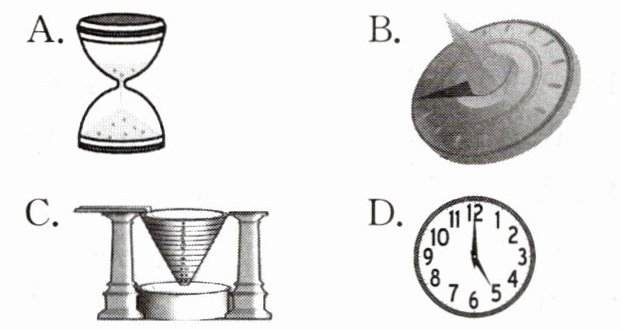
(
A. sunny
B. rainy
C. cloudy
D. snowy
(
A. Sticks measured time in Egypt day and night.
B. Sundials were first used in ancient Egypt.
C. Sand glasses usually measure a long time.
D. The water clock showed the time by the water level in the bowls.
(
A. Something about sundials.
B. How to tell the time by looking at the Sun.
C. How to tell the time in the past.
D. Some inventions in China.
阅读下面短文, 从所给的四个选项中选出能回答所提问题或完成所给句子的一个最佳答案。
How did people tell the time before clocks were invented?
At first, the ancient people looked up at the Sun and could tell it was the middle of the day when the Sun was directly overhead in the sky. They also knew when it was morning or evening.
Later, the Egyptians used sticks. These sticks measured (测量) time during the day. The Sun shone on the tall stick and the stick made a shadow (阴影). As the Sun moved across the sky, the position (位置) of the shadow changed. This would let people tell what time it was.
Over time, the Chinese first used sundials instead of shadow sticks. The sundial has a type of shadow stick on it. As the Sun shines on it, a shadow appears on the numbers. Each number stands for an hour of the day. But sundials don't work at night or on a cloudy day! There are no shadows unless the Sun is out.
Water clocks used water to measure time at night. Water dripped (滴落) slowly from one bowl into another. The level of the water in the bowls slowed the time.
People also used sand glasses. You may have seen one. Some games still use sand glasses. The sand falls from the top of the sand glass to the bottom. It measures short amounts of the time. The more sand falls, the more time has passed. When the sand has finished falling, you have to turn the second glass over.
(
C
)21. At first, the ancient people told the time by looking at ____.A. the stick
B. the shadow
C. the Sun
D. the Moon
(
B
)22. 新考向 图片示意 Which picture can be a "sundial"?(
A
)23. Sundials can be used to tell the time when it is ____.A. sunny
B. rainy
C. cloudy
D. snowy
(
D
)24. Which of the following is right according to the passage?A. Sticks measured time in Egypt day and night.
B. Sundials were first used in ancient Egypt.
C. Sand glasses usually measure a long time.
D. The water clock showed the time by the water level in the bowls.
(
C
)25. What's the main idea of the passage?A. Something about sundials.
B. How to tell the time by looking at the Sun.
C. How to tell the time in the past.
D. Some inventions in China.
答案:
21-25 CBADC
查看更多完整答案,请扫码查看

