

 搜索
搜索
第63页
- 第1页
- 第2页
- 第3页
- 第4页
- 第5页
- 第6页
- 第7页
- 第8页
- 第9页
- 第10页
- 第11页
- 第12页
- 第13页
- 第14页
- 第15页
- 第16页
- 第17页
- 第18页
- 第19页
- 第20页
- 第21页
- 第22页
- 第23页
- 第24页
- 第25页
- 第26页
- 第27页
- 第28页
- 第29页
- 第30页
- 第31页
- 第32页
- 第33页
- 第34页
- 第35页
- 第36页
- 第37页
- 第38页
- 第39页
- 第40页
- 第41页
- 第42页
- 第43页
- 第44页
- 第45页
- 第46页
- 第47页
- 第48页
- 第49页
- 第50页
- 第51页
- 第52页
- 第53页
- 第54页
- 第55页
- 第56页
- 第57页
- 第58页
- 第59页
- 第60页
- 第61页
- 第62页
- 第63页
- 第64页
- 第65页
- 第66页
- 第67页
- 第68页
- 第69页
- 第70页
- 第71页
- 第72页
- 第73页
- 第74页
- 第75页
- 第76页
- 第77页
- 第78页
- 第79页
- 第80页
- 第81页
- 第82页
- 第83页
- 第84页
- 第85页
- 第86页
- 第87页
- 第88页
- 第89页
- 第90页
- 第91页
- 第92页
- 第93页
- 第94页
- 第95页
- 第96页
- 第97页
- 第98页
- 第99页
- 第100页
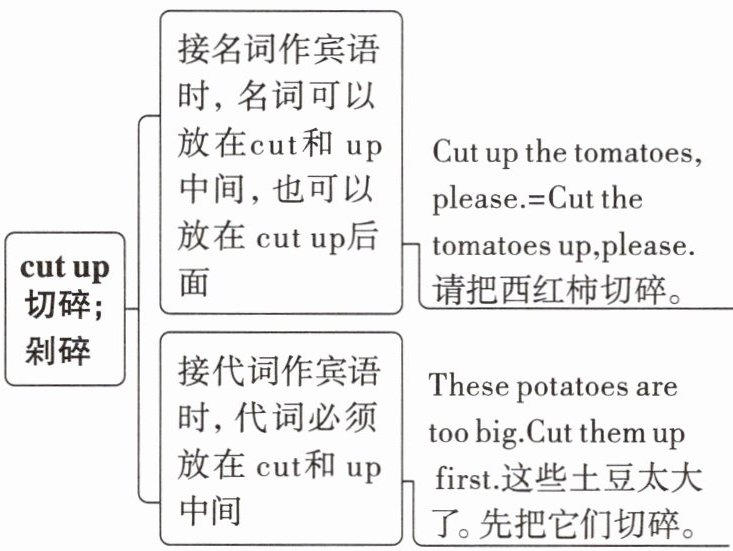
探究点1 cut up的用法
| cut up切碎;剁碎 | 接名词作宾语时,名词可以放在cut和up中间,也可以放在cut up后面 | Cut up the tomatoes, please.= Cut the tomatoes up,please. 请把西红柿切碎。 |
| | 接代词作宾语时,代词必须放在cut和up中间 | These potatoes are too big.Cut them up first.这些土豆太大了。先把它们切碎。 |
[知识拓展]
cut...in/into...意为“将……切成……”。
Peel three apples and then cut them into pieces. 把三个苹果削皮,然后切成块。
[情境应用]
1. Here is a banana. Please ____. We'll make a banana milk shake.
A. cut them up
B. cut up it
C. cut it up
D. cut up them
2. Try to ____ the peppers ____ small pieces. (将……切成……)
1. (
2.
| cut up切碎;剁碎 | 接名词作宾语时,名词可以放在cut和up中间,也可以放在cut up后面 | Cut up the tomatoes, please.= Cut the tomatoes up,please. 请把西红柿切碎。 |
| | 接代词作宾语时,代词必须放在cut和up中间 | These potatoes are too big.Cut them up first.这些土豆太大了。先把它们切碎。 |
[知识拓展]
cut...in/into...意为“将……切成……”。
Peel three apples and then cut them into pieces. 把三个苹果削皮,然后切成块。
[情境应用]
1. Here is a banana. Please ____. We'll make a banana milk shake.
A. cut them up
B. cut up it
C. cut it up
D. cut up them
2. Try to ____ the peppers ____ small pieces. (将……切成……)
1. (
C
)2.
cut;into
答案:
1. C
2. cut;into
2. cut;into
探究点2 mix的用法
| mix | 作动词,意为“(使)混合;融合;调配” | Oil and water do not mix. 油和水不相融。 |
| | mix...with...表示“(使)……和……融合” | What happens when you mix eggs with water? 你混合水和鸡蛋的时候会发生什么呢? |
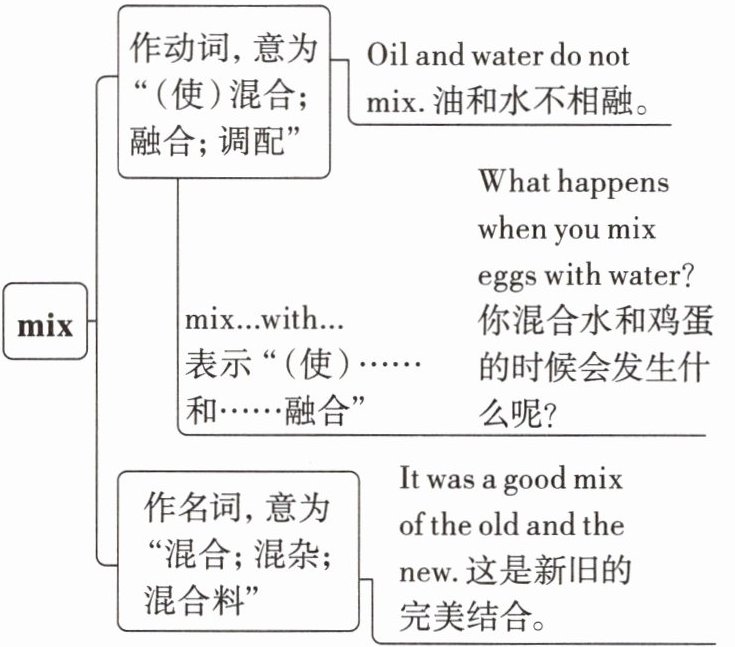
| | 作名词,意为“混合;混杂;混合料” | It was a good mix of the old and the new. 这是新旧的完美结合。 |
[情境应用]
1. If you
2. My mum always
| mix | 作动词,意为“(使)混合;融合;调配” | Oil and water do not mix. 油和水不相融。 |
| | mix...with...表示“(使)……和……融合” | What happens when you mix eggs with water? 你混合水和鸡蛋的时候会发生什么呢? |
| | 作名词,意为“混合;混杂;混合料” | It was a good mix of the old and the new. 这是新旧的完美结合。 |
[情境应用]
1. If you
mix
blue and yellow, you will get green. (mix)2. My mum always
mixes
honey with
warm water for me to drink. (把……和……混合)
答案:
1. mix 2. mixes; with
判断每组单词中画线部分的发音是否相同,相同的写“S”,不同的写“D”
1. go—no(
2. boat—coat(
3. house—soup(
4. snow—cow(
5. hear—bear(
6. sky—ask(
7. school—chair(
8. air—hair(
9. sure—pure(
10. star—fast(
1. go—no(
S
)2. boat—coat(
S
)3. house—soup(
D
)4. snow—cow(
D
)5. hear—bear(
D
)6. sky—ask(
S
)7. school—chair(
D
)8. air—hair(
S
)9. sure—pure(
S
)10. star—fast(
S
)
答案:
S S D D D S D S S S
Ⅰ. 根据句意,用括号中所给词的适当形式填空
1. When water
2. You need two
3. Shake(摇动) the bottle well so that the milk
4. After finishing reading the book Who Moved My
5. How do we
6. My mother
7. Do you want some
8. —How much are these
—They're ten yuan.
9. We have chicken, fish and
1. When water
boils
, it will change into steam(水蒸气). (boil)2. You need two
tablespoons
of honey for the first step. (tablespoon)3. Shake(摇动) the bottle well so that the milk
mixes
with the tea. (mix)4. After finishing reading the book Who Moved My
cheese
, I realize the importance of changing. (cheese)5. How do we
make
chicken soup? (make)6. My mother
baked
a cake for me last Sunday. (bake)7. Do you want some
pepper
in your soup? (pepper)8. —How much are these
tomatoes
? (tomato)—They're ten yuan.
9. We have chicken, fish and
mashed
potatoes for dinner. (mash)
答案:
1. boils 2. tablespoons 3. mixes 4. cheese 5. make 6. baked 7. pepper 8. tomatoes 9. mashed
查看更多完整答案,请扫码查看

