

 搜索
搜索
第29页
- 第1页
- 第2页
- 第3页
- 第4页
- 第5页
- 第6页
- 第7页
- 第8页
- 第9页
- 第10页
- 第11页
- 第12页
- 第13页
- 第14页
- 第15页
- 第16页
- 第17页
- 第18页
- 第19页
- 第20页
- 第21页
- 第22页
- 第23页
- 第24页
- 第25页
- 第26页
- 第27页
- 第28页
- 第29页
- 第30页
- 第31页
- 第32页
- 第33页
- 第34页
- 第35页
- 第36页
- 第37页
- 第38页
- 第39页
- 第40页
- 第41页
- 第42页
- 第43页
- 第44页
- 第45页
- 第46页
- 第47页
- 第48页
- 第49页
- 第50页
- 第51页
- 第52页
- 第53页
- 第54页
- 第55页
- 第56页
- 第57页
- 第58页
- 第59页
- 第60页
- 第61页
- 第62页
- 第63页
- 第64页
- 第65页
- 第66页
- 第67页
- 第68页
- 第69页
- 第70页
- 第71页
- 第72页
- 第73页
- 第74页
- 第75页
- 第76页
- 第77页
- 第78页
- 第79页
- 第80页
- 第81页
- 第82页
- 第83页
- 第84页
- 第85页
- 第86页
- 第87页
- 第88页
- 第89页
- 第90页
- 第91页
- 第92页
- 第93页
- 第94页
- 第95页
- 第96页
- 第97页
- 第98页
- 第99页
- 第100页
- 第101页
- 第102页
- 第103页
- 第104页
- 第105页
- 第106页
- 第107页
- 第108页
- 第109页
- 第110页
- 第111页
- 第112页
- 第113页
- 第114页
- 第115页
- 第116页
- 第117页
- 第118页
- 第119页
- 第120页
- 第121页
- 第122页
- 第123页
- 第124页
- 第125页
- 第126页
- 第127页
- 第128页
- 第129页
- 第130页
- 第131页
- 第132页
- 第133页
- 第134页
- 第135页
- 第136页
- 第137页
- 第138页
- 第139页
- 第140页
- 第141页
- 第142页
- 第143页
- 第144页
- 第145页
- 第146页
- 第147页
- 第148页
- 第149页
- 第150页
- 第151页
- 第152页
- 第153页
- 第154页
- 第155页
- 第156页
- 第157页
- 第158页
- 第159页
- 第160页
- 第161页
- 第162页
- 第163页
- 第164页
- 第165页
- 第166页
- 第167页
- 第168页
- 第169页
- 第170页
- 第171页
- 第172页
- 第173页
- 第174页
- 第175页
- 第176页
- 第177页
- 第178页
- 第179页
- 第180页
- 第181页
- 第182页
- 第183页
- 第184页
- 第185页
- 第186页
- 第187页
- 第188页
- 第189页
- 第190页
- 第191页
- 第192页
- 第193页
- 第194页
- 第195页
- 第196页
- 第197页
- 第198页
- 第199页
- 第200页
- 第201页
- 第202页
- 第203页
- 第204页
- 第205页
B
阅读下面材料,从题中所给的A、B、C、D四个选项中选出一个最佳选项。
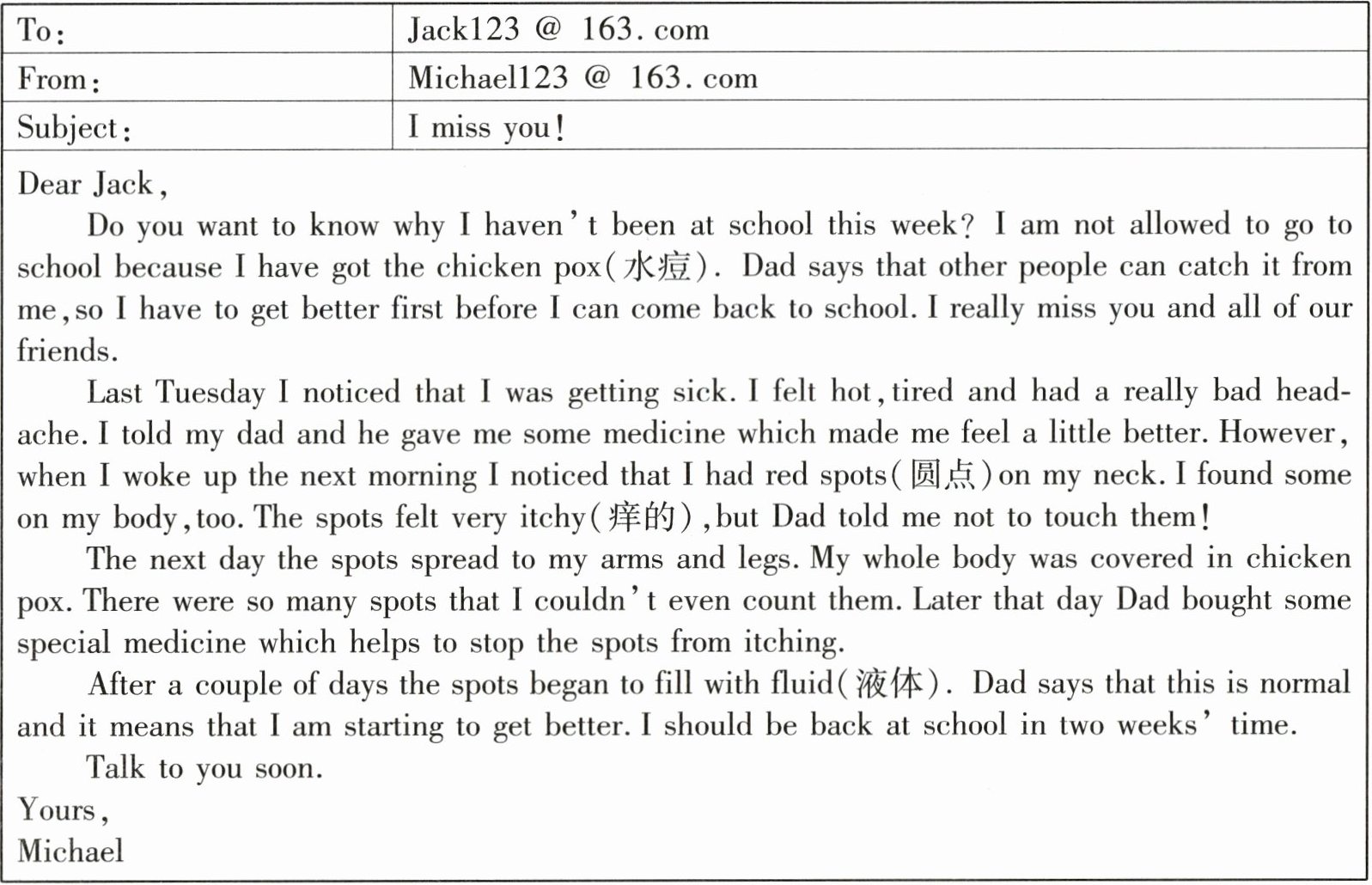
(
A. at school B. at home C. in the hospital D. in the library
(
A. they are on vacation now B. they have moved away with their parents
C. he cannot go to school now D. he is in a different school now
(
A. neck and body B. arms and legs C. neck and arms D. hands and legs
(
A. week B. two weeks C. month D. two months
(
A. only happens to children B. is a very dangerous illness
C. only happens in school D. can spread from one person to another
阅读下面材料,从题中所给的A、B、C、D四个选项中选出一个最佳选项。
(
B
)6. Michael wrote this email ______.A. at school B. at home C. in the hospital D. in the library
(
C
)7. Michael misses his friends because ______.A. they are on vacation now B. they have moved away with their parents
C. he cannot go to school now D. he is in a different school now
(
A
)8. Michael first found red spots on his ______.A. neck and body B. arms and legs C. neck and arms D. hands and legs
(
B
)9. It will take another ______ for Michael to get well again.A. week B. two weeks C. month D. two months
(
D
)10. We can learn from the passage that the chicken pox ______.A. only happens to children B. is a very dangerous illness
C. only happens in school D. can spread from one person to another
答案:
6.B 7.C 8.A 9.B 10.D
C
阅读下面材料,从题中所给的A、B、C、D四个选项中选出一个最佳选项。
If you live in Shanghai, you might have taken a "lesson" in sorting (分类) garbage, as the city introduced new garbage-sorting regulations (规章) on July 1, 2019.
As China's first city to carry out strict regulations on garbage sorting and recycling, Shanghai requires its residents (居民) to sort garbage into four categories (类别), namely recyclable, harmful, dry and wet waste. If people fail to sort their garbage properly, they can be fined up to 200 yuan.
Since the regulation took effect, the amount of total daily waste in Shanghai has been reduced by an average of 15,500 tons, dropping 26 percent from the end of 2018, while the average daily weight of recyclables hits 4,500 tons, five times higher than the end of 2018, according to the Shanghai Landscaping and City Appearance Administrative Bureau.
The city also rebuilt 21,000 waste-sorting stations and more than 40,000 waste bins have been updated (更新). The city's waste collection and transportation system (运输系统) is complete, according to the bureau.
"Proper waste sorting protects the environment and saves natural resources," said Deng Jianping, director of the bureau. "Led by the central government, Shanghai is making efforts to develop long-term solutions to garbage management."
However, there have also been some problems. Some people complained that it is difficult to deal with wet garbage, as they are asked to remove wet garbage from its bag when dumping (倾倒). According to the sorting rules, the wet garbage must go in the wet waste bin and the bag must go in the dry waste bin.
This separation is necessary, as it ensures that the wet garbage will decompose (分解) properly and become useful organic (有机的) waste, the bureau said.
Plastic bags can affect this process. Some people in Shanghai are instead using paper bags that can biodegrade (生物降解) or plastic containers that can be washed and reused, according to Xinhua.
(
A. recyclable, dry, harmful and kitchen waste B. recyclable, kitchen, dry and "other" waste
C. harmful, recyclable, dry and "other" waste D. harmful, recyclable, dry and wet waste
(
A. The garbage-sorting regulation has already brought improvements. |
B. Recyclable waste comes out to two-thirds of the total daily waste. |
C. In 2019, people produced less waste than in 2018. |
D. Shanghai needs stricter rules to deal with waste. |
(
A. has added more than 40,000 waste bins B. has had problems with garbage management
C. will help other cities make garbage-sorting regulations D. is still looking for long-term solutions to deal with garbage
(
A. The process of sorting garbage. B. The process of dumping wet waste.
C. The process of decomposing wet waste. D. The separation of wet waste and dry waste.
(
A. why Shanghai must sort their garbage B. how Shanghai sorts their garbage
C. the new garbage-sorting regulation in Shanghai and some of its achievement D. how to protect our environment
阅读下面材料,从题中所给的A、B、C、D四个选项中选出一个最佳选项。
If you live in Shanghai, you might have taken a "lesson" in sorting (分类) garbage, as the city introduced new garbage-sorting regulations (规章) on July 1, 2019.
As China's first city to carry out strict regulations on garbage sorting and recycling, Shanghai requires its residents (居民) to sort garbage into four categories (类别), namely recyclable, harmful, dry and wet waste. If people fail to sort their garbage properly, they can be fined up to 200 yuan.
Since the regulation took effect, the amount of total daily waste in Shanghai has been reduced by an average of 15,500 tons, dropping 26 percent from the end of 2018, while the average daily weight of recyclables hits 4,500 tons, five times higher than the end of 2018, according to the Shanghai Landscaping and City Appearance Administrative Bureau.
The city also rebuilt 21,000 waste-sorting stations and more than 40,000 waste bins have been updated (更新). The city's waste collection and transportation system (运输系统) is complete, according to the bureau.
"Proper waste sorting protects the environment and saves natural resources," said Deng Jianping, director of the bureau. "Led by the central government, Shanghai is making efforts to develop long-term solutions to garbage management."
However, there have also been some problems. Some people complained that it is difficult to deal with wet garbage, as they are asked to remove wet garbage from its bag when dumping (倾倒). According to the sorting rules, the wet garbage must go in the wet waste bin and the bag must go in the dry waste bin.
This separation is necessary, as it ensures that the wet garbage will decompose (分解) properly and become useful organic (有机的) waste, the bureau said.
Plastic bags can affect this process. Some people in Shanghai are instead using paper bags that can biodegrade (生物降解) or plastic containers that can be washed and reused, according to Xinhua.
(
D
)11. People in Shanghai are asked to sort their garbage into the ______ categories.A. recyclable, dry, harmful and kitchen waste B. recyclable, kitchen, dry and "other" waste
C. harmful, recyclable, dry and "other" waste D. harmful, recyclable, dry and wet waste
(
A
)12. What does the third paragraph tell us?A. The garbage-sorting regulation has already brought improvements. |
B. Recyclable waste comes out to two-thirds of the total daily waste. |
C. In 2019, people produced less waste than in 2018. |
D. Shanghai needs stricter rules to deal with waste. |
(
D
)13. According to Deng Jianping, Shanghai ______.A. has added more than 40,000 waste bins B. has had problems with garbage management
C. will help other cities make garbage-sorting regulations D. is still looking for long-term solutions to deal with garbage
(
C
)14. What does "this process" in the last paragraph refer to?A. The process of sorting garbage. B. The process of dumping wet waste.
C. The process of decomposing wet waste. D. The separation of wet waste and dry waste.
(
C
)15. This article tells us ______.A. why Shanghai must sort their garbage B. how Shanghai sorts their garbage
C. the new garbage-sorting regulation in Shanghai and some of its achievement D. how to protect our environment
答案:
11.D 12.A 13.D 14.C 15.C
查看更多完整答案,请扫码查看

