

 搜索
搜索
第79页
- 第1页
- 第2页
- 第3页
- 第4页
- 第5页
- 第6页
- 第7页
- 第8页
- 第9页
- 第10页
- 第11页
- 第12页
- 第13页
- 第14页
- 第15页
- 第16页
- 第17页
- 第18页
- 第19页
- 第20页
- 第21页
- 第22页
- 第23页
- 第24页
- 第25页
- 第26页
- 第27页
- 第28页
- 第29页
- 第30页
- 第31页
- 第32页
- 第33页
- 第34页
- 第35页
- 第36页
- 第37页
- 第38页
- 第39页
- 第40页
- 第41页
- 第42页
- 第43页
- 第44页
- 第45页
- 第46页
- 第47页
- 第48页
- 第49页
- 第50页
- 第51页
- 第52页
- 第53页
- 第54页
- 第55页
- 第56页
- 第57页
- 第58页
- 第59页
- 第60页
- 第61页
- 第62页
- 第63页
- 第64页
- 第65页
- 第66页
- 第67页
- 第68页
- 第69页
- 第70页
- 第71页
- 第72页
- 第73页
- 第74页
- 第75页
- 第76页
- 第77页
- 第78页
- 第79页
- 第80页
- 第81页
- 第82页
- 第83页
- 第84页
- 第85页
- 第86页
- 第87页
- 第88页
- 第89页
- 第90页
- 第91页
- 第92页
- 第93页
- 第94页
- 第95页
- 第96页
- 第97页
- 第98页
- 第99页
- 第100页
- 第101页
- 第102页
- 第103页
- 第104页
- 第105页
- 第106页
- 第107页
- 第108页
考点3 work out 计算出;解决
一感悟读句子感悟用法
* We learn how to work out maths problems in class. 课堂上我们学习如何计算出数学题。(教材·P48)
* The problem is easy. You can work it out. 这道题很简单。你能解出它来。
* We must work out a plan first. 我们必须先制订出一个计划。
* I can’t work out the meaning of this poem. 我弄不懂这首诗的含义。
二探究抓要点探究归纳
(1)work out意为“计算出;解决;制订;理解等”;
(2)当宾语是名词时,放中间或out后都可以;但当宾语是代词时(如it,them等),必须放在
三运用多维度灵活运用
(1)The maths problem is very difficult. Can you help me
A. work out it
B. work on it
C. work it out
D. work it on
(2)我们必须尽快制订出一个计划。We must
(3)我确信最后一切都会解决。I’m sure everything will
一感悟读句子感悟用法
* We learn how to work out maths problems in class. 课堂上我们学习如何计算出数学题。(教材·P48)
* The problem is easy. You can work it out. 这道题很简单。你能解出它来。
* We must work out a plan first. 我们必须先制订出一个计划。
* I can’t work out the meaning of this poem. 我弄不懂这首诗的含义。
二探究抓要点探究归纳
(1)work out意为“计算出;解决;制订;理解等”;
(2)当宾语是名词时,放中间或out后都可以;但当宾语是代词时(如it,them等),必须放在
中间
。三运用多维度灵活运用
(1)The maths problem is very difficult. Can you help me
C
?A. work out it
B. work on it
C. work it out
D. work it on
(2)我们必须尽快制订出一个计划。We must
work out
a plan as quickly as possible.(3)我确信最后一切都会解决。I’m sure everything will
work out
in the end.
答案:
考点3
二探究
(2)中间
三运用
(1)C 解析:考查动词短语辨析。句意:这道数学题很难。你可以帮我计算出它吗? work out 计算出;解决,work on 从事。代词作宾语时,要放在 work 与 out 之间。
(2)work out
(3)work out
二探究
(2)中间
三运用
(1)C 解析:考查动词短语辨析。句意:这道数学题很难。你可以帮我计算出它吗? work out 计算出;解决,work on 从事。代词作宾语时,要放在 work 与 out 之间。
(2)work out
(3)work out
考点4 useful adj. 有用的;有益的
一感悟读句子感悟用法
* Maths is very useful in our life... 数学在我们生活中非常有用……(教材·P48)
* The car is a useful machine. 汽车是个有用的机器。
二探究抓要点探究归纳
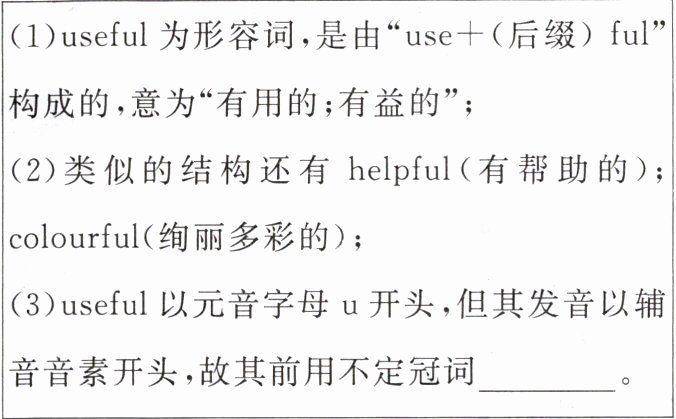
三运用多维度灵活运用
(1)The bike is
A. a
B. an
C. the
D. /
(2)Numbers are
一感悟读句子感悟用法
* Maths is very useful in our life... 数学在我们生活中非常有用……(教材·P48)
* The car is a useful machine. 汽车是个有用的机器。
二探究抓要点探究归纳
三运用多维度灵活运用
(1)The bike is
A
useful tool(工具).A. a
B. an
C. the
D. /
(2)Numbers are
useful
(use)in our life.
答案:
考点4
二探究
(3)a
三运用
(1)A 解析:考查冠词辨析。句意:自行车是一个有用的工具。根据句意可知此处表示泛指“一”,且 useful 以辅音音素开头,故用不定冠词 a。
(2)useful
二探究
(3)a
三运用
(1)A 解析:考查冠词辨析。句意:自行车是一个有用的工具。根据句意可知此处表示泛指“一”,且 useful 以辅音音素开头,故用不定冠词 a。
(2)useful
短文填空
Dear Jack,
How are you these days? I am very 1.
How about you? What’s your favourite subject? I really want to 10.
Yours,
Li Hua
Dear Jack,
How are you these days? I am very 1.
busy
(忙的)on Thursdays. At 8:00 I have maths. It’s not 2.fun
(乐趣). My teacher says it’s 3.useful
(use),but it’s difficult for me. Then at 9:00 I 4.have
science. It’s easy and interesting. At 10:00,I have 5.history
(历史). After that,I have PE. We all like it because it’s relaxing for 6.us
(we). Lunch is always from 12:00 to 13:00. And after that we have 7.Chinese
(China). It’s my favourite subject. Our Chinese 8.teacher
(teach),Mrs Chen,is great fun. The Chinese class 9.finishes
(finish)at 13:50,and after that I have an art lesson for an hour. I like art very much.How about you? What’s your favourite subject? I really want to 10.
know
(know)about your school life.Yours,
Li Hua
答案:
提优训练
1. busy 2. fun 3. useful 4. have 5. history
6. us 7. Chinese 8. teacher 9. finishes
10. know
1. busy 2. fun 3. useful 4. have 5. history
6. us 7. Chinese 8. teacher 9. finishes
10. know
查看更多完整答案,请扫码查看

