

 搜索
搜索
第117页
- 第1页
- 第2页
- 第3页
- 第4页
- 第5页
- 第6页
- 第7页
- 第8页
- 第9页
- 第10页
- 第11页
- 第12页
- 第13页
- 第14页
- 第15页
- 第16页
- 第17页
- 第18页
- 第19页
- 第20页
- 第21页
- 第22页
- 第23页
- 第24页
- 第25页
- 第26页
- 第27页
- 第28页
- 第29页
- 第30页
- 第31页
- 第32页
- 第33页
- 第34页
- 第35页
- 第36页
- 第37页
- 第38页
- 第39页
- 第40页
- 第41页
- 第42页
- 第43页
- 第44页
- 第45页
- 第46页
- 第47页
- 第48页
- 第49页
- 第50页
- 第51页
- 第52页
- 第53页
- 第54页
- 第55页
- 第56页
- 第57页
- 第58页
- 第59页
- 第60页
- 第61页
- 第62页
- 第63页
- 第64页
- 第65页
- 第66页
- 第67页
- 第68页
- 第69页
- 第70页
- 第71页
- 第72页
- 第73页
- 第74页
- 第75页
- 第76页
- 第77页
- 第78页
- 第79页
- 第80页
- 第81页
- 第82页
- 第83页
- 第84页
- 第85页
- 第86页
- 第87页
- 第88页
- 第89页
- 第90页
- 第91页
- 第92页
- 第93页
- 第94页
- 第95页
- 第96页
- 第97页
- 第98页
- 第99页
- 第100页
- 第101页
- 第102页
- 第103页
- 第104页
- 第105页
- 第106页
- 第107页
- 第108页
- 第109页
- 第110页
- 第111页
- 第112页
- 第113页
- 第114页
- 第115页
- 第116页
- 第117页
- 第118页
- 第119页
- 第120页
- 第121页
- 第122页
- 第123页
- 第124页
- 第125页
- 第126页
- 第127页
- 第128页
- 第129页
- 第130页
- 第131页
- 第132页
- 第133页
- 第134页
- 第135页
- 第136页
- 第137页
- 第138页
- 第139页
- 第140页
- 第141页
- 第142页
- 第143页
- 第144页
- 第145页
- 第146页
- 第147页
- 第148页
- 第149页
五、阅读短文,在文中空白处填入1个适当的单词,或用括号内所给单词的正确形式填空。
You must have heard of Sanfu days. Well, Sanfu days are also known as the "Chinese dog days of summer". They mark the 1
Sanfu days include 2
Sanfu days usually come between mid-July 5
In Changsha, local people often eat roosters(公鸡) during Sanfu days, especially during Toufu. That's because it is always hot with heavy rain in summer. Local people believe that eating roosters can clear the wet in 8
Besides, the practice of using Sanfutie is also known in China during Sanfu days. It is a kind of traditional Chinese herbal patch(贴片). Many people use Sanfutie 10
You must have heard of Sanfu days. Well, Sanfu days are also known as the "Chinese dog days of summer". They mark the 1
hottest
(hot) days of summer.Sanfu days include 2
three
(third) periods(时期): Toufu, Zhongfu and Mofu. In Chinese, "Fu" 3has
(have) the meaning of "hiding". So it is also a suggestion for people to stay 4at
home to "hide" from the strong heat outdoors in summer.Sanfu days usually come between mid-July 5
and
mid-August. During this time, Chinese people follow different traditional 6ways
(way) to deal with the heat and stay healthy. Now let's have 7a
look at some customs(习俗) of spending the "Chinese dog days of summer".In Changsha, local people often eat roosters(公鸡) during Sanfu days, especially during Toufu. That's because it is always hot with heavy rain in summer. Local people believe that eating roosters can clear the wet in 8
their
(they) bodies. And there is even an old saying that goes, "A rooster at the 9beginning
(begin) of Sanfu days, a healthy body the whole year."Besides, the practice of using Sanfutie is also known in China during Sanfu days. It is a kind of traditional Chinese herbal patch(贴片). Many people use Sanfutie 10
to help
(help) them prevent some winter illnesses.
答案:
1. hottest 2. three 3. has 4. at 5. and 6. ways 7. a 8. their 9. beginning 10. to help
六、阅读理解。
Every season brings special things—flowers in spring, sunshine in summer, colourful leaves in autumn, and snow in winter. People have created fun sayings and expressions about these seasons over the years. Let's get to know some of them!
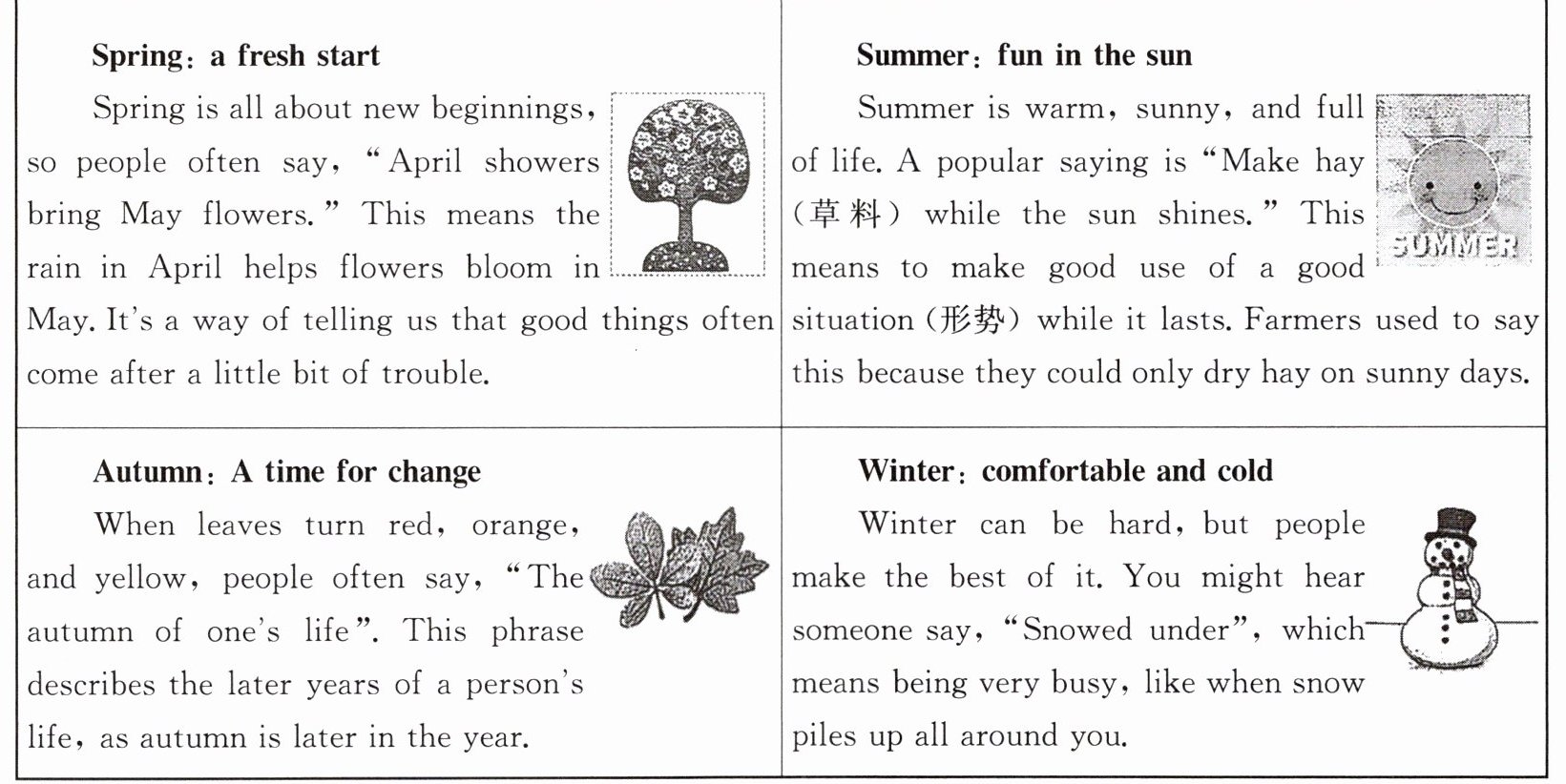
Seasonal sayings are like little bits of wisdom(智慧) in fun words. So next time you hear one, smile and think about how it connects to the world around you!
(
A. History. B. Health. C. Technology. D. Nature.
(
A. It is about working only in summer.
B. It teaches us to work when having a chance.
C. It tells us to rest during sunny days.
D. It tells people to dry some grass in spring.
(
A. People should enjoy all the seasons.
B. Different seasons have their own weather.
C. Seasonal sayings help us understand life and nature.
D. Spring and summer are better than autumn and winter.
Every season brings special things—flowers in spring, sunshine in summer, colourful leaves in autumn, and snow in winter. People have created fun sayings and expressions about these seasons over the years. Let's get to know some of them!
Seasonal sayings are like little bits of wisdom(智慧) in fun words. So next time you hear one, smile and think about how it connects to the world around you!
(
D
)1. In which part of a website can we find this article?A. History. B. Health. C. Technology. D. Nature.
(
B
)2. What can you learn from "Make hay while the sun shines."?A. It is about working only in summer.
B. It teaches us to work when having a chance.
C. It tells us to rest during sunny days.
D. It tells people to dry some grass in spring.
(
C
)3. What is the main idea of the article?A. People should enjoy all the seasons.
B. Different seasons have their own weather.
C. Seasonal sayings help us understand life and nature.
D. Spring and summer are better than autumn and winter.
答案:
1. D 【点拨】根据“Every season brings special things — flowers in spring,sunshine in summer,colourful leaves in autumn,and snow in winter.”可知,本文主要讲述的是关于季节的谚语,所以可以在网站的自然部分找到这篇文章。故选 D。 2. B 【点拨】根据“This means to make good use of a good situation(形势) while it lasts.”可知,“Make hay while the sun shines.”教会我们抓住工作的时机。故选 B。 3. C 【点拨】根据“Seasonal sayings are like little bits of wisdom(智慧) in fun words.”可知,这篇文章的主旨是季节谚语帮助我们理解生活和自然。故选 C。
查看更多完整答案,请扫码查看

