

 搜索
搜索
第108页
- 第1页
- 第2页
- 第3页
- 第4页
- 第5页
- 第6页
- 第7页
- 第8页
- 第9页
- 第10页
- 第11页
- 第12页
- 第13页
- 第14页
- 第15页
- 第16页
- 第17页
- 第18页
- 第19页
- 第20页
- 第21页
- 第22页
- 第23页
- 第24页
- 第25页
- 第26页
- 第27页
- 第28页
- 第29页
- 第30页
- 第31页
- 第32页
- 第33页
- 第34页
- 第35页
- 第36页
- 第37页
- 第38页
- 第39页
- 第40页
- 第41页
- 第42页
- 第43页
- 第44页
- 第45页
- 第46页
- 第47页
- 第48页
- 第49页
- 第50页
- 第51页
- 第52页
- 第53页
- 第54页
- 第55页
- 第56页
- 第57页
- 第58页
- 第59页
- 第60页
- 第61页
- 第62页
- 第63页
- 第64页
- 第65页
- 第66页
- 第67页
- 第68页
- 第69页
- 第70页
- 第71页
- 第72页
- 第73页
- 第74页
- 第75页
- 第76页
- 第77页
- 第78页
- 第79页
- 第80页
- 第81页
- 第82页
- 第83页
- 第84页
- 第85页
- 第86页
- 第87页
- 第88页
- 第89页
- 第90页
- 第91页
- 第92页
- 第93页
- 第94页
- 第95页
- 第96页
- 第97页
- 第98页
- 第99页
- 第100页
- 第101页
- 第102页
- 第103页
- 第104页
- 第105页
- 第106页
- 第107页
- 第108页
- 第109页
- 第110页
- 第111页
- 第112页
- 第113页
- 第114页
- 第115页
- 第116页
- 第117页
- 第118页
- 第119页
- 第120页
- 第121页
- 第122页
- 第123页
- 第124页
- 第125页
- 第126页
- 第127页
- 第128页
- 第129页
- 第130页
- 第131页
- 第132页
- 第133页
- 第134页
- 第135页
- 第136页
- 第137页
- 第138页
- 第139页
- 第140页
- 第141页
- 第142页
- 第143页
- 第144页
- 第145页
- 第146页
- 第147页
- 第148页
- 第149页
- 第150页
- 第151页
- 第152页
- 第153页
- 第154页
- 第155页
- 第156页
- 第157页
- 第158页
- 第159页
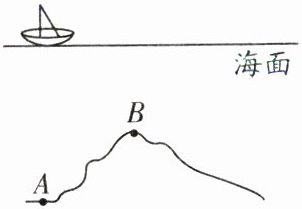
23. 海岭又称海底山脉,一般在海面以下,如图所示,某勘探船停在该海岭底部的A处正上方向海底发出声呐信号,6s后收到回波信号.之后勘探船以2km/h的平均速度沿直线行驶到达海岭最高点B处正上方,用时2h,该船再次向海底发出声呐信号,经3s后收到回波信号.已知声信号在海水中的传播速度为1500m/s.求:
(1)A处海水的深度;
(2)勘探船两次探测间航行的距离是多少?
(3)B处比A处高多少米?
(1)A处海水的深度;
(2)勘探船两次探测间航行的距离是多少?
(3)B处比A处高多少米?
答案:
(1)4500m
(2)4000m
(3)2250m
解析:
(1)由$v=\dfrac{s}{t}$可知,6s内声波传播的距离$s_{1}=v_{\text{声}}t_{1}=1500\ \text{m/s}×6\ \text{s}=9000\ \text{m}$,A处海水的深度$s_{A}=\dfrac{1}{2}s_{1}=\dfrac{1}{2}×9000\ \text{m}=4500\ \text{m}$.
(2)由$v=\dfrac{s}{t}$可得,勘探船两次探测间航行的距离$s=v_{\text{船}}t=2\ \text{km/h}×2\ \text{h}=4\ \text{km}=4000\ \text{m}$.
(3)由$v=\dfrac{s}{t}$可得,3s内声波传播的距离$s_{2}=v_{\text{声}}t_{2}=1500\ \text{m/s}×3\ \text{s}=4500\ \text{m}$,B处海水的深度$s_{B}=\dfrac{1}{2}s_{2}=\dfrac{1}{2}×4500\ \text{m}=2250\ \text{m}$,B处比A处高$\Delta s=s_{A}-s_{B}=4500\ \text{m}-2250\ \text{m}=2250\ \text{m}.$
(1)4500m
(2)4000m
(3)2250m
解析:
(1)由$v=\dfrac{s}{t}$可知,6s内声波传播的距离$s_{1}=v_{\text{声}}t_{1}=1500\ \text{m/s}×6\ \text{s}=9000\ \text{m}$,A处海水的深度$s_{A}=\dfrac{1}{2}s_{1}=\dfrac{1}{2}×9000\ \text{m}=4500\ \text{m}$.
(2)由$v=\dfrac{s}{t}$可得,勘探船两次探测间航行的距离$s=v_{\text{船}}t=2\ \text{km/h}×2\ \text{h}=4\ \text{km}=4000\ \text{m}$.
(3)由$v=\dfrac{s}{t}$可得,3s内声波传播的距离$s_{2}=v_{\text{声}}t_{2}=1500\ \text{m/s}×3\ \text{s}=4500\ \text{m}$,B处海水的深度$s_{B}=\dfrac{1}{2}s_{2}=\dfrac{1}{2}×4500\ \text{m}=2250\ \text{m}$,B处比A处高$\Delta s=s_{A}-s_{B}=4500\ \text{m}-2250\ \text{m}=2250\ \text{m}.$
24. 为了节能,某商场的自动扶梯安装了智能控制系统,在扶梯底端前3m处安装了如图1所示红外系统:乘客通过时,红外传感开关被触发,扶梯启动,同时计时器开始计时,若在设定时间t内无乘客通过顶端,扶梯将停止运行.已知扶梯长16m,从启动到匀速运行的v-t图像如图2所示,若乘客步行速度在0.5~1.5m/s之间.
(1)求乘客从红外杆处运动至扶梯底端的时间范围.
(2)为确保安全,设定时间t应至少为多少秒?

(1)求乘客从红外杆处运动至扶梯底端的时间范围.
(2)为确保安全,设定时间t应至少为多少秒?
答案:
(1)2~6s
(2)26s
解析:
(1)人步行的最小速度是0.5m/s,此时人从红外杆处走到扶梯底端所用的时间为$t_{1}=\dfrac{s_{1}}{v_{1}}=\dfrac{3\ \text{m}}{0.5\ \text{m/s}}=6\ \text{s}$,人步行的最大速度是1.5m/s,此时人从红外杆处走到扶梯底端所用的时间为$t_{2}=\dfrac{s_{1}}{v_{2}}=\dfrac{3\ \text{m}}{1.5\ \text{m/s}}=2\ \text{s}$.即乘客从红外杆处运动至扶梯底端的时间范围是2~6s.
(2)为确保安全,速度最慢的人也应安全乘坐扶梯到达顶端,故设定的时间至少为最慢的人全程运动的时间;由
(1)可知此时人从红外杆处走到扶梯所用的时间为$t_{1}=6\ \text{s}$,由图2可知,2s后扶梯匀速运动的速度是0.8m/s,故人乘坐扶梯从底端到顶端运动的时间为$t_{3}=\dfrac{s_{2}}{v_{3}}=\dfrac{16\ \text{m}}{0.8\ \text{m/s}}=20\ \text{s}$,故整个过程的总时间为$t_{\text{总}}=t_{1}+t_{3}=6\ \text{s}+20\ \text{s}=26\ \text{s}$,即设定时间应至少为26s.
(1)2~6s
(2)26s
解析:
(1)人步行的最小速度是0.5m/s,此时人从红外杆处走到扶梯底端所用的时间为$t_{1}=\dfrac{s_{1}}{v_{1}}=\dfrac{3\ \text{m}}{0.5\ \text{m/s}}=6\ \text{s}$,人步行的最大速度是1.5m/s,此时人从红外杆处走到扶梯底端所用的时间为$t_{2}=\dfrac{s_{1}}{v_{2}}=\dfrac{3\ \text{m}}{1.5\ \text{m/s}}=2\ \text{s}$.即乘客从红外杆处运动至扶梯底端的时间范围是2~6s.
(2)为确保安全,速度最慢的人也应安全乘坐扶梯到达顶端,故设定的时间至少为最慢的人全程运动的时间;由
(1)可知此时人从红外杆处走到扶梯所用的时间为$t_{1}=6\ \text{s}$,由图2可知,2s后扶梯匀速运动的速度是0.8m/s,故人乘坐扶梯从底端到顶端运动的时间为$t_{3}=\dfrac{s_{2}}{v_{3}}=\dfrac{16\ \text{m}}{0.8\ \text{m/s}}=20\ \text{s}$,故整个过程的总时间为$t_{\text{总}}=t_{1}+t_{3}=6\ \text{s}+20\ \text{s}=26\ \text{s}$,即设定时间应至少为26s.
查看更多完整答案,请扫码查看

