

 搜索
搜索
第7页
- 第1页
- 第2页
- 第3页
- 第4页
- 第5页
- 第6页
- 第7页
- 第8页
- 第9页
- 第10页
- 第11页
- 第12页
- 第13页
- 第14页
- 第15页
- 第16页
- 第17页
- 第18页
- 第19页
- 第20页
- 第21页
- 第22页
- 第23页
- 第24页
- 第25页
- 第26页
- 第27页
- 第28页
- 第29页
- 第30页
- 第31页
- 第32页
- 第33页
- 第34页
- 第35页
- 第36页
- 第37页
- 第38页
- 第39页
- 第40页
- 第41页
- 第42页
- 第43页
- 第44页
- 第45页
- 第46页
- 第47页
- 第48页
- 第49页
- 第50页
- 第51页
- 第52页
- 第53页
- 第54页
- 第55页
- 第56页
- 第57页
- 第58页
- 第59页
- 第60页
- 第61页
- 第62页
- 第63页
- 第64页
- 第65页
- 第66页
- 第67页
- 第68页
- 第69页
- 第70页
- 第71页
- 第72页
- 第73页
- 第74页
- 第75页
- 第76页
- 第77页
- 第78页
- 第79页
- 第80页
- 第81页
- 第82页
- 第83页
- 第84页
- 第85页
- 第86页
- 第87页
一、用方框中所给单词的适当形式填空。
chopstick empty point manner polite
1. Mandy has the habit of collecting empty boxes and using them again.
2. The little boy has no manners, so people don't think he is well - educated by his parents.
3. It's impolite to talk to others with much food in your mouth.
4. The American man who is used to using forks can't use the chopsticks well at dinner.
5. I got lost yesterday, but luckily, a girl pointed out the right direction to me.
chopstick empty point manner polite
1. Mandy has the habit of collecting empty boxes and using them again.
2. The little boy has no manners, so people don't think he is well - educated by his parents.
3. It's impolite to talk to others with much food in your mouth.
4. The American man who is used to using forks can't use the chopsticks well at dinner.
5. I got lost yesterday, but luckily, a girl pointed out the right direction to me.
答案:
1. empty 2. manners 3. impolite 4. chopsticks 5. pointed
二、英汉互译。
将下列英语句子译成汉语,汉语句子译成英语。
6. You must be very excited to have a chance to visit the beautiful city.
______
7. I feel a little nervous because I will have a job interview tomorrow.
__________
8. 我们应该什么时间到那里?(suppose)
__________
9. 他将被期待在会议上发言。(expect)
____________
10. 你能教我怎样使用筷子吗?(how to do)
____________
将下列英语句子译成汉语,汉语句子译成英语。
6. You must be very excited to have a chance to visit the beautiful city.
______
7. I feel a little nervous because I will have a job interview tomorrow.
__________
8. 我们应该什么时间到那里?(suppose)
__________
9. 他将被期待在会议上发言。(expect)
____________
10. 你能教我怎样使用筷子吗?(how to do)
____________
答案:
6. 有机会游览这座美丽的城市,你一定很兴奋。
7. 我感到有点儿紧张,因为我明天有一场工作面试。
8. When/ What time are we supposed to get there?
9. He will be expected to speak at the meeting.
10. Can you teach me how to use chopsticks?
7. 我感到有点儿紧张,因为我明天有一场工作面试。
8. When/ What time are we supposed to get there?
9. He will be expected to speak at the meeting.
10. Can you teach me how to use chopsticks?
三、阅读还原。
根据短文内容,从短文后的选项中选出能填入空白处的最佳选项。(选项中有一项为多余选项)
(2024·凉山州)Different countries have different manners about social situations. In Mexico, people shake hands when they meet for the first time. In Brazil, people sometimes kiss. In Korea, people usually bow. Do you know Chinese fist - and - palm salute(拱手礼)? It is one of classic greeting manners in China. 11.
The occasions of making fist - and - palm salute
For centuries, China has been known as a “Liyi Zhibang”. Nowadays, Chinese usually shake hands when meeting others, but sometimes they also make fist - and - palm salute. 12. People make fist - and - palm salute when they visit someone during the Spring Festival or attend someone's wedding ceremony, birthday party and so on.
The history of fist - and - palm salute
13. It started in the West Zhou Dynasty. If people met strangers, they would prepare for a fight if necessary, and hands were always ready for holding weapons(武器). Holding hands together pointed to themselves was a meaning of expressing kindness. Later it became one of traditional Chinese manners when meeting each other.
14.
How do you make fist - and - palm salute properly? First, stand at attention. Then, if you are a man, right - hand half - fist, and then the left - hand hold the right - hand in front of your chest. For a woman, left - hand half - fist, and then the right - hand put the left - hand on the top. Next, watch each other, raise both hands to brow(额头) and bend down. 15. Also, you could say some lucky greeting words to each other for three times.
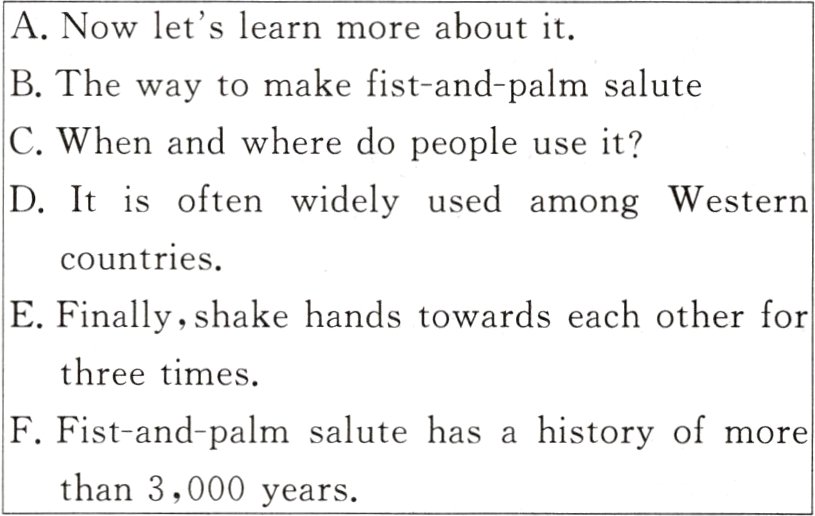
11.___ 12. ___ 13. ___ 14. ___ 15. ___
根据短文内容,从短文后的选项中选出能填入空白处的最佳选项。(选项中有一项为多余选项)
(2024·凉山州)Different countries have different manners about social situations. In Mexico, people shake hands when they meet for the first time. In Brazil, people sometimes kiss. In Korea, people usually bow. Do you know Chinese fist - and - palm salute(拱手礼)? It is one of classic greeting manners in China. 11.
The occasions of making fist - and - palm salute
For centuries, China has been known as a “Liyi Zhibang”. Nowadays, Chinese usually shake hands when meeting others, but sometimes they also make fist - and - palm salute. 12. People make fist - and - palm salute when they visit someone during the Spring Festival or attend someone's wedding ceremony, birthday party and so on.
The history of fist - and - palm salute
13. It started in the West Zhou Dynasty. If people met strangers, they would prepare for a fight if necessary, and hands were always ready for holding weapons(武器). Holding hands together pointed to themselves was a meaning of expressing kindness. Later it became one of traditional Chinese manners when meeting each other.
14.
How do you make fist - and - palm salute properly? First, stand at attention. Then, if you are a man, right - hand half - fist, and then the left - hand hold the right - hand in front of your chest. For a woman, left - hand half - fist, and then the right - hand put the left - hand on the top. Next, watch each other, raise both hands to brow(额头) and bend down. 15. Also, you could say some lucky greeting words to each other for three times.
11.___ 12. ___ 13. ___ 14. ___ 15. ___
答案:
11 - 15 ACFBE
查看更多完整答案,请扫码查看

