

 搜索
搜索
第2页
- 第1页
- 第2页
- 第3页
- 第4页
- 第5页
- 第6页
- 第7页
- 第8页
- 第9页
- 第10页
- 第11页
- 第12页
- 第13页
- 第14页
- 第15页
- 第16页
- 第17页
- 第18页
- 第19页
- 第20页
- 第21页
- 第22页
- 第23页
- 第24页
- 第25页
- 第26页
- 第27页
- 第28页
- 第29页
- 第30页
- 第31页
- 第32页
- 第33页
- 第34页
- 第35页
- 第36页
- 第37页
- 第38页
- 第39页
- 第40页
- 第41页
- 第42页
- 第43页
- 第44页
- 第45页
- 第46页
- 第47页
- 第48页
- 第49页
- 第50页
- 第51页
- 第52页
- 第53页
- 第54页
- 第55页
- 第56页
- 第57页
- 第58页
- 第59页
- 第60页
- 第61页
- 第62页
- 第63页
- 第64页
- 第65页
- 第66页
- 第67页
- 第68页
- 第69页
- 第70页
- 第71页
- 第72页
- 第73页
- 第74页
- 第75页
- 第76页
- 第77页
- 第78页
- 第79页
- 第80页
- 第81页
- 第82页
- 第83页
- 第84页
- 第85页
- 第86页
- 第87页
五、阅读理解。
(2024·湖北)So far, China has successfully sent a large number of satellites(卫星) and spaceships into space. Space scientists have been greatly inspired(赋予灵感) by the old stories and ancient famous people when giving them names.
Since thousands of years ago, Chinese people have dreamed of going to the moon. Chang'e Flying to the Moon is one of the most popular stories. As you can see, China's first man - made satellite to circle around the moon was named Chang'e Ⅰ. More interestingly, the moon rover(探测器) was named after the Jade Rabbit, who is the partner of Chang'e in the story. These old stories carry people's best wishes and dreams. With the development of science and technology, our scientists have made them come true.
Kua Fu Goes After the Sun is another story to show how much ancient Chinese people wanted to know about the unknown world. Now, Kua Fu is going with the scientists to “visit” the sun, because we have a space project called Kua Fu Mission.
Besides the ancient stories, space scientists also get ideas from ancient famous people. For example, Mozi, an ancient scientist, discovered that light travels in a straight line over 2,000 years ago. His discovery made space study take a big step at that time. So, China's first quantum(量子) science satellite was named Mozi, making China the first country in the world to achieve quantum communication between satellites and the ground.
From such simple things as giving names to the satellites, we can see how great our traditional culture is and what an impact(影响) it has on our modern science and technology.
( )21. In China, space scientists get ideas from ________ when naming satellites.
①old stories ②traditional projects
③ancient famous people ④popular inventions
A. ①② B. ①③
C. ②④ D. ③④
( )22. What do we know about Chang'e Ⅰ according to the passage?
A. It moves around the moon.
B. It protects the Jade Rabbit.
C. It “visits” the sun with the scientists.
D. It is the world's first man - made satellite.
( )23. 新考向 写作手法 How does the writer support his opinion in Paragraph 4?
A. By listing numbers.
B. By comparing facts.
C. By giving an example.
D. By reporting a result.
( )24. 新考向 篇章结构 Which is the RIGHT structure of the passage?(① = Paragraph 1...)
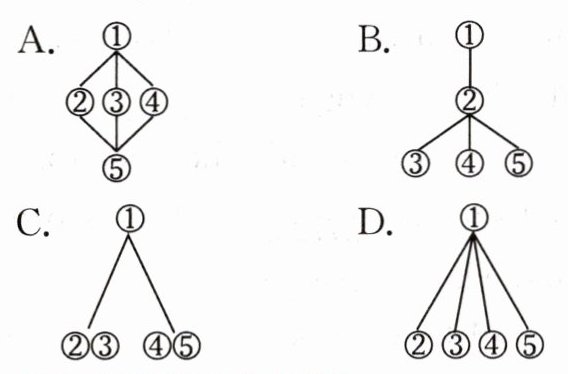
( )25. 新考向 写作意图 What's the writer's main purpose of writing the passage?
A. To spread the traditional Chinese culture.
B. To explain how our scientists develop the space industry.
C. To introduce the achievements in our science and technology.
D. To tell how traditional Chinese culture influences our space science.
(2024·湖北)So far, China has successfully sent a large number of satellites(卫星) and spaceships into space. Space scientists have been greatly inspired(赋予灵感) by the old stories and ancient famous people when giving them names.
Since thousands of years ago, Chinese people have dreamed of going to the moon. Chang'e Flying to the Moon is one of the most popular stories. As you can see, China's first man - made satellite to circle around the moon was named Chang'e Ⅰ. More interestingly, the moon rover(探测器) was named after the Jade Rabbit, who is the partner of Chang'e in the story. These old stories carry people's best wishes and dreams. With the development of science and technology, our scientists have made them come true.
Kua Fu Goes After the Sun is another story to show how much ancient Chinese people wanted to know about the unknown world. Now, Kua Fu is going with the scientists to “visit” the sun, because we have a space project called Kua Fu Mission.
Besides the ancient stories, space scientists also get ideas from ancient famous people. For example, Mozi, an ancient scientist, discovered that light travels in a straight line over 2,000 years ago. His discovery made space study take a big step at that time. So, China's first quantum(量子) science satellite was named Mozi, making China the first country in the world to achieve quantum communication between satellites and the ground.
From such simple things as giving names to the satellites, we can see how great our traditional culture is and what an impact(影响) it has on our modern science and technology.
( )21. In China, space scientists get ideas from ________ when naming satellites.
①old stories ②traditional projects
③ancient famous people ④popular inventions
A. ①② B. ①③
C. ②④ D. ③④
( )22. What do we know about Chang'e Ⅰ according to the passage?
A. It moves around the moon.
B. It protects the Jade Rabbit.
C. It “visits” the sun with the scientists.
D. It is the world's first man - made satellite.
( )23. 新考向 写作手法 How does the writer support his opinion in Paragraph 4?
A. By listing numbers.
B. By comparing facts.
C. By giving an example.
D. By reporting a result.
( )24. 新考向 篇章结构 Which is the RIGHT structure of the passage?(① = Paragraph 1...)
( )25. 新考向 写作意图 What's the writer's main purpose of writing the passage?
A. To spread the traditional Chinese culture.
B. To explain how our scientists develop the space industry.
C. To introduce the achievements in our science and technology.
D. To tell how traditional Chinese culture influences our space science.
答案:
21 - 25 BACAD
查看更多完整答案,请扫码查看

