

 搜索
搜索
第73页
- 第2页
- 第3页
- 第4页
- 第5页
- 第6页
- 第7页
- 第8页
- 第9页
- 第10页
- 第11页
- 第12页
- 第13页
- 第14页
- 第15页
- 第16页
- 第17页
- 第18页
- 第19页
- 第20页
- 第21页
- 第22页
- 第23页
- 第24页
- 第25页
- 第26页
- 第27页
- 第28页
- 第29页
- 第30页
- 第31页
- 第32页
- 第33页
- 第34页
- 第35页
- 第36页
- 第37页
- 第38页
- 第39页
- 第40页
- 第41页
- 第42页
- 第43页
- 第44页
- 第45页
- 第46页
- 第47页
- 第48页
- 第49页
- 第50页
- 第51页
- 第52页
- 第53页
- 第54页
- 第55页
- 第56页
- 第57页
- 第58页
- 第59页
- 第60页
- 第61页
- 第62页
- 第63页
- 第64页
- 第65页
- 第66页
- 第67页
- 第68页
- 第69页
- 第70页
- 第71页
- 第72页
- 第73页
- 第74页
- 第75页
- 第76页
Ⅲ. Task reading.
Charles Richard Drew, an African - American, started blood banks. He was born on June 3, 1904, in Washington D. C. His father was a lawyer and his mother was a teacher. Drew was the eldest of their five children. The boy tried to get good grades when he was at school. Drew was good at sports and he won four medals in swimming when he was eight years old. During his high school years, Drew was a great member of the football, basketball and baseball teams.
After high school, Drew attended Amherst College. The young man didn't have enough money to go to medical school, so he worked and saved his money. Finally, in 1928, he went to a medical school in Canada. Then he studied at Columbia University Medical School.
Drew's interest was blood, specifically "blood transfusions (输血)". He wanted to learn all he could about the subject. He studied the idea of a "blood bank" which is a way to collect and store blood for transfusions. Through his experiments, Drew found out that blood plasma (血浆) could be successfully used instead of whole blood. Plasma can be stored for longer than whole blood. In 1940, Drew wrote about the results of his experiments in a report.
Drew is considered to have created the "blood bank" for the following two reasons: He found that blood can be separated (分开) into different parts, and that plasma can be kept until it is needed for a blood transfusion.
要求:1题判断正(T)误(F);2题将画线句子翻译成汉语;3题填空;4题回答问题;5题选择正确答案。
1. Drew was good at sports when he was in high school. (
2.
3. The interest of Charles Richard Drew is
4. What is a "blood bank"?
5. Why is Drew believed to have created the "blood bank"?
A. He found that blood can be separated into different parts.
B. He found that plasma can be kept until it is needed for a blood transfusion.
C. He found out that blood plasma could be successfully used instead of whole blood.
D. A and B.
(
Charles Richard Drew, an African - American, started blood banks. He was born on June 3, 1904, in Washington D. C. His father was a lawyer and his mother was a teacher. Drew was the eldest of their five children. The boy tried to get good grades when he was at school. Drew was good at sports and he won four medals in swimming when he was eight years old. During his high school years, Drew was a great member of the football, basketball and baseball teams.
After high school, Drew attended Amherst College. The young man didn't have enough money to go to medical school, so he worked and saved his money. Finally, in 1928, he went to a medical school in Canada. Then he studied at Columbia University Medical School.
Drew's interest was blood, specifically "blood transfusions (输血)". He wanted to learn all he could about the subject. He studied the idea of a "blood bank" which is a way to collect and store blood for transfusions. Through his experiments, Drew found out that blood plasma (血浆) could be successfully used instead of whole blood. Plasma can be stored for longer than whole blood. In 1940, Drew wrote about the results of his experiments in a report.
Drew is considered to have created the "blood bank" for the following two reasons: He found that blood can be separated (分开) into different parts, and that plasma can be kept until it is needed for a blood transfusion.
要求:1题判断正(T)误(F);2题将画线句子翻译成汉语;3题填空;4题回答问题;5题选择正确答案。
1. Drew was good at sports when he was in high school. (
T
)2.
这个年轻人没有足够的钱去上医学院,所以他一边工作一边攒钱。
3. The interest of Charles Richard Drew is
blood, specifically "blood transfusions"
.4. What is a "blood bank"?
It is a way to collect and store blood for transfusions.
5. Why is Drew believed to have created the "blood bank"?
A. He found that blood can be separated into different parts.
B. He found that plasma can be kept until it is needed for a blood transfusion.
C. He found out that blood plasma could be successfully used instead of whole blood.
D. A and B.
(
D
)
答案:
1. T
2. 这个年轻人没有足够的钱去上医学院,所以他一边工作一边攒钱。
3. blood, specifically "blood transfusions"
4. It is a way to collect and store blood for transfusions.
5. D
2. 这个年轻人没有足够的钱去上医学院,所以他一边工作一边攒钱。
3. blood, specifically "blood transfusions"
4. It is a way to collect and store blood for transfusions.
5. D
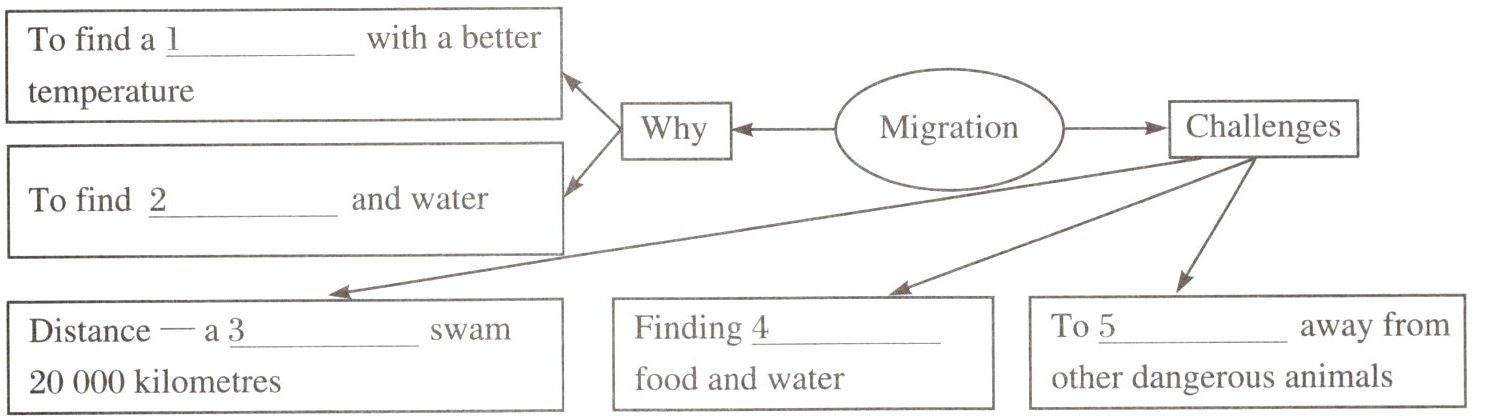
Ⅳ. Read the passage and fill in the information map.
Great white sharks in the Pacific Ocean, wildebeests (角马) in Africa, and Arctic terns (北极燕鸥) in the Atlantic - these animals seem quite different. One swims, one walks, and the third flies. But they all have one thing in common. They all migrate.
Some migrating animals move to a place with a better temperature. Some go to find food or water. The groups travel as one, but during the trip, they face many different challenges.
One challenge is distance. Some migrating animals take very long trips. For example, one great white shark swam from Australia to South Africa and back. In nine months, it swam about 20 000 kilometres!
Another challenge is finding enough food and water during the journey. For example, each Mali elephant needs over 200 litres of water each day. To get this, they need to go from one water hole to another.
Besides, migrating animals have to keep away from other animals that want to eat them. The zebra has to avoid lions. Travelling as a group helps keep them safe. When one zebra is in trouble, the other members make a circle around it.
By working as a group, migrating animals travel long distances to make their lives better.
|To find a 1
|To find 2
|Distance - a 3
|Finding 4
|To 5
Great white sharks in the Pacific Ocean, wildebeests (角马) in Africa, and Arctic terns (北极燕鸥) in the Atlantic - these animals seem quite different. One swims, one walks, and the third flies. But they all have one thing in common. They all migrate.
Some migrating animals move to a place with a better temperature. Some go to find food or water. The groups travel as one, but during the trip, they face many different challenges.
One challenge is distance. Some migrating animals take very long trips. For example, one great white shark swam from Australia to South Africa and back. In nine months, it swam about 20 000 kilometres!
Another challenge is finding enough food and water during the journey. For example, each Mali elephant needs over 200 litres of water each day. To get this, they need to go from one water hole to another.
Besides, migrating animals have to keep away from other animals that want to eat them. The zebra has to avoid lions. Travelling as a group helps keep them safe. When one zebra is in trouble, the other members make a circle around it.
By working as a group, migrating animals travel long distances to make their lives better.
|To find a 1
place
with a better temperature||To find 2
food
and water||Distance - a 3
great white shark
swam 20 000 kilometres||Finding 4
enough
food and water||To 5
keep
away from other dangerous animals|
答案:
1. place
2. food
3. great white shark
4. enough
5. keep
2. food
3. great white shark
4. enough
5. keep
查看更多完整答案,请扫码查看

