

 搜索
搜索
2025年全品学练考九年级英语人教版内蒙古专版
注:目前有些书本章节名称可能整理的还不是很完善,但都是按照顺序排列的,请同学们按照顺序仔细查找。练习册 2025年全品学练考九年级英语人教版内蒙古专版 答案主要是用来给同学们做完题方便对答案用的,请勿直接抄袭。
第106页
- 第1页
- 第2页
- 第3页
- 第4页
- 第5页
- 第6页
- 第7页
- 第8页
- 第9页
- 第10页
- 第11页
- 第12页
- 第13页
- 第14页
- 第15页
- 第16页
- 第17页
- 第18页
- 第19页
- 第20页
- 第21页
- 第22页
- 第23页
- 第24页
- 第25页
- 第26页
- 第27页
- 第28页
- 第29页
- 第30页
- 第31页
- 第32页
- 第33页
- 第34页
- 第35页
- 第36页
- 第37页
- 第38页
- 第39页
- 第40页
- 第41页
- 第42页
- 第43页
- 第44页
- 第45页
- 第46页
- 第47页
- 第48页
- 第49页
- 第50页
- 第51页
- 第52页
- 第53页
- 第54页
- 第55页
- 第56页
- 第57页
- 第58页
- 第59页
- 第60页
- 第61页
- 第62页
- 第63页
- 第64页
- 第65页
- 第66页
- 第67页
- 第68页
- 第69页
- 第70页
- 第71页
- 第72页
- 第73页
- 第74页
- 第75页
- 第76页
- 第77页
- 第78页
- 第79页
- 第80页
- 第81页
- 第82页
- 第83页
- 第84页
- 第85页
- 第86页
- 第87页
- 第88页
- 第89页
- 第90页
- 第91页
- 第92页
- 第93页
- 第94页
- 第95页
- 第96页
- 第97页
- 第98页
- 第99页
- 第100页
- 第101页
- 第102页
- 第103页
- 第104页
- 第105页
- 第106页
- 第107页
- 第108页
- 第109页
- 第110页
- 第111页
- 第112页
- 第113页
- 第114页
- 第115页
- 第116页
- 第117页
- 第118页
- 第119页
- 第120页
- 第121页
- 第122页
- 第123页
- 第124页
- 第125页
- 第126页
- 第127页
- 第128页
- 第129页
- 第130页
Ⅰ. 用括号中所给单词的适当形式完成句子(每空仅限1个单词)
1. John took part in the
2. People are used to
3. The children had a great time
4.
5. Now, I'm comfortable
6. Good
7. I thought the movie would be boring, but
8. I wasn't used to going to bed early, but I'm
9. Write a letter to your pen pal to give her some
10. Mr. Watson
1. John took part in the
exchange
program to improve his spoken English. (exchange)2. People are used to
communicating
in different ways, such as through speaking, writing, or body language. (communicate)3. The children had a great time
playing
in the water yesterday evening. (play)4.
Basic
knowledge of grammar is necessary for learning a new language. (base)5. Now, I'm comfortable
speaking
French because I have been used to the life here. (speak)6. Good
behavior
should be praised. (behave)7. I thought the movie would be boring, but
actually
it was really exciting. (actual)8. I wasn't used to going to bed early, but I'm
gradually
getting used to it. (gradual)9. Write a letter to your pen pal to give her some
suggestions
on how to behave properly in China. (suggest)10. Mr. Watson
emptied
the bottle of water and then filled it with beer. (empty)
答案:
1. exchange 2. communicating 3. playing 4. Basic 5. speaking 6. behavior 7. actually 8. gradually 9. suggestions 10. emptied
Ⅱ. 从方框中选出合适的短语,并用其适当形式填空
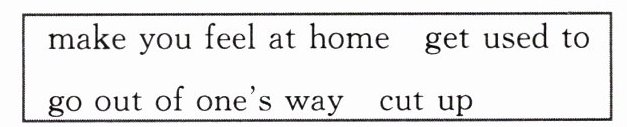
11. The cook is
12. Don't worry, Mary. You will
13. He always
14. We will provide you with the best service and
11. The cook is
cutting up
some chicken and he is going to make chicken soup.12. Don't worry, Mary. You will
get used to
the daily life here.13. He always
goes out of his way
to help me when I am in trouble.14. We will provide you with the best service and
make you feel at home
.
答案:
11. cutting up 12. get used to 13. goes out of his way 14. make you feel at home
Ⅲ. 阅读理解(主题:人与社会·各地习俗)
When two people meet, there are a lot of ways of greeting. The ways of greeting are not always the same in different countries.
In America, two people usually greet each other with a handshake. It is a way to show respect. Athletes from opposite teams shake hands before a game for the same reason. However, most Americans don't shake hands when they meet the people they have already known well. When American friends meet each other, they might only wave(挥手), or maybe just nod(点头) their heads.
In New Zealand, there is a special way of greeting called "hongi". In the greeting, two people press their noses together and close their eyes. This is an old tradition that comes from Maoris, who were the first people to live in New Zealand. Even today, many New Zealanders still press their noses when they meet.
Kissing is sometimes used as a way to greet someone. In some countries, important people used to wear special rings. It was the custom for visitors to kiss these rings when they came for a meeting. In France, when people meet, sometimes they kiss each other on the face.
In Japan, people bow to each other every time they meet. Even family members bow to each other. How low to bow depends on how respected the other person is.
Today, new ways of greeting are created all the time. People can do this with a quick "hi", a handshake, or even a simple smile. The important thing is that the people they are greeting understand them.
(
A. Showing love.
B. Showing respect.
C. Introducing each other.
(
A. Hongi is a kind of traditional food in New Zealand.
B. Maoris used to be an old village in New Zealand.
C. Hongi is an old tradition in New Zealand.
(
A. It depends on how respected the other person is.
B. It depends on how old the other person is.
C. It depends on how successful the other person is.
(
A. It's OK for Americans to nod heads when they meet their friends.
B. Family members in Japan do not bow to each other.
C. The ways of greeting are changing over time.
When two people meet, there are a lot of ways of greeting. The ways of greeting are not always the same in different countries.
In America, two people usually greet each other with a handshake. It is a way to show respect. Athletes from opposite teams shake hands before a game for the same reason. However, most Americans don't shake hands when they meet the people they have already known well. When American friends meet each other, they might only wave(挥手), or maybe just nod(点头) their heads.
In New Zealand, there is a special way of greeting called "hongi". In the greeting, two people press their noses together and close their eyes. This is an old tradition that comes from Maoris, who were the first people to live in New Zealand. Even today, many New Zealanders still press their noses when they meet.
Kissing is sometimes used as a way to greet someone. In some countries, important people used to wear special rings. It was the custom for visitors to kiss these rings when they came for a meeting. In France, when people meet, sometimes they kiss each other on the face.
In Japan, people bow to each other every time they meet. Even family members bow to each other. How low to bow depends on how respected the other person is.
Today, new ways of greeting are created all the time. People can do this with a quick "hi", a handshake, or even a simple smile. The important thing is that the people they are greeting understand them.
(
B
)15. What does the underlined part "the same reason" refer to?A. Showing love.
B. Showing respect.
C. Introducing each other.
(
C
)16. What can we learn from the third paragraph?A. Hongi is a kind of traditional food in New Zealand.
B. Maoris used to be an old village in New Zealand.
C. Hongi is an old tradition in New Zealand.
(
A
)17. How low does a Japanese bow to the other?A. It depends on how respected the other person is.
B. It depends on how old the other person is.
C. It depends on how successful the other person is.
(
B
)18. Which of the following is NOT true according to the passage?A. It's OK for Americans to nod heads when they meet their friends.
B. Family members in Japan do not bow to each other.
C. The ways of greeting are changing over time.
答案:
15.B 16.C 17.A 18.B
查看更多完整答案,请扫码查看

