

 搜索
搜索
第72页
- 第2页
- 第3页
- 第4页
- 第5页
- 第6页
- 第7页
- 第8页
- 第9页
- 第10页
- 第11页
- 第12页
- 第13页
- 第14页
- 第15页
- 第16页
- 第17页
- 第18页
- 第19页
- 第20页
- 第21页
- 第22页
- 第23页
- 第24页
- 第25页
- 第26页
- 第27页
- 第28页
- 第29页
- 第30页
- 第31页
- 第32页
- 第33页
- 第34页
- 第35页
- 第36页
- 第37页
- 第38页
- 第39页
- 第40页
- 第41页
- 第42页
- 第43页
- 第44页
- 第45页
- 第46页
- 第47页
- 第48页
- 第49页
- 第50页
- 第51页
- 第52页
- 第53页
- 第54页
- 第55页
- 第56页
- 第57页
- 第58页
- 第59页
- 第60页
- 第61页
- 第62页
- 第63页
- 第64页
- 第65页
- 第66页
- 第67页
- 第68页
- 第69页
- 第70页
- 第71页
- 第72页
- 第73页
- 第74页
- 第75页
- 第76页
- 第77页
- 第78页
- 第79页
- 第80页
- 第81页
- 第82页
- 第83页
- 第84页
- 第85页
- 第86页
- 第87页
- 第88页
- 第89页
- 第90页
- 第91页
- 第92页
- 第93页
- 第94页
- 第95页
- 第96页
- 第97页
- 第98页
- 第99页
- 第100页
Ⅰ. Make sentences with words or phrases.
1. great - grandma, my, in, past, often, tells, the, life, me, about______
2. no, they, machines, cleaning, had, help, cooking, or, with, to______
3. winter, we, electric, cold, use, heaters, warm, house, the, in, to______
1. great - grandma, my, in, past, often, tells, the, life, me, about______
2. no, they, machines, cleaning, had, help, cooking, or, with, to______
3. winter, we, electric, cold, use, heaters, warm, house, the, in, to______
答案:
1. My great-grandma often tells me about life in the past.
2. They had no machines to help with cooking or cleaning.
3. We use electric heaters to warm the house in cold winter.
2. They had no machines to help with cooking or cleaning.
3. We use electric heaters to warm the house in cold winter.
Ⅱ. Answer the questions according to P62 of the Text Book.
1. Which aspect(s) of changes does Harry write about?______
2. Find the two pairs of words or phrases to show contrast in the article.______
3. How did people keep warm in the past? What about now?______
1. Which aspect(s) of changes does Harry write about?______
2. Find the two pairs of words or phrases to show contrast in the article.______
3. How did people keep warm in the past? What about now?______
答案:
1. Living conditions and schools.
2. "When she was a child" vs "today" and "in the old days" vs "today".
3. They burned wood to keep warm in the past. Now they use electric heaters.
2. "When she was a child" vs "today" and "in the old days" vs "today".
3. They burned wood to keep warm in the past. Now they use electric heaters.
Ⅲ. Translate the following sentences into English.
1. 过去人们靠烧柴取暖,如今我们用暖气取暖。______
2. 过去人们常步行或骑自行车出行,现在很多人开车或坐地铁。______
3. 以前我们主要通过写信交流,可现在大家常用微信发消息。______
4. 以前孩子们常玩户外游戏,现在他们更多地在手机上玩电子游戏。______
1. 过去人们靠烧柴取暖,如今我们用暖气取暖。______
2. 过去人们常步行或骑自行车出行,现在很多人开车或坐地铁。______
3. 以前我们主要通过写信交流,可现在大家常用微信发消息。______
4. 以前孩子们常玩户外游戏,现在他们更多地在手机上玩电子游戏。______
答案:
1. In the old days, people burned wood to keep warm. Today, we use heaters to keep warm.
2. In the past, people often travelled on foot or by bike. Now, many people drive cars or take the underground.
3. We mainly communicated by writing letters before, but now people often send messages on WeChat.
4. Kids used to play outdoor games before. Now, they play video games on mobile phones more often.
2. In the past, people often travelled on foot or by bike. Now, many people drive cars or take the underground.
3. We mainly communicated by writing letters before, but now people often send messages on WeChat.
4. Kids used to play outdoor games before. Now, they play video games on mobile phones more often.
Ⅳ. Writing—plan your writing by finishing the following chart.
| Changes in our lives | |
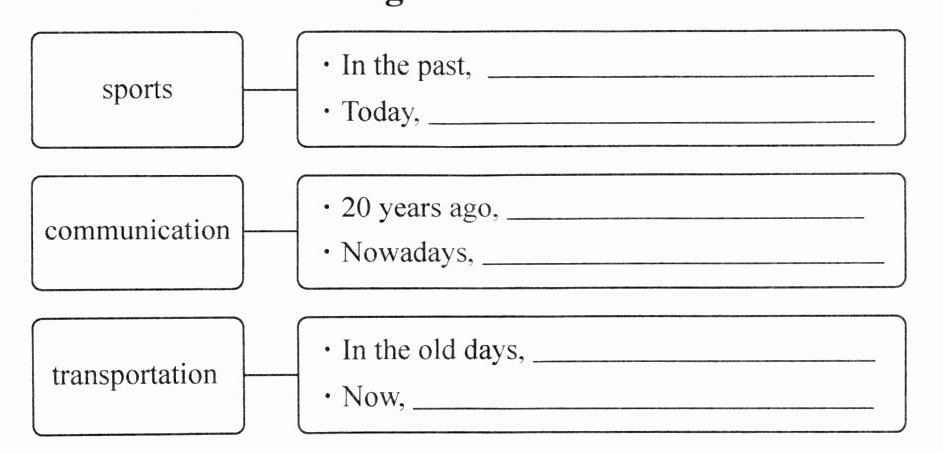
| sports | · In the past, ______
· Today, ______ |
| communication | · 20 years ago, ______
· Nowadays, ______ |
| transportation | · In the old days, ______
· Now, ______ |
| Changes in our lives | |
| sports | · In the past, ______
· Today, ______ |
| communication | · 20 years ago, ______
· Nowadays, ______ |
| transportation | · In the old days, ______
· Now, ______ |
答案:
sports: In the past, people usually did simple sports like running and jumping. Today, people can do various sports such as swimming, playing basketball and going to the gym. communication: 20 years ago, people mainly communicated by writing letters or using fixed-line telephones. Nowadays, people use smartphones to call, text and video chat easily. transportation: In the old days, people often went out on foot, by bike or by slow buses. Now, people can take fast trains, planes and private cars to travel.
Ⅴ. Answer the questions.
As an old saying goes, a good book is like a good friend. If so, my best friend must be *The Old Man and the Sea* by American writer Ernest Hemingway.
In my eyes, Ernest Hemingway is probably one of the greatest writers in the 20th century. When he was 19, he volunteered to go to war because he wanted to take risks. However, he was badly hurt in the war and got back home. In Hemingway's life, this experience was important. He wrote several books about the war to show how bad life was for the young men who had to fight.
Hemingway likes to write in very short sentences with simple words. This is because he wants his readers to feel the emotions of his stories clearly. *The Old Man and the Sea* is one of his famous books. I have read it twice. I learned a lot from this book, especially the spirit of the main character, Santiago.
*The Old Man and the Sea* is a story about an old fisherman named Santiago who fights with a big fish by himself in the sea. He experiences many ups and downs. He has no water, food or people to help him. But he never gives in to the big fish, dangerous animals, rough sea or even his own illness.
Although the story is short and simple, it is still very powerful. It tells us that a man can be destroyed but not defeated. Santiago is such a strong and brave man that he fears no difficulties. That's why I like the book most. Every time I read it, it cheers me up. I hope I can be like Santiago.
1. How old was Hemingway when he volunteered to go to war?______
2. Why does Hemingway like to write in very short sentences with simple words?______
3. Which book has the writer read twice?______
4. Does Santiago fight with a big fish alone in the sea?______
5. What do you think of Santiago?______
As an old saying goes, a good book is like a good friend. If so, my best friend must be *The Old Man and the Sea* by American writer Ernest Hemingway.
In my eyes, Ernest Hemingway is probably one of the greatest writers in the 20th century. When he was 19, he volunteered to go to war because he wanted to take risks. However, he was badly hurt in the war and got back home. In Hemingway's life, this experience was important. He wrote several books about the war to show how bad life was for the young men who had to fight.
Hemingway likes to write in very short sentences with simple words. This is because he wants his readers to feel the emotions of his stories clearly. *The Old Man and the Sea* is one of his famous books. I have read it twice. I learned a lot from this book, especially the spirit of the main character, Santiago.
*The Old Man and the Sea* is a story about an old fisherman named Santiago who fights with a big fish by himself in the sea. He experiences many ups and downs. He has no water, food or people to help him. But he never gives in to the big fish, dangerous animals, rough sea or even his own illness.
Although the story is short and simple, it is still very powerful. It tells us that a man can be destroyed but not defeated. Santiago is such a strong and brave man that he fears no difficulties. That's why I like the book most. Every time I read it, it cheers me up. I hope I can be like Santiago.
1. How old was Hemingway when he volunteered to go to war?______
2. Why does Hemingway like to write in very short sentences with simple words?______
3. Which book has the writer read twice?______
4. Does Santiago fight with a big fish alone in the sea?______
5. What do you think of Santiago?______
答案:
1. He was 19.
2. Because he wants his readers to feel the emotions of his stories clearly.
3. The Old Man and the Sea.
4. Yes, he does.
5. He is strong, brave, and never gives up.
2. Because he wants his readers to feel the emotions of his stories clearly.
3. The Old Man and the Sea.
4. Yes, he does.
5. He is strong, brave, and never gives up.
查看更多完整答案,请扫码查看

